
例python nfft fourier变换-信号重建归一化问题
我为nfft和scipy.fft编写了一个完整的工作示例。在这两种情况下,我从一个简单的一维正弦信号开始,带一点噪声,进行傅里叶变换,然后返回并重建原始信号。
下面是我的代码,尽可能干净和可读性好:
import numpy
import nfft
import scipy
import scipy.fft
import matplotlib.pyplot as plt

if True: #<--- Ensure non-global namespace
    #Define signal:
    x = -0.5 + numpy.random.rand(1000)
    #x = numpy.linspace(-.5, .5, 1000) #--> in case we want to run uniform time domain
    f = numpy.sin(10 * 2 * numpy.pi * x) + .1*numpy.random.randn( 1000 ) #Add some  'y' randomness to the sample

    #prepare wavenumbers for transform:
    N = len(x)
    k = - N // 2 + numpy.arange(N)
    #print ('k', k) #---> Uniform Steps [-500, -499, ...0..., 499,500]

    f_k = nfft.nfft_adjoint(x, f, len(k), truncated=False )

    #plot transform
    plt.figure()
    plt.plot(k, f_k.real, label='real')
    plt.plot(k, f_k.imag, label='imag')
    plt.legend()

    #Reconstruct the original signal with nfft
    f_recon = nfft.nfft( x, f_k ) / 2000

    #Plot original vs reconstructed
    plt.figure()
    plt.title('nfft')
    plt.scatter(x, f, label='f(x)')
    plt.scatter(x, f_recon, label='f_recon(x)', marker='+')
    plt.legend()

if True: #<--- Ensure non-global namespace
    #Define signal:
    x = numpy.linspace(-.5, .5, 1000)
    f = numpy.sin(10 * 2 * numpy.pi * x) + .1*numpy.random.randn( 1000 ) #Add some 'y' randomness to the sample

    #prepare wavenumbers for transform:
    N = len(x)
    TimeSpacing = x[1] - x[0]
    k = scipy.fft.fftfreq(N, TimeSpacing)
    #print ('k', k) #---> Confusing steps: [0,1,...500,-500,-499,...-1]

    f_k = scipy.fft.fft(f)

    #plot transform
    plt.figure()
    plt.plot(k, f_k.real, label='real')
    plt.plot(k, f_k.imag, label='imag')
    plt.legend()

    #Reconstruct the original signal with scipy.fft
    f_recon = scipy.fft.ifft(f_k)

    #Plot original vs reconstructed
    plt.figure()
    plt.title('scipy.fft')
    plt.scatter(x, f, label='f(x)')
    plt.scatter(x, f_recon, label='f_recon(x)', marker='+')
    plt.legend()

plt.show()
以下是相关的生成地块:
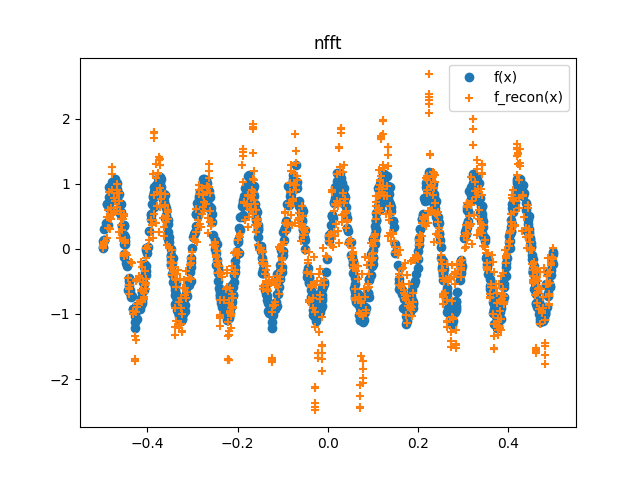
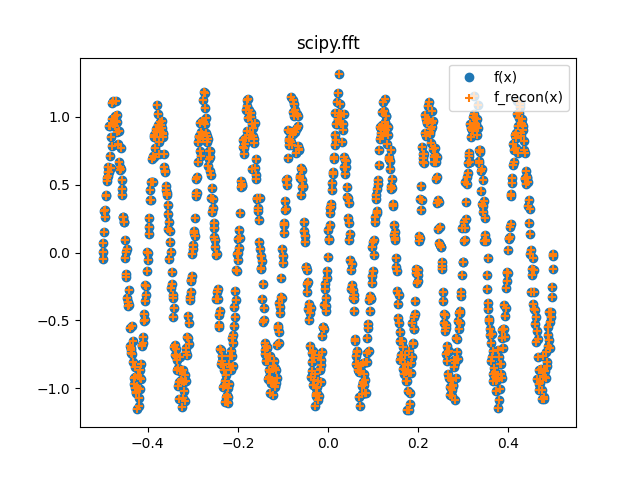
nfft的重建似乎在正常化方面失败了。我武断地把震级除以2000年,只是为了让它们更好地绘制出来。什么是正确的归一化常数?
nfft似乎也没有复制原来的观点。即使我的归一化常量是正确的,我也不可能得到原来的点。
我做错了什么,我该如何解决呢?
回答 2
Stack Overflow用户
发布于 2021-05-04 20:26:04
上面提到的包没有实现反向nfft。
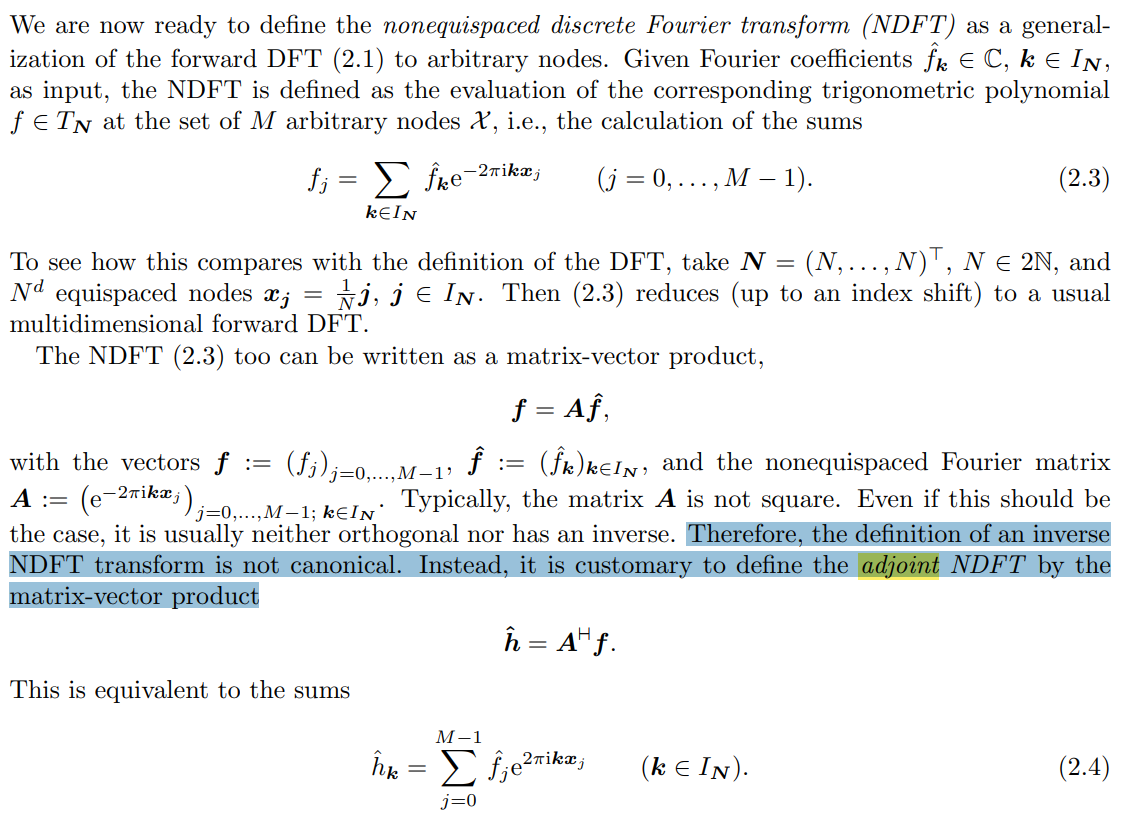
ndft是f_hat @ np.exp(-2j * np.pi * x * k[:, None]),ndft_adjoint是f @ np.exp(2j * np.pi * k * x[:, None])
让k = -N//2 + np.arange(N)和A = np.exp(-2j * np.pi * k * k[:, None])
A @ np.conj(A) = N * np.eye(N) (数字检查)
因此,对于随机x,伴随变换等于逆变换。给出的参考文件提供了几个选项,我实现了算法1 CGNE,第9页
import numpy as np # I have the habit to use np
def nfft_inverse(x, y, N, w = 1, L=100):
    f = np.zeros(N, dtype=np.complex128);
    r = y - nfft.nfft(x, f);
    p = nfft.nfft_adjoint(x, r, N);
    r_norm = np.sum(abs(r)**2 * w)
    for l in range(L):
        p_norm = np.sum(abs(p)**2 * w);
        alpha = r_norm / p_norm
        f += alpha * w * p;
        r = y - nfft.nfft(x, f)
        r_norm_2 = np.sum(abs(r)**2 * w)
        beta = r_norm_2 / r_norm
        p = beta * p + nfft.nfft_adjoint(x, w * r, N)
        r_norm = r_norm_2;
        #print(l, r_norm)
    return f;
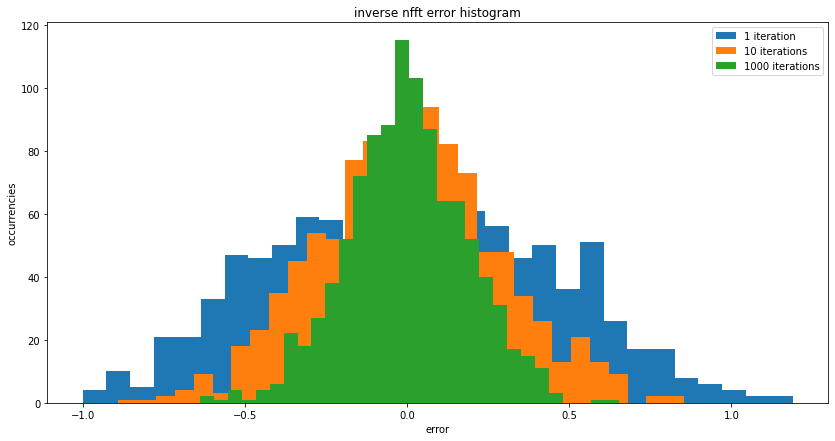
该算法收敛速度慢,收敛速度差。
    plt.figure(figsize=(14, 7))
    plt.title('inverse nfft error histogram')
    #plt.scatter(x, f_hat, label='f(x)')
    h_hat = nfft_inverse(x, f, N, L = 1)
    plt.hist(f_hat - numpy.real(h_hat), bins=30, label='1 iteration')
    h_hat = nfft_inverse(x, f, N, L = 10)
    plt.hist(f_hat - numpy.real(h_hat), bins=30, label='10 iterations')
    h_hat = nfft_inverse(x, f, N, L = 1000)
    plt.hist(f_hat - numpy.real(h_hat), bins=30, label='1000 iterations')
    plt.xlabel('error')
    plt.ylabel('occurrencies')
    plt.legend()
我也尝试使用枕极小化,显式地最小化剩余的||nfft(x, f) - y||**2。
import numpy as np # the habit
import scipy.optimize
def nfft_gradient_descent(x, y, N, L=10, tol=1e-8, method='CG'):
    '''
    compute $min || A @ f - y ||**2 via gradient descent
    the gradient is

    `A^H @ (A @ f - y)`

    Multiply by A using nfft.nfft

    '''
    def cost(fpack):
        f = fpack[0::2] + 1j * fpack[1::2]
        u = np.sum(np.abs(nfft.nfft(x, f) - y)**2)
        return u
    def grad(fpack):
        f = fpack[0::2] + 1j * fpack[1::2]
        r = nfft.nfft(x, f) - y
        u = nfft.nfft_adjoint(x, r, N)
        return np.stack([np.real(u), np.imag(u)], axis=1).reshape(-1)

    x0 = np.zeros([N, 2])
    result = scipy.optimize.minimize(cost, x0=x0, jac=grad, tol=tol, method=method, options={'maxiter': L, 'disp': True})
    return result.x[0::2] + 1j * result.x[1::2];
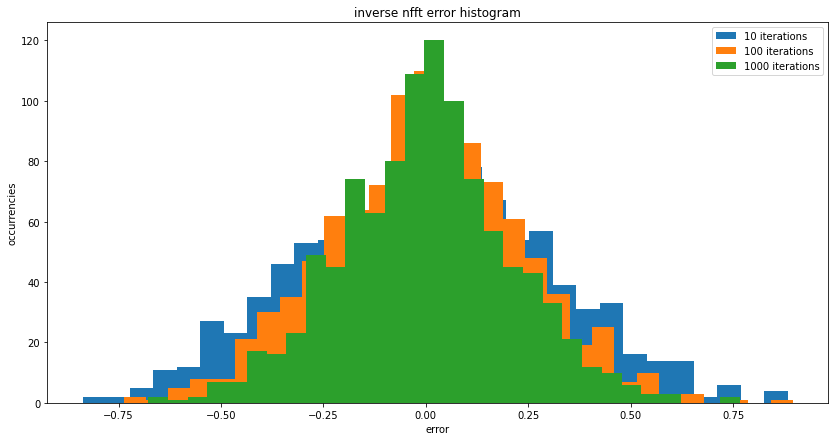
结果看起来很相似,如果你愿意的话,你可以自己尝试不同的方法或参数。但我认为这种变换是病态的,因为变换后的残差大大减少了,但重构值上的残差却很大。
编辑1
从根本上说,你发现这个算法没有一个真正的反义词吗?我不能得到我的原点?X != nfft(nfft_adjoint(x))
请查看参考纸的2.3节
数值比较
Cris Luengo回答提供了另一种可能性,即,与其在x点重构f,不如使用ifft在等距点重构重放版本。所以你已经有三个选择了,我会做一个简单的比较。请记住,图中显示的是基于NFFT计算的16k样本,而这里我使用1k样本。
由于FFT方法使用不同的点,我们无法与原始信号进行比较,所以我要做的是在没有噪声的情况下与谐波函数进行比较。噪声的方差是0.01,所以精确的重构会导致这种均方误差。
N = 1024
x = -0.5 + numpy.random.rand(N)
f_hat = numpy.sin(10 * 2 * numpy.pi * x) + .1*numpy.random.randn( N ) #Add some  'y' randomness to the sample

k = - N // 2 + numpy.arange(N)
f = nfft.nfft(x, f_hat)

print('nfft_inverse')
h_hat = nfft_inverse(x, f, len(x), L = 10)
print('10 iterations: ', np.mean((numpy.sin(10 * 2 * numpy.pi * x) - numpy.real(h_hat))**2))
h_hat = nfft_inverse(x, f, len(x), L = 100)
print('100 iterations: ', np.mean((numpy.sin(10 * 2 * numpy.pi * x) - numpy.real(h_hat))**2))
h_hat = nfft_inverse(x, f, len(x), L = 1000)
print('1000 iterations: ', np.mean((numpy.sin(10 * 2 * numpy.pi * x) - numpy.real(h_hat))**2))
print('nfft_gradient_descent')
h_hat = nfft_gradient_descent(x, f, len(x), L = 10)
print('10 iterations: ', np.mean((numpy.sin(10 * 2 * numpy.pi * x) - numpy.real(h_hat))**2))
h_hat = nfft_gradient_descent(x, f, len(x), L = 100)
print('100 iterations: ', np.mean((numpy.sin(10 * 2 * numpy.pi * x) - numpy.real(h_hat))**2))
h_hat = nfft_gradient_descent(x, f, len(x), L = 1000)
print('1000 iterations: ', np.mean((numpy.sin(10 * 2 * numpy.pi * x) - numpy.real(h_hat))**2))


#Reconstruct the original at a spaced grid based on nfft result using ifft
f_recon = - numpy.fft.fftshift(numpy.fft.ifft(numpy.fft.ifftshift(f_k))) / (N / N2)
x_recon = k / N;
print('using IFFT: ', np.mean((numpy.sin(10 * 2 * numpy.pi * x_recon) - numpy.real(f_recon))**2))
结果:
nfft_inverse
10 iterations:  0.0798988590351581
100 iterations:  0.05136853850272318
1000 iterations:  0.037316315280700896
nfft_gradient_descent
10 iterations:  0.08832834348902704
100 iterations:  0.05901599049633016
1000 iterations:  0.043921864589484
using IFFT:  0.49044932854606377
另一种看法是
plt.plot(numpy.sin(10 * 2 * numpy.pi * x_recon), numpy.real(f_recon), '.', label='ifft')
plt.plot(numpy.sin(10 * 2 * numpy.pi * x), numpy.real(nfft_gradient_descent(x, f, len(x), L = 5)), '.', label='gradient descent L=5')
plt.plot(numpy.sin(10 * 2 * numpy.pi * x), numpy.real(nfft_inverse(x, f, len(x), L = 5)), '.', label='nfft_inverse L=5')
plt.plot(numpy.sin(10 * 2 * numpy.pi * x), np.real(f_hat), '.', label='original')
plt.legend()
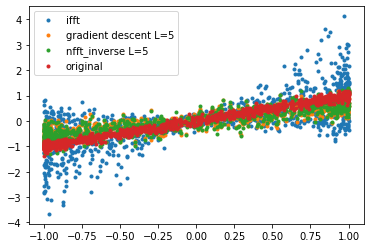
尽管IFFT矩阵具有更好的条件,但它给出的结果是信号的重建效果更差。此外,从最后的情节,它变得更加明显,有一个轻微的衰减。可能是由于系统的能量泄漏到假想部分(我的代码中有错误??)。只是一个简单的测试,乘以1.3就可以得到更好的结果。
Stack Overflow用户
发布于 2021-05-05 07:34:56
鲍勃已经发布了极好的回答,这只是为了补充一些细节,我希望是有益的。
首先,比较计算频率分量的两幅图。请注意,NFFT的噪声比常规FFT的噪声大得多。你估计这些频率分量的采样信号来自有噪声的样本,在一种情况下样本有规律的间隔,在另一种情况下它们是随机间隔的。这是一个众所周知的结果,常规抽样比随机抽样更有效(有效意味着你需要更少的样本来获取相同数量的信息)。因此,随机抽样会产生更多的噪声。
我们可以根据NFFT估计的频率分量计算“正常”逆FFT:
f_recon = numpy.fft.fftshift(numpy.fft.ifft(numpy.fft.ifftshift(f_k)))
x_recon = numpy.linspace(-.5, .5, N)我使用ifftshift是因为NFFT定义了从-N/2到N/2-1的k,而FFT定义了从0到N-1。ifftshift交换信号的两部分,将第一部分转换为第二部分(从N/2到N-1的k等于-N/2到-1)。我还对IFFT的结果使用了fftshift,因为同样的东西适用于时间轴,它将原点从第一个样本移到序列的中间。
注意f_recon有多吵。我们可以用非均匀采样信号来解释f_k的差估计。还有一个符号错误,当我们比较f_k的两个估计值时,我们已经可以观察到这个错误。这来自于伴随的NFFT,指数中的符号与逆DFT相同,这实际上意味着f_recon是翻转的w.r.t。x。
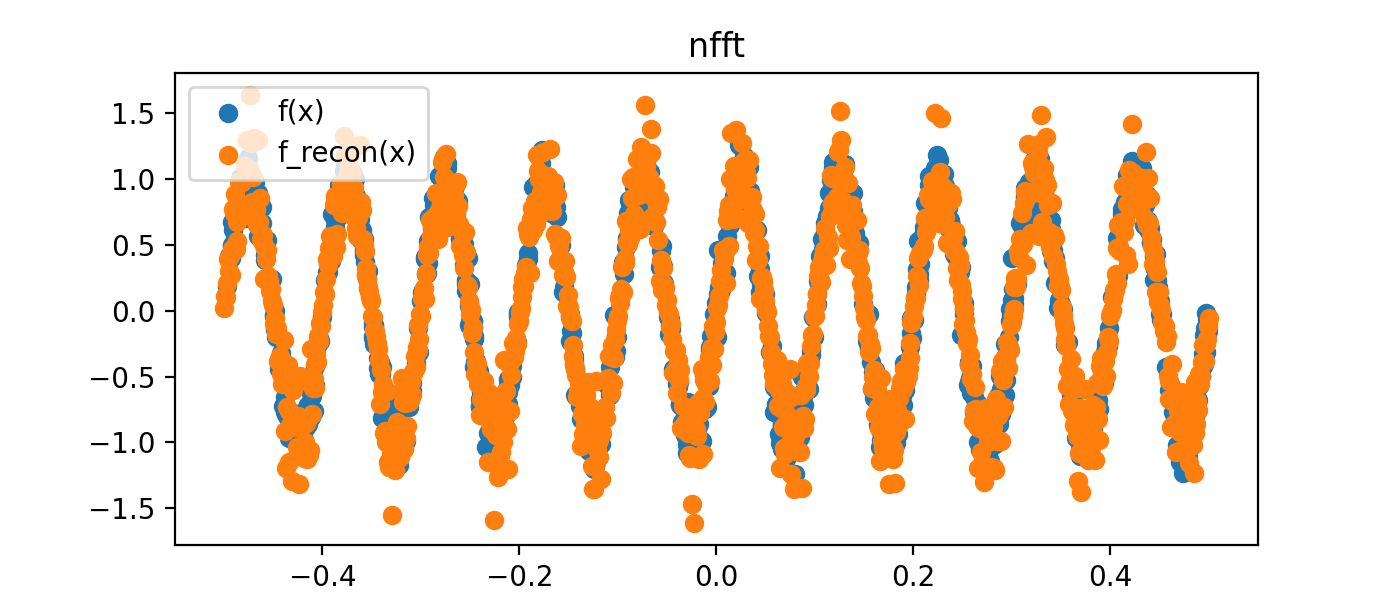
如果我们增加随机样本的数量,我们可以得到一个更好的估计:
import numpy
import nfft
import matplotlib.pyplot as plt

#Define signal:
N = 1024 * 16  # power of two for speed
x = -0.5 + numpy.random.rand(N)
f = numpy.sin(10 * 2 * numpy.pi * x) + .1 * numpy.random.randn(N) # Add some  'y' randomness to the sample

#prepare wavenumbers for transform:
k = - N // 2 + numpy.arange(N)

N2 = 1024
f_k = nfft.nfft_adjoint(x, f, N2, truncated=False)

#Reconstruct the original signal with nfft
#   (note the minus sign to flip the signal, in reality we should flip x)
f_recon = - numpy.fft.fftshift(numpy.fft.ifft(numpy.fft.ifftshift(f_k))) / (N / N2)
x_recon = numpy.linspace(-.5, .5, N2, endpoint=False)

#Plot original vs reconstructed
plt.figure()
plt.title('nfft')
plt.scatter(x[:N2], f[:N2], label='f(x)') # don't plot all samples, there's too many
plt.scatter(x_recon, f_recon, label='f_recon(x)')
plt.legend()
plt.show()
https://stackoverflow.com/questions/67350588
复制相似问题
腾讯云开发者

Copyright © 2013 - 2026 Tencent Cloud. All Rights Reserved. 腾讯云 版权所有
深圳市腾讯计算机系统有限公司 ICP备案/许可证号:粤B2-20090059  粤公网安备44030502008569号
腾讯云计算(北京)有限责任公司 京ICP证150476号 | 京ICP备11018762号