全球气候科研差距新发现,发表于 Science Advances


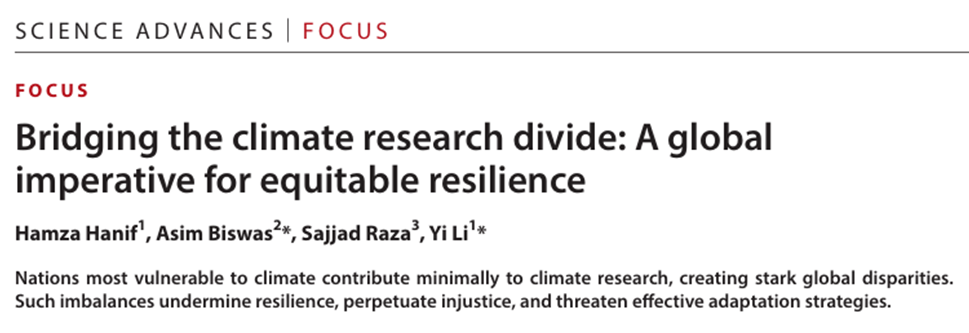
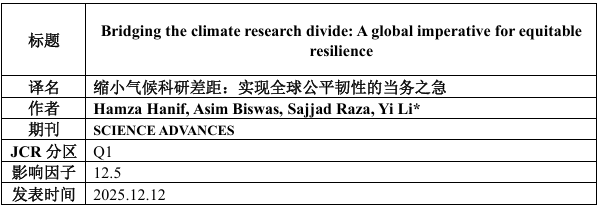
西北农林科技大学水利与建筑工程学院李毅教授研究团队在气候研究领域取得重要进展。该研究在国际权威期刊Science Advances上发表,由博士研究生Hamza Hanif(哈尼)在李毅教授指导下完成。研究系统揭示了全球气候研究中存在的关键不一致问题,这些差距可能对全球范围内有效推进气候适应策略构成挑战。
具体研究要点如下:
1.科研成果发表量与气候脆弱性之间的失衡
对超过70万篇气候变化相关文献的系统分析表明,全球各国的气候科研成果发表量与其对气候变化的脆弱性之间存在显著不匹配。研究发现,美国、中国、英国、德国和澳大利亚五个国家贡献了全球52%的气候变化相关论文,而气候脆弱性最高的五个国家:乍得、尼日尔、所罗门群岛、密克罗尼西亚和苏丹,相关论文发表量仅占0.04%。这种显著的不平衡可能对全球气候韧性与适应战略产生深远影响,使最易受气候变化影响的地区在制定和实施适应措施时,缺乏充分的科学证据支持。
2.解码全球气候研究格局
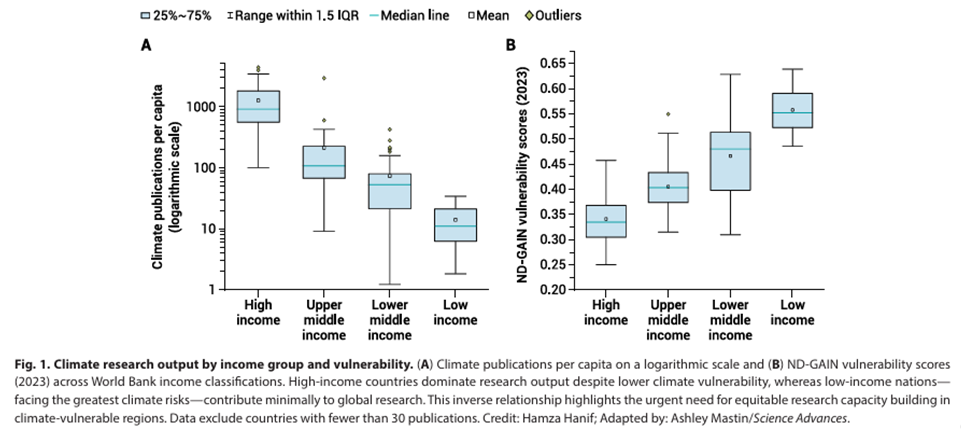
最新研究揭示,全球范围内气候脆弱性与科研贡献之间存在显著的反向关系,这一差距在不同收入水平国家之间尤为明显。研究发现,一国历史温室气体排放量与其气候研究论文发表量高度相关(r = 0.84),表明全球气候研究格局在很大程度上反映了长期形成的经济与发展不平衡。
研究指出,这种不对称格局形成了一个令人担忧的循环:历史上对温室气体排放贡献最大的高收入国家,具备更充足的资源开展气候影响研究并制定应对策略;而承受气候变化影响最为严重的脆弱国家,却普遍缺乏科研能力,难以发展符合本地实际的气候适应方案。
此外,科研经费和基础设施分配不均进一步加剧了这一差距。研发投入占国内生产总值(GDP)比例较高的国家,往往在 ND-GAIN 指数中表现更优,意味着其气候风险相对较低。同时,“人才外流(brain drain)”现象持续削弱气候脆弱国家的本土科研能力,使这些地区在应对日益严峻的气候挑战时面临更大困难。
3.公众认知与参与:一线希望
研究分析显示出一种看似矛盾却具有启发性的趋势:与发达国家相比,发展中国家的公众在为气候适应行动提供经济支持方面表现出更高的意愿。这种更强的公众认知水平与行动意愿,为政策制定者和科研人员提供了独特机遇,使其能够更有效地与地方社区开展合作。
研究指出,充分调动并引导这种公众参与潜力,有助于缩小科学研究与实际应用之间的差距,推动气候适应措施在基层层面的落地实施,从而提升脆弱地区应对气候变化的能力。
4.科研差距的隐性代价
研究指出,全球气候科研的不平衡状况违背了《巴黎协定》中关于气候正义的原则—即基于公平与“共同但有区别的责任”采取行动。这种不均衡限制了脆弱地区制定有效且符合本地需求的适应策略的能力,同时使全球对气候影响的理解偏向发达国家视角。
此外,这一差距也剥夺了全球社会获取前沿气候变化洞察的机会。脆弱地区的地方知识、原住民经验、独特生态系统以及特定区域的适应实践仍未得到充分研究,这可能导致全球气候策略设计时出现不适宜或低效的风险。
5.打破循环:气候科研公平的新范式
传统气候研究计划多集中于技术转移和短期能力建设,未能解决持续加剧科研不平衡的系统性障碍。最新研究提出了一套七点综合框架,旨在缩小全球气候科研差距:
1.设立全球气候科研公平基金 呼吁绿色气候基金(Green Climate Fund)和全球环境基金(Global Environment Facility)设立专项资金,优先支持脆弱国家的长期、可持续气候研究项目,解决本地气候挑战。
2.实施“全球韧性1%计划” 鼓励发达国家主要气候研究资助机构将预算的1%用于支持与气候脆弱国家科研机构的合作,侧重知识共创而非单向技术转移。
3.建立全球气候科研团队(Global Climate Research Corps) 建议联合国环境规划署(UNEP)和世界气象组织(WMO)设立项目,将经验丰富的气候研究人员派驻脆弱国家开展长期合作,促进知识传递与能力建设,包括双向交流。
4.建设区域气候科研枢纽 在全球最脆弱地区设立先进的气候研究中心,由政府间气候变化专门委员会(IPCC)协调,确保有效贡献于全球气候评估。
5.开发开放的全球气候数据平台 由国际科学理事会(International Science Council)的世界数据系统(World Data System)牵头,建设全面、用户友好的全球气候数据平台,聚合和标准化气候数据,优先保障资源受限地区研究人员的可访问性。
6.实施公平导向的学术出版实践 学术期刊应采取政策,积极推动来自代表性不足地区的研究发表,包括设立专题专辑、降低出版费用和提供导师指导项目,遵循出版伦理委员会(COPE)指导原则。
7.整合原住民与地方知识 建立正式机制,将原住民和地方知识纳入全球气候评估与研究议程,参照生物多样性与生态系统服务政府间科学政策平台(IPBES)模式,确保地方社区从研究设计到成果传播全过程的积极参与。
6.迈向更公平的未来
上述倡议代表了全球气候科研方法的根本性转变。通过赋能脆弱国家开展符合本地需求的研究,不仅能够提升全球适应能力,还可发现创新解决方案,使应对气候变化的行动真正实现全球化。
这一目标的实现需要多方协同合作。联合国气候变化框架公约(UNFCCC)可将相关举措纳入全球气候政策,并有可能融入未来的缔约方会议(COP)议程。国际科学理事会(International Science Council)则可协调全球科研界响应,推动合作并制定公平科研标准。
随着气候变化影响加剧,来自多元研究视角的洞察与创新将成为制定稳健且可适应解决方案的关键。缩小气候科研差距,有望为全球构建更具韧性、公平与可持续的未来。
English Version
Professor Li Yi’s research group at the College of Water Resources and Architectural Engineering, Northwest A&F University, has achieved a significant breakthrough with the publication of a major study in Science Advances. The research, led by PhD candidate Hamza Hanif under Professor Li Yi’s supervision, reveals critical disparities in global climate research that threatens effective climate adaptation worldwide.
1.RESEARCH OUTPUT VERSUS CLIMATE VULNERABILITY
The comprehensive analysis of over 700,000 climate change publications reveals a stark contrast: nations most vulnerable to climate impacts contribute minimally to climate research. Five countries, the United States, China, the United Kingdom, Germany, and Australia, produce 52% of climate research output, while the five most climate-vulnerable nations, Chad, Niger, Solomon Islands, Micronesia, and Sudan, account for only 0.04% of publications.
This imbalance has profound implications for global climate resilience and adaptation strategies, potentially leaving the most vulnerable populations without necessary scientific insights to adapt to their rapidly changing environments.
2.DECODING THE GLOBAL CLIMATE RESEARCH LANDSCAPE
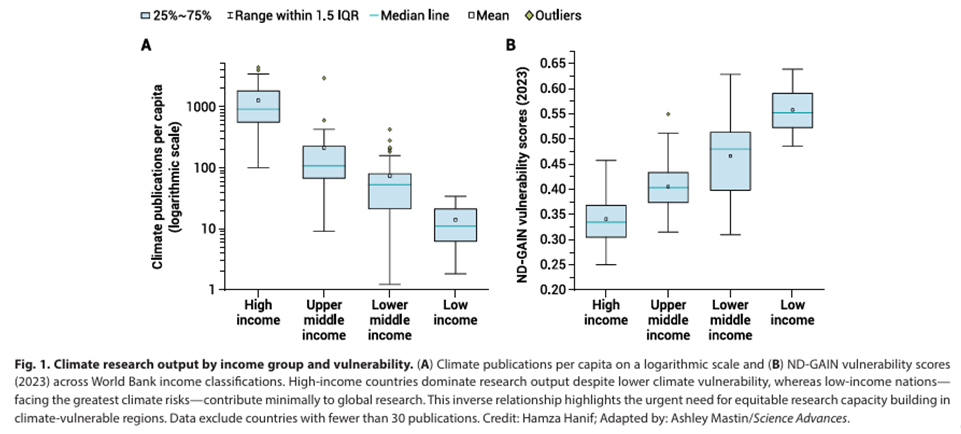
The study reveals a pronounced inverse relationship between climate vulnerability and research contribution across income groups. The research divide mirrors the global economic divide, with strong correlation (r = 0.84) between a country’s historical greenhouse gas emissions and its climate research output.
This creates a troubling cycle: wealthy nations, historically responsible for most emissions, are best equipped to study and address climate impacts, while vulnerable nations bearing the brunt of these impacts lack research capacity to develop locally relevant adaptation strategies.
The disparity is worsened by unequal distribution of research funding and infrastructure. Countries with higher R&D expenditure as percentage of GDP achieve better ND-GAIN index scores, indicating lower climate risk. “Brain drain” effects further compound the problem, as climate researchers migrate from vulnerable countries to well-funded institutions in developed nations, depleting local research capacity when needed most.
3.PUBLIC AWARENESS AND ENGAGEMENT: A SILVER LINING
The analysis reveals a paradoxical trend: populations in developing countries exhibit higher willingness to contribute financially toward climate adaptation compared to developed nations. This heightened public awareness and willingness to act presents unique opportunities for policymakers and researchers to engage with local communities, potentially bridging the gap between scientific research and on-the-ground implementation.
4.THE HIDDEN COSTS OF RESEARCH DISPARITY
The disparity contradicts climate justice principles in the Paris Agreement, which calls for action based on equity and common but differentiated responsibilities. This imbalance hampers development of effective, locally tailored adaptation strategies in vulnerable regions and skews global understanding of climate impacts toward developed nations' perspectives.
It also deprives the global community of crucial insights from climate change frontlines. Local and indigenous knowledge, unique ecosystems, and region-specific adaptation practices in vulnerable areas remain understudied, potentially leading to ill-suited or ineffective global strategies.
5.BREAKING THE CYCLE: A NEW PARADIGM FOR CLIMATE RESEARCH EQUITY
Traditional climate research initiatives have predominantly focused on technology transfer and short-term capacity building, failing to address systemic barriers perpetuating research inequality. The study proposes a comprehensive seven-point framework to bridge this divide:
1) Establish a Global Climate Research Equity Fund:
Calling on the Green Climate Fund and Global Environment Facility to create dedicated funding for building climate research capacity in vulnerable nations, prioritizing long-term, sustainable research projects addressing local climate challenges.
2) Implement a “1% for Global Resilience” Initiative:
Urging major climate research funding bodies in developed nations to allocate 1% of budgets to support research partnerships with institutions in climate-vulnerable countries, focusing on co-creation of knowledge rather than one-way expertise transfer.
3) Create a Global Climate Research Corps:
Proposing UNEP and WMO establish a program placing experienced climate researchers in vulnerable nations for extended periods, fostering knowledge transfer and capacity building, including reverse exchanges.
4) Launch Regional Climate Research Hubs:
Establishing state-of-the-art climate research centers in the world’s most vulnerable regions, coordinated by IPCC to ensure effective contribution to global climate assessments.
5) Develop an Open Global Climate Data Platform:
The World Data System of the International Science Council should lead creation of a comprehensive, user-friendly platform aggregating and standardizing climate data worldwide, prioritizing accessibility for researchers in resource-constrained settings.
6) Implement Equity-Focused Publishing Practices:
Scientific journals should adopt policies actively promoting research from underrepresented regions, guided by the Committee on Publication Ethics, including dedicated special issues, reduced publication fees, and mentorship programs.
7) Integrate Indigenous and Local Knowledge:
Creating formal mechanisms to incorporate indigenous and local knowledge into global climate assessments and research agendas, following the IPBES model, actively involving local communities in research from design to dissemination.
6.TOWARD A MORE EQUITABLE FUTURE
These proposals represent a fundamental shift in approaching global climate research. By empowering vulnerable nations to conduct locally relevant studies, global adaptive capacity can be enhanced, innovative solutions uncovered, and collective response to climate change made truly global.
Implementation requires coordinated action from multiple stakeholders. UNFCCC could integrate these initiatives into global climate policy, potentially incorporating them into future COP agreements. The International Science Council could coordinate the scientific community's response, facilitating collaborations and setting standards for equitable research practices.
引用格式:
Hanif, H., Biswas, A., Raza, S., Li, Y., 2025. Bridging the climate research divide: A global imperative for equitable resilience. Science Advances, 11(50): eadz0469
本期编辑
张桂源
END
声明:欢迎转载、转发。气象学家公众号转载信息旨在传播交流,其内容由作者负责,不代表本号观点。文中部分图片来源于网络,如涉及内容、版权和其他问题,请联系小编处理。
本文参与 腾讯云自媒体同步曝光计划,分享自微信公众号。
原始发表:2025-12-14,如有侵权请联系 cloudcommunity@tencent.com 删除
评论
登录后参与评论
推荐阅读
腾讯云开发者

Copyright © 2013 - 2026 Tencent Cloud. All Rights Reserved. 腾讯云 版权所有
深圳市腾讯计算机系统有限公司 ICP备案/许可证号:粤B2-20090059  粤公网安备44030502008569号
腾讯云计算(北京)有限责任公司 京ICP证150476号 | 京ICP备11018762号