
如何将NetworkX图转换为ete3树对象?
我试图弄清楚如何从一个ete3.Tree有向图构建一个networkx对象?我以我认为会产生预期结果的方式添加了每个child,但我遇到了麻烦。
edges = [('lvl-1', 'lvl-2.1'), ('lvl-1', 'lvl-2.2'), ('lvl-2.1', 'lvl-3.1'), ('lvl-2.1', 2), ('lvl-2.2', 4), ('lvl-2.2', 6), ('lvl-3.1', 'lvl-4.1'), ('lvl-3.1', 5), ('lvl-4.1', 1), ('lvl-4.1', 3), ('input', 'lvl-1')]
graph = nx.OrderedDiGraph()
graph.add_edges_from(edges)
nx.draw(graph, pos=nx.nx_agraph.graphviz_layout(graph, prog="dot"), with_labels=True, node_size=1000, node_color="lightgray")
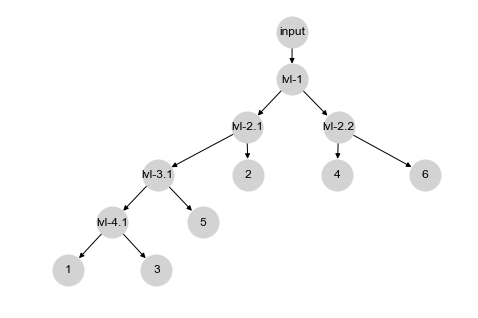
tree = ete3.Tree()
for parent, children in itertools.groupby(graph.edges(), lambda edge:edge[0]):
    subtree = ete3.Tree(name=parent)
    for child in children:
        subtree.add_child(name=child[1])
    tree.add_child(child=subtree, name=parent)
print(tree)
#       /-lvl-2.1
#    /-|
#   |   \-lvl-2.2
#   |
#   |   /-lvl-3.1
#   |--|
#   |   \-2
#   |
#   |   /-4
#   |--|
# --|   \-6
#   |
#   |   /-lvl-4.1
#   |--|
#   |   \-5
#   |
#   |   /-1
#   |--|
#   |   \-3
#   |
#    \- /-lvl-1
我也尝试过以下几种方法,但没有奏效:
tree = ete3.Tree()
for parent, child in graph.edges():
    if parent not in tree:
        tree.add_child(name=parent)
    subtree = tree.search_nodes(name=parent)[0]
    subtree.add_child(name=child)
print(tree)
#                /-1
#             /-|
#          /-|   \-3
#         |  |
#       /-|   \-5
#      |  |
#    /-|   \-2
#   |  |
#   |  |   /-4
# --|   \-|
#   |      \-6
#   |
# \- /-lvl-1回答 2
Stack Overflow用户
发布于 2018-07-13 19:41:00
# Graph
edges = [('lvl-1', 'lvl-2.1'), ('lvl-1', 'lvl-2.2'), ('lvl-2.1', 'lvl-3.1'), ('lvl-2.1', 2), ('lvl-2.2', 4), ('lvl-2.2', 6), ('lvl-3.1', 'lvl-4.1'), ('lvl-3.1', 5), ('lvl-4.1', 1), ('lvl-4.1', 3), ('input', 'lvl-1')]
G = nx.OrderedDiGraph()
G.add_edges_from(edges)

# Tree
root = "input"
subtrees = {node:ete3.Tree(name=node) for node in G.nodes()}
[*map(lambda edge:subtrees[edge[0]].add_child(subtrees[edge[1]]), G.edges())]
tree = subtrees[root]
print(tree.get_ascii())
#                                /-1
#                         /lvl-4.1
#                  /lvl-3.1      \-3
#                 |      |
#           /lvl-2.1      \-5
#          |      |
# -inputlvl-1      \-2
#          |
#          |       /-4
#           \lvl-2.2
# \-6Stack Overflow用户
发布于 2018-07-11 03:15:24
子树和从networkX对象中读取是可以的,问题是您要直接将所有子树添加到原始tree实例中。在ete3中,Tree类是实际上只是一个节点 (包括指向其后代的指针,如果有的话),因此tree.add_child直接向根节点添加新的子节点/子树。
你应该做的是在枯树的叶子上迭代,找到一个node.name == parent,并把所有的孩子都附加到它上。另外,您应该一个接一个地附加它们,而不是预先生成一个子树.否则,您将得到具有一个父节点和一个子节点的附加内部节点。
编辑:
您的代码的第二个版本几乎是正确的,但是您没有考虑到如果根不是它们的实际父节点,则永远不会将节点附加到树(即根)。这可能就是为什么您将lvl-1作为一个单独的节点,而不是其他节点的父节点。另外,我不确定networkX图的遍历顺序,这可能很重要。更安全(如果更丑)版本如下所示:
# Setting up a root node for lvl-1 to attach to
tree.add_child(name='input')
# A copy in a list, because you may not want to edit the original graph
edges = list(graph.edges)
while len(edges) > 0:
    for parent, child in edges:
        # check if this edge's parent is in the tree
        for leaf it tree.get_leaves():
            if leaf.name == parent:
                # if it is, add child and thus create an edge
                leaf.add_child(name=child)
            # Wouldn't want to add the same edge twice, would you?
            edges.remove((parent, child))
    # Now if there are edges still unplaced, try again.
里面可能有几个排字,而且绝对是超慢的。从边缘计数或更糟的角度来看,关于O(n**2)的东西,所有的迭代和列表删除都是这样。可能有一种方法可以将图形从根遍历到叶,这将不需要边缘列表的副本(并且将在一个迭代中工作)。但它最终会产生一棵正确的树。
https://stackoverflow.com/questions/51273890
复制相似问题
腾讯云开发者

Copyright © 2013 - 2026 Tencent Cloud. All Rights Reserved. 腾讯云 版权所有
深圳市腾讯计算机系统有限公司 ICP备案/许可证号:粤B2-20090059  粤公网安备44030502008569号
腾讯云计算(北京)有限责任公司 京ICP证150476号 | 京ICP备11018762号