
从cyk中提取概率和最有可能的解析树
从cyk中提取概率和最有可能的解析树
提问于 2018-05-11 18:16:59
为了理解cyk算法,我已经完成了示例:https://www.youtube.com/watch?v=VTH1k-xiswM&feature=youtu.be。
其结果是:
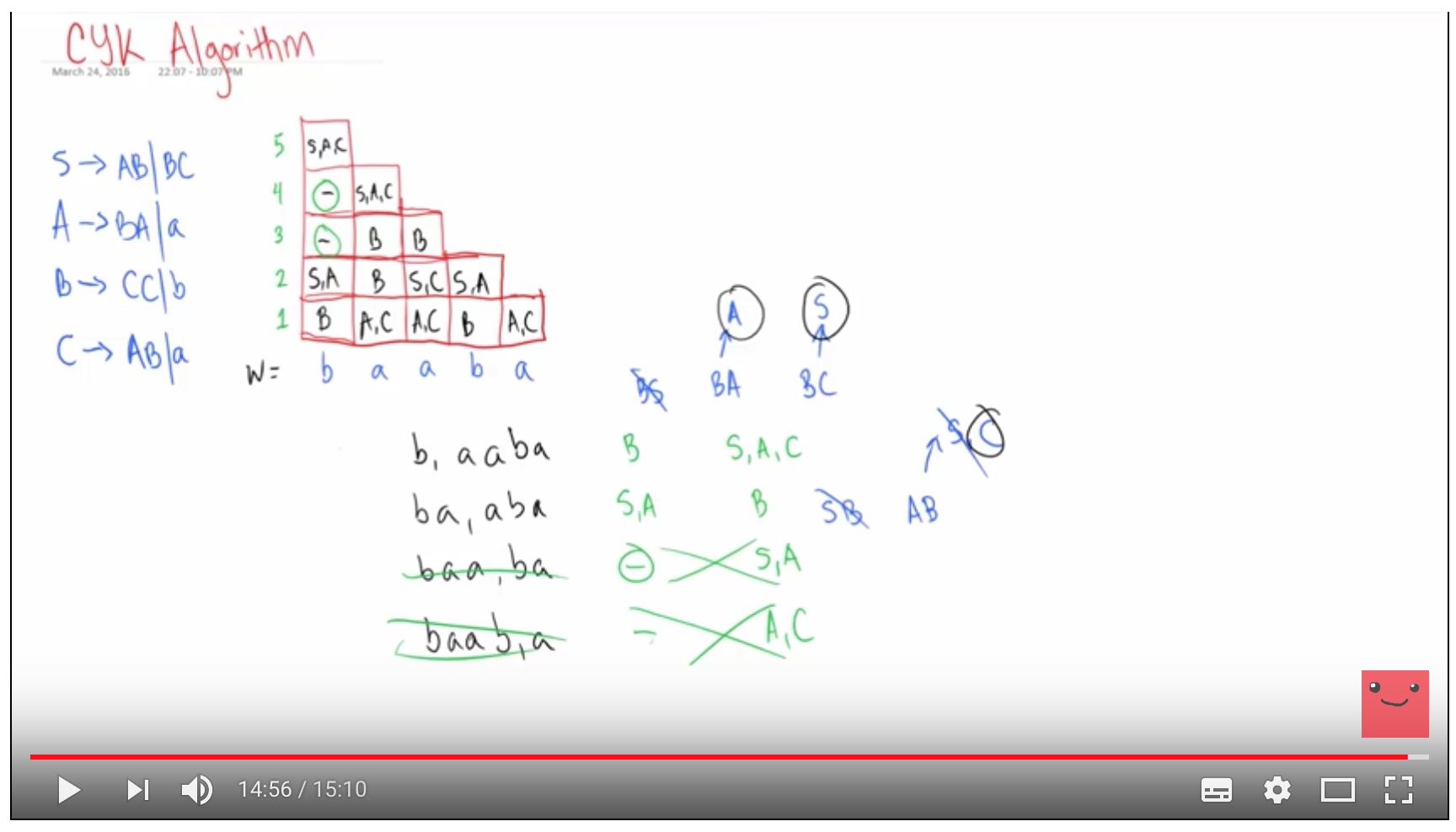
如何提取与每个解析关联的概率并提取最有可能的解析树?
回答 1
Stack Overflow用户
回答已采纳
发布于 2018-05-15 13:22:37
这是PCFG的两个截然不同的问题:
- recognition:句子是否属于CFG生成的语言?(产出:是或否)
- 解析:这句话的最高得分树是什么?(输出:解析树)
问题中链接的CKY算法视频只处理识别问题。为了同时执行解析问题,我们需要(i)保持每个解析项的得分,(ii)跟踪层次关系(例如,如果我们使用S -> NP VP规则:我们必须跟踪哪个NP和哪个VP用于预测S)。
符号:
- 解析项
[X, i, j]: s表示有一个节点标记为X生成令牌I(包括)到j(排除),其得分为根植于X的子树的日志概率。 - 这个句子是一个单词
w_1 w_2 ... w_n的序列。
在抽象层次上,PCFG解析可以表述为一组演绎规则:
- 扫描规则(读取令牌)
____________________________{前提:X -> w_i是语法规则X,i,i+1: log p(X -> w_i)
光泽:如果语法中有一个规则
X -> w_i,那么我们可以在图表中添加项[X, i, i+1]。 - 完整规则(创建一个新的自下而上的成分)
X,i,k: s1 Y,k,j: s2 Z -> X是语法规则Z,i,j: s1 + s2 + log p(Z -> X,Y)
光泽:如果图表中有两个解析项
[X, i, k]和[Y, k, j],语法中有一个规则Z -> X Y,那么我们可以将[Z, i, j]添加到图表中。
加权分析的目的是推导出得分最高的句法分析项目[S, 0, n]:s (S:axiom,n:句子长度)。
全算法伪码
# The chart stores parsing items and their scores
chart[beginning(int)][end(int)][NonTerminal][score(float)]

# the backtrack table is used to recover the parse tree at the end
backtrack[beginning][end][NonTerminal][item_left, item_right]

# insert a new item in the chart
# for a given span (i, j) and nonterminal X, we only need to
# keep the single best scoring item.
def insert(X, i, j, score, Y, Z, k):
    if X not in chart[i][j] or chart[i][j][X] < score
        chart[i][j][X] <- score
        backtrack[i][j][X] <- (Y, i, k), (Z, k, j)

n <- length of sentence

for i in range(0, n):
    # apply scan rule
    insert(X, i, i+1, log p(X -> w_i)) for each grammar rule X -> w_i

for span_length in range(2, n):
    for beginning in range(0, n - span_length):
        end <- beginning + span_length

        for k in range(beginning+1, end -1):
            # apply completion rules
            for each grammar rule X -> Y Z such that
                * Y is in chart[beginning][k]
                * Z is in chart[k][end]

                score_left <- chart[beginning][k][Y]
                score_right <- chart[k][end][Z]

                insert(X, beginning, end, log p(X -> Y Z) + score_left + score_right)

if there is S (axiom) in chart[0][n], then parsing is successful
    the score (log probability) of the best tree is chart[0][n][S]
    the best tree can be recovered recursively by following pointers from backtrack[0][n][S]
else:
    parsing failure, the sentence does not belong to the language
    generated by the grammar
一些注意事项:
- 时间复杂度为O(n^3⋅x~+),其中\G_x是文法的大小。
- 该算法假定语法在乔姆斯基范式中。
页面原文内容由Stack Overflow提供。腾讯云小微IT领域专用引擎提供翻译支持
原文链接:
https://stackoverflow.com/questions/50298074
复制相关文章
相似问题
腾讯云开发者

Copyright © 2013 - 2026 Tencent Cloud. All Rights Reserved. 腾讯云 版权所有
深圳市腾讯计算机系统有限公司 ICP备案/许可证号:粤B2-20090059  粤公网安备44030502008569号
腾讯云计算(北京)有限责任公司 京ICP证150476号 | 京ICP备11018762号