
Runge-Kutta四阶法
Runge-Kutta四阶法
提问于 2016-12-11 08:43:10
我正在对两个方程组实现Runge四阶方法。
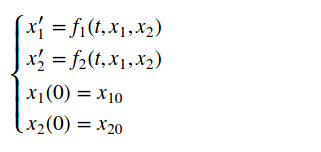
H是段数,所以T/h是步长。
def cauchy(f1, f2, x10, x20, T, h):
    x1 = [x10]
    x2 = [x20]

    for i in range(1, h):
        k11 = f1((i-1)*T/h, x1[-1], x2[-1])
        k12 = f2((i-1)*T/h, x1[-1], x2[-1])
        k21 = f1((i-1)*T/h + T/h/2, x1[-1] + T/h/2*k11, x2[-1] + T/h/2*k12)
        k22 = f2((i-1)*T/h + T/h/2, x1[-1] + T/h/2*k11, x2[-1] + T/h/2*k12)
        k31 = f1((i-1)*T/h + T/h/2, x1[-1] + T/h/2*k21, x2[-1] + T/h/2*k22)
        k32 = f2((i-1)*T/h + T/h/2, x1[-1] + T/h/2*k21, x2[-1] + T/h/2*k22)
        k41 = f1((i-1)*T/h + T/h, x1[-1] + T/h*k31, x2[-1] + T/h*k32)
        k42 = f2((i-1)*T/h + T/h, x1[-1] + T/h*k31, x2[-1] + T/h*k32)

        x1.append(x1[-1] + T/h/6*(k11 + 2*k21 + 2*k31 + k41))
        x2.append(x2[-1] + T/h/6*(k12 + 2*k22 + 2*k32 + k42))

    return x1, x2
然后我在这个系统上测试:
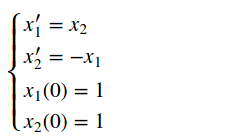
def f1(t, x1, x2):
    return x2

def f2(t, x1, x2):
    return -x1

def true_x1(t):
    return np.cos(t) + np.sin(t)

def true_x2(t):
    return np.cos(t) - np.sin(t)
它似乎工作得很好(我还用不同的初始值和不同的功能测试了它:所有这些都工作得很好):
x10 = 1
x20 = 1
T = 1
h = 10

x1, x2 = cauchy(f1, f2, x10, x20, T, h)
t = np.linspace(0, T, h)

plt.xlabel('t')
plt.ylabel('x1')
plt.plot(t, true_x1(t), "blue", label="true_x1")
plt.plot(t, x1, "red", label="approximation_x1")
plt.legend(bbox_to_anchor=(0.97, 0.27))
plt.show()

plt.xlabel('t')
plt.ylabel('x2')
plt.plot(t, true_x2(t), "blue", label="true_x2")
plt.plot(t, x2, "red", label="approximation_x2")
plt.legend(bbox_to_anchor=(0.97, 0.97))
plt.show()
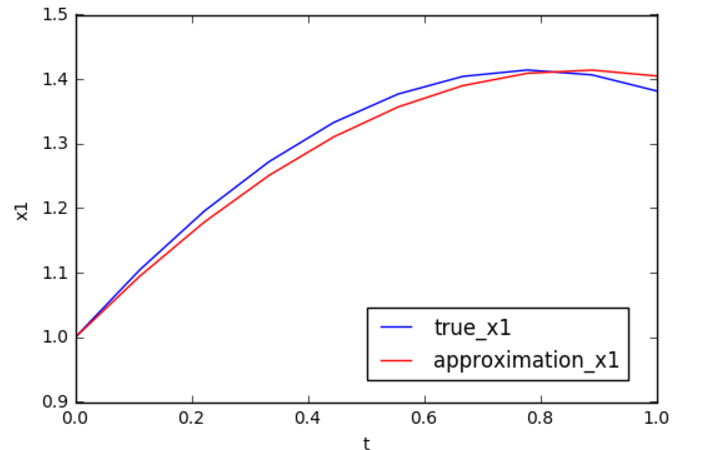
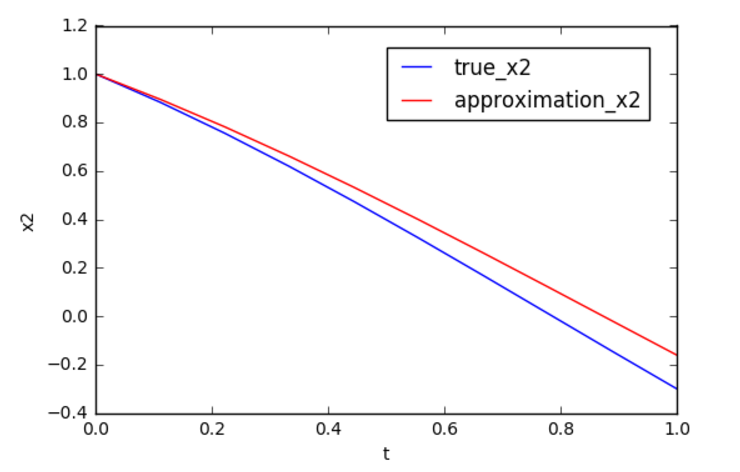
然后,我想检查错误是否符合O(step^4)的顺序,所以我减少了步骤并计算错误,如下所示:

step = []
x1_error = []
x2_error = []
for segm in reversed(range(10, 1000)):
    x1, x2 = cauchy(f1, f2, x10, x20, T, segm)
    t = np.linspace(0, T, segm)
    step.append(1/segm)
    x1_error.append(np.linalg.norm(x1 - true_x1(t), np.inf))
    x2_error.append(np.linalg.norm(x2 - true_x2(t), np.inf))
我明白了:
plt.plot(step, x1_error, label="x1_error")
plt.plot(step, x2_error, label="x2_error")
plt.legend()
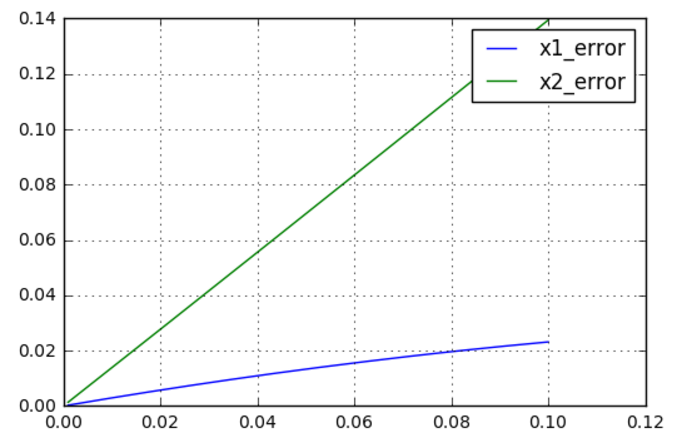
因此,误差从步长上是线性的。这真的很奇怪,因为它应该是在O(step^4)的顺序上。有人能告诉我我做错了什么吗?
回答 1
Stack Overflow用户
回答已采纳
发布于 2016-12-11 09:06:23
for i in range(1, h):这将从1迭代到h-1。由于缺少最后一步,从x[h-1] at time T-T/h到time T的确切解决方案的区别是O(T/h)。
因此使用
for i in range(1,h+1):h从i-1到i的步骤,或者
for i in range(h):h从i到i+1的步骤。
此外,np.linspace(0,1,4)将生成4等间距的数字,其中第一个是0,最后一个是1,结果是
array([ 0. , 0.33333333, 0.66666667, 1. ])这可能不是你所期望的。因此,有了上述更正使用。
t = np.linspace(0, T, segm+1)在两个计算中使用相同的时间点。
如果使用通常意义上的字母,h或dt是步骤的大小,N是步骤的数目,那么遵循代码就更容易了。然后在循环h=T/N或dt=T/N之前定义,以避免在函数调用中重复使用T/N。
页面原文内容由Stack Overflow提供。腾讯云小微IT领域专用引擎提供翻译支持
原文链接:
https://stackoverflow.com/questions/41084371
复制相关文章
相似问题
腾讯云开发者

Copyright © 2013 - 2026 Tencent Cloud. All Rights Reserved. 腾讯云 版权所有
深圳市腾讯计算机系统有限公司 ICP备案/许可证号:粤B2-20090059  粤公网安备44030502008569号
腾讯云计算(北京)有限责任公司 京ICP证150476号 | 京ICP备11018762号