
C中的Lanczos插值
C中的Lanczos插值
提问于 2015-12-10 09:50:51
我需要在c代码中实现以下公式:resampling,因此我使用多维插值方法:

其中L(x-i)或L(y-i)是:
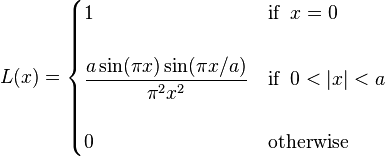
我使用ppm图像格式,通过一个小脚本获得rgb值。这是我现在实际的lanczos方法:
double _L(int param) {
    /*
    LANCZOS KERNEL
    */

    int a = 2; // factor "a" from formula
    if(param == 0) {

        return 1;
    }
    if(abs(param) > 0 && abs(param) < a) {

        return (a*sin(PI*param) * sin((PI*param)/a))/(PI*PI*param*param)
    }
    return 0;
}

void lanczos_interpolation(PPMImage *img) {

    if(img) {

        int start_i, start_j, limit_i, limit_j;
        int a = 2; // factor "a" from formula
        samples_ij = img->x*img->y; // "sij" from formula

        for(x = 0;x < img->x;x++) {

            for(y = 0;y = < img->y;y++) {

                start_i = floor(x)-a+1:
                limit_i = floor(x)+a;
                for(i = start_i;i <= limit_i;i++) {

                    start_j = floor(y)-a+1:
                    limit_j = floor(y)+a;
                    for(i = start_i;i <= limit_i;i++) {

                        img->data[x+(W*y)].red = (int)(samples_ij * _L(x-i) * _L(y-j)) // "_L" represents "L(x-i)" from formula
                        img->data[x+(W*y)].green = (int)(samples_ij * _L(x-i) * _L(y-j)) // "_L" represents "L(x-i)" from formula
                        img->data[x+(W*y)].blue = (int)(samples_ij * _L(x-i) * _L(y-j)) // "_L" represents "L(x-i)" from formula
                    }
                }
            }
        }
    }
}
代码的这一部分让我很困惑:
img->data[x+(W*y)].red = (int)(samples_ij * _L(x-i) * _L(y-j)) // "_L" represents "L(x-i)" from formula
img->data[x+(W*y)].green = (int)(samples_ij * _L(x-i) * _L(y-j)) // "_L" represents "L(x-i)" from formula
img->data[x+(W*y)].blue = (int)(samples_ij * _L(x-i) * _L(y-j)) // "_L" represents "L(x-i)" from formula
有人能帮我处理c中的lanczos插值吗?这是我的完整C文件:
谢谢!
回答 1
Stack Overflow用户
发布于 2015-12-11 18:40:30
请看,您是,没有在代码中进行任何形式的插值。
插值操作如下:
input pixels => Lanczos interpolation => output interpolated pixels
                        |
                        |
                        V
        a sum operation in the neighbourhood
            of the corresponding location
               in the input image
你的问题如下:
- 你没有理解
Lanczos interpolation technique。事实上,你似乎不知道什么是插值。 - 您的代码没有
input pixels和output pixels。 - 代码中没有
summation。(您只是将Lanczos高效时间s_ij分配给img像素。同样,s_ij的像素值实际上是公式中的input像素值,但是将图像中像素总数的固定值分配给s_ij。 - 您不必要地使用了
floor(*)函数。
我对你的建议是:
- 以算法的方式理解什么是插值。
- 为您的目的编写算法/伪代码。
- 确保您在步骤1和步骤2中是正确的。
- 然后只尝试编写代码。
页面原文内容由Stack Overflow提供。腾讯云小微IT领域专用引擎提供翻译支持
原文链接:
https://stackoverflow.com/questions/34198553
复制相关文章
相似问题
腾讯云开发者

Copyright © 2013 - 2026 Tencent Cloud. All Rights Reserved. 腾讯云 版权所有
深圳市腾讯计算机系统有限公司 ICP备案/许可证号:粤B2-20090059  粤公网安备44030502008569号
腾讯云计算(北京)有限责任公司 京ICP证150476号 | 京ICP备11018762号