
VHDL信号分配延迟与仿真混淆
新的VHDL,并试图实现一个小的缓存。
我的cache.vhd的一部分
entity cache is

      Port (  clock  : in  STD_LOGIC;
              rw_sel  : in  STD_LOGIC;  --'1' to read from cache ,
                                                --'0' to write to cache
              ad_sel: in STD_LOGIC;     --'0' to send address,     '1' to send data
              data_in :in STD_LOGIC_VECTOR (7 downto 0);
                                         --send data or address controled by ad_sel
                     ...
        end cache;

        architecture Behavioral of cache is
        ....
        signal block_addr_n : integer range 0 to 15;
                            -- cache block address
        signal block_cell_addr_n: integer range 0 to 1;
                            -- byte-in-cache address
    begin
    process(clock, init)
    begin
    case init is
        when '0' =>
            for i in 0 to 15 loop
                cache_memory(i)<="1111111111111111";
                tag_memory(i)<="11";
            end loop;
        when others =>null;
    end case;
    case ad_sel is
        when '0' =>
            address<=data_in(6 downto 0);
        when '1' => data_cpu_wr<=data_in;
        when others =>null;
    end case;
    block_addr_n  <= conv_integer(unsigned(address(4 downto 1)));
    block_cell_addr_n<=conv_integer(address(0));
    case rw_sel is
            ....
我的testbench文件的一部分:
 ....
      --Inputs
   signal clock : std_logic := '0';
   signal rw_sel : std_logic := '1';
   signal ad_sel : std_logic := '0';
   signal init: std_logic:='1';
   signal data_in : std_logic_vector(7 downto 0) := (others => '0');
  ....
 stim_proc: process
   begin
         -- initialize
        init<='0';
        wait for 100 ns;
        -- read address "0101111"(MSB cut), expecting miss
        cache_mem_data<="1100110011001100";
        ad_sel<='0';
        rw_sel<='1';
        data_in<="00101111";
        clock <= not clock;
        wait for 100 ns;
        -- write to address "0101111" but written in "0000000" which is default
        data_in<="10101010";
        ad_sel<='1';
        rw_sel<='0';
        clock<=not clock;
        wait for 100 ns;
        data_in<="00101111";
        ad_sel<='0';
        rw_sel<='1';
        clock<=not clock;
      wait;
   end process;

END;
我在ISim窗口里得到的是
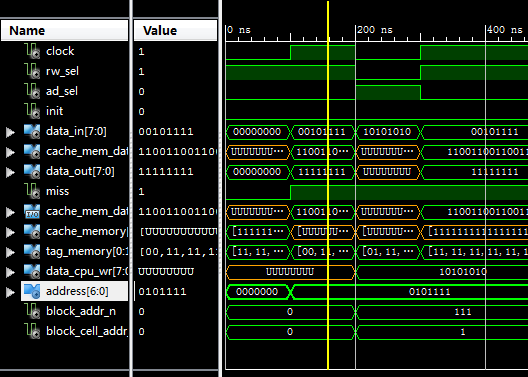
为什么block_addr_n和block_cell_addr_n不能在第二个100 ns内分配,因为信号address是直接分配的?我认为这就是导致我的程序产生意外结果的原因,因为缓存块0是写入的,而我只是将address 0设置为默认值,但在前100 ns之后传入地址"0101111“。
有什么想法吗?
回答 2
Stack Overflow用户
发布于 2015-04-18 05:23:47
灵敏度列表并不包含在进程中使用的所有信号,因为address是一个信号(分配在同一进程中,但这并不重要),但是信号不在进程的灵敏度列表中。因此,当address的值发生变化时,模拟器不会重新执行该进程。工艺部件:
process(clock, init)
begin
    ...
    address<=data_in(6 downto 0);
    ...
    block_addr_n  <= conv_integer(unsigned(address(4 downto 1)));
block_cell_addr_n<=conv_integer(address(0));如果您使用的是VHDL-2008,那么您可以使用process (all)自动生成灵敏度列表,但我认为Xilinx还没有实现VHDL-2008,所以您可能必须手动将所有使用过的信号都包含在灵敏度列表中,这样才能自己创建灵敏度列表。
顺便说一句,考虑让进程纯粹是组合(门)或时钟(触发器或RAMs),这样组合进程就不应该在灵敏度列表中有clock。
Stack Overflow用户
发布于 2015-04-18 09:49:11
我认为您的实际问题可能是对如何编写进度的误解。现在编写流程的方式将产生纯粹的组合逻辑和锁存。你想要的是寄存器,RAM和组合逻辑。
一个时钟化的进程会写成这样:
process(clock, init) --A clocked process shall have only the clock and reset signal in the sensitivity list. This is correct.
begin
   if init = '0' then --"init" is used as a reset signal
      for i in 0 to 15 loop
         --This will reset the cache memory. It works, but
         --doing it this way prevents the synthesis tool from infering a RAM block.
         --To allow RAM inference you can write only one memory location per clock cycle.
         cache_memory(i)<="1111111111111111";
         tag_memory(i)<="11";
      end loop;
   elsif rising_edge( clock ) then
      case ad_sel is
         when '0' =>
            address<=data_in(6 downto 0);
         when '1' => data_cpu_wr<=data_in;
         when others =>null;
      end case;
      block_addr_n  <= conv_integer(unsigned(address(4 downto 1)));
      block_cell_addr_n<=conv_integer(address(0));
      case rw_sel is
      ...
   end if;
请注意,这不会立即起作用。您的测试平台中也存在一些问题。例如,您的init信号无限期低。
对于简单的条件,您也可能希望使用"if“语句而不是"case”。示例:
if ad_sel='0' then
   address<=data_in(6 downto 0);
else
   data_cpu_wr<=data_in;
end if;https://stackoverflow.com/questions/29713041
复制相似问题
腾讯云开发者

Copyright © 2013 - 2026 Tencent Cloud. All Rights Reserved. 腾讯云 版权所有
深圳市腾讯计算机系统有限公司 ICP备案/许可证号:粤B2-20090059  粤公网安备44030502008569号
腾讯云计算(北京)有限责任公司 京ICP证150476号 | 京ICP备11018762号