
一次呈现多个GLKViewControllers
我有一个简单的GLKViewcontroller子类,它在被告知时呈现纹理。这本身就很好,这正是我需要它做的。但是,由于某种原因,当我试图在一个场景中使用它时,我一次拥有6个相同视图控制器的副本(设置为指向同一个视图的容器视图),它不起作用。我有一个加载和显示纹理方法,以选择哪个纹理要从加载纹理的地图。似乎只有最后一个视图,我把纹理正确地画出来,剩下的作为黑色方块出现。
下面是我的故事板的截图:
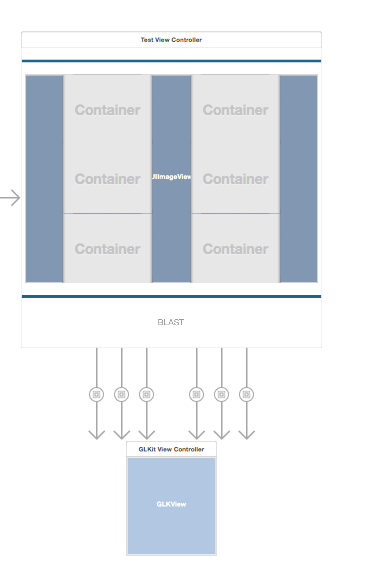
以下是我的加载和绘制代码:
-(void)glkView:(GLKView *)view drawInRect:(CGRect)rect
{
    [EAGLContext setCurrentContext:self.context];
    self.view.backgroundColor = [UIColor clearColor];
    self.view.opaque = NO;
    glClearColor(0, 0, 0, 0);
    glClear(GL_COLOR_BUFFER_BIT);
    glBlendFunc(GL_SRC_ALPHA, GL_ONE_MINUS_SRC_ALPHA);
    glEnable(GL_BLEND);

    //sprite render:
    if ( self.showTexture )
    {
        if ( firstDraw )
        {
            self.imageShowTime = [ATAppDelegate getCurrentTime];
            firstDraw = NO;
        }
        self.effect.texture2d0.name = selectedTexture.name;
        self.effect.texture2d0.enabled = YES;
        self.effect.transform.modelviewMatrix = self.modelMatrix;

        [self.effect prepareToDraw];

        long offset = (long)&_quad;

        glEnableVertexAttribArray(GLKVertexAttribPosition);
        glEnableVertexAttribArray(GLKVertexAttribTexCoord0);

        glVertexAttribPointer(GLKVertexAttribPosition, 2, GL_FLOAT, GL_FALSE, sizeof(TexturedVertex), (void *) (offset + offsetof(TexturedVertex, geometryVertex)));
        glVertexAttribPointer(GLKVertexAttribTexCoord0, 2, GL_FLOAT, GL_FALSE, sizeof(TexturedVertex), (void *) (offset + offsetof(TexturedVertex, textureVertex)));

        glDrawArrays(GL_TRIANGLE_STRIP, 0, 4);
    }
    else
    {
        firstDraw = YES;
    }
}

-(void)loadTextures:(NSArray *)textureNames
{
    if ( textures == nil )
    {
        textures = [[NSMutableDictionary alloc] init];
    }
    [textures removeAllObjects];

    NSDictionary * options = [NSDictionary dictionaryWithObjectsAndKeys:
                              [NSNumber numberWithBool:YES],
                              GLKTextureLoaderOriginBottomLeft,
                              nil];
    NSError * error;

    for ( NSString *texName in textureNames )
    {

        NSString *path = [[NSBundle mainBundle] pathForResource:texName ofType:nil];
        GLKTextureInfo *newTex = [GLKTextureLoader textureWithContentsOfFile:path options:options error:&error];
        if ( newTex == nil || error != nil )
        {
            NSLog(@"Error loading file: %@", [error localizedDescription]);
            return ;
        }

        NSLog(@"Loaded texture: %@ for name: %@", newTex, texName);

        CGSize contentSize = CGSizeMake(newTex.width, newTex.height);

        NSDictionary *texInfo = @{@"texture" : newTex, @"contentSize" : [NSValue valueWithCGSize:contentSize]};

        textures[texName] = texInfo;
    }
}

-(void)showTexture:(NSString *)texture
{
    NSDictionary *texInfo = textures[texture];

    if ( texInfo == nil )
    {
        NSLog(@"ERROR: no texture info found for texture name :%@ in %@", texture, textures);
    }
    else
    {
        NSLog(@"Showing texture: %@", texInfo);
    }

    selectedTexture = texInfo[@"texture"];
    curContentSize = [texInfo[@"contentSize"] CGSizeValue];
}回答 1
Stack Overflow用户
发布于 2014-11-10 11:44:51
这个问题最有可能发生在openGL上下文中。问题是,每个控制器将创建每个自己的上下文,每个必须在使用之前设置在任何,绘图,呈现,纹理加载。
我从不用GLKView或GLKViewController这样的胡言乱语来容忍我。要么是纹理只在一个上下文中加载,要么您需要为每个上下文(视图控制器)加载它们,要么找到一种方法从一个控制器中使用共享组创建上下文:当您创建一个上下文时,可以从它获得一个共享组,然后使用这个共享组(一个上下文属性)初始化新的上下文。结果是,新的上下文可以使用元素,比如在主上下文上创建的纹理,反之亦然。更大的问题可能是,这些控制器正在对openGL做一些额外的工作,并且在这样做之前不会重置上下文。
无论如何,使用openGL创建多个视图应该很好,所以我希望您能找到一个很好的解决方案。也许您所需要做的就是在loadTextures方法的顶部设置当前上下文。
https://stackoverflow.com/questions/26807835
复制相似问题
腾讯云开发者

Copyright © 2013 - 2026 Tencent Cloud. All Rights Reserved. 腾讯云 版权所有
深圳市腾讯计算机系统有限公司 ICP备案/许可证号:粤B2-20090059  粤公网安备44030502008569号
腾讯云计算(北京)有限责任公司 京ICP证150476号 | 京ICP备11018762号