
超高斯拟合
我得研究激光束的轮廓。为了达到这个目的,我需要找到一条适合我的数据的超高斯曲线。超高斯方程:
I * exp(- 2 * ((x - x0) /sigma)^P)其中P考虑了平顶激光束的曲线特性.
我开始用Python对我的曲线进行简单的高斯拟合。拟合返回高斯曲线,其中对I、x0和sigma的值进行了优化。(我使用函数curve_fit)高斯曲线方程:
I * exp(-(x - x0)^2 / (2 * sigma^2))现在,我想向前迈出一步。,我想做超高斯曲线拟合,因为我需要考虑光束的平顶特性。因此,我需要一个拟合,它也优化了P参数。
有人知道如何做一个与Python匹配的超高斯曲线吗?
我知道有一种方法可以用做一个超高斯拟合,这不是开源。我没有。因此,我也想知道,如果有人知道一个开源软件,这是可以做一个超高斯曲线拟合或执行。
谢谢
回答 4
Stack Overflow用户
发布于 2020-03-21 16:18:28
那么,您需要编写一个函数来计算参数化的超高斯,并使用它来建模数据,比如使用scipy.optimize.curve_fit。作为LMFIT (https://lmfit.github.io/lmfit-py/)的主要作者,它为拟合和曲线拟合提供了一个高级接口,我建议您尝试这个库。使用这种方法,您的超级高斯模型函数和用于拟合数据的模型函数可能如下所示:
import numpy as np
from lmfit import Model

def super_gaussian(x, amplitude=1.0, center=0.0, sigma=1.0, expon=2.0):
    """super-Gaussian distribution
    super_gaussian(x, amplitude, center, sigma, expon) =
        (amplitude/(sqrt(2*pi)*sigma)) * exp(-abs(x-center)**expon / (2*sigma**expon))
    """
    sigma = max(1.e-15, sigma)
    return ((amplitude/(np.sqrt(2*np.pi)*sigma))
            * np.exp(-abs(x-center)**expon / 2*sigma**expon))

# generate some test data
x = np.linspace(0, 10, 101)
y = super_gaussian(x, amplitude=7.1, center=4.5, sigma=2.5, expon=1.5)
y += np.random.normal(size=len(x), scale=0.015)

# make Model from the super_gaussian function
model = Model(super_gaussian)

# build a set of Parameters to be adjusted in fit, named from the arguments
# of the model function (super_gaussian), and providing initial values
params = model.make_params(amplitude=1, center=5, sigma=2., expon=2)

# you can place min/max bounds on parameters
params['amplitude'].min = 0
params['sigma'].min = 0
params['expon'].min = 0
params['expon'].max = 100

# note: if you wanted to make this strictly Gaussian, you could set
# expon=2  and prevent it from varying in the fit:
### params['expon'].value = 2.0
### params['expon'].vary = False

# now do the fit
result = model.fit(y, params, x=x)

# print out the fit statistics, best-fit parameter values and uncertainties
print(result.fit_report())

# plot results
import matplotlib.pyplot as plt
plt.plot(x, y, label='data')
plt.plot(x, result.best_fit, label='fit')
plt.legend()
plt.show()
这将打印一个报告,如
[[Model]]
    Model(super_gaussian)
[[Fit Statistics]]
    # fitting method   = leastsq
    # function evals   = 53
    # data points      = 101
    # variables        = 4
    chi-square         = 0.02110713
    reduced chi-square = 2.1760e-04
    Akaike info crit   = -847.799755
    Bayesian info crit = -837.339273
[[Variables]]
    amplitude:  6.96892162 +/- 0.09939812 (1.43%) (init = 1)
    center:     4.50181661 +/- 0.00217719 (0.05%) (init = 5)
    sigma:      2.48339218 +/- 0.02134446 (0.86%) (init = 2)
    expon:      3.25148164 +/- 0.08379431 (2.58%) (init = 2)
[[Correlations]] (unreported correlations are < 0.100)
    C(amplitude, sigma) =  0.939
    C(sigma, expon)     = -0.774
    C(amplitude, expon) = -0.745
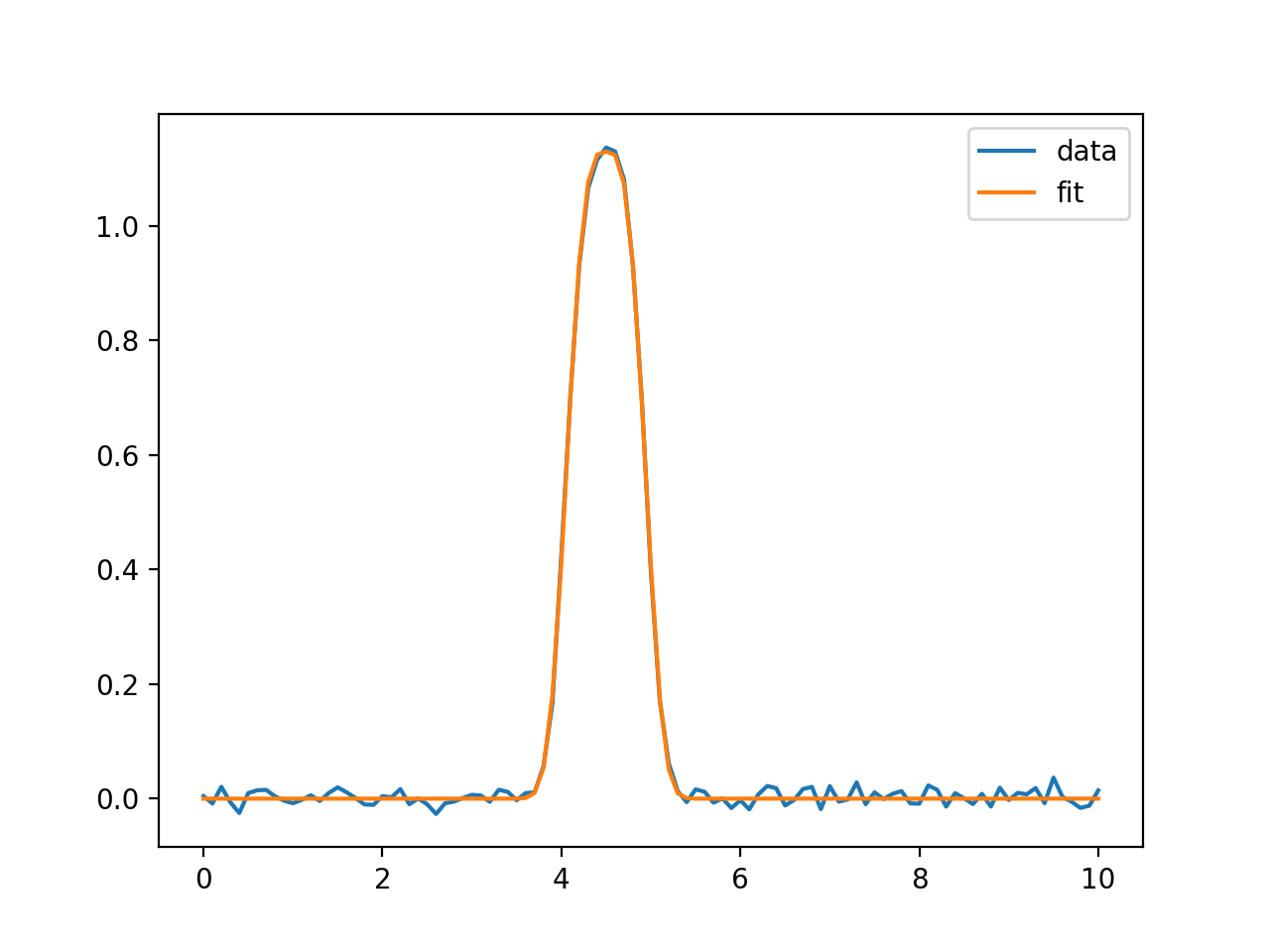
生成这样的情节
Stack Overflow用户
发布于 2020-09-03 09:07:43
这是超高斯的函数。
    def super_gaussian(x, amp, x0, sigma):
        rank = 2
        return amp * ((np.exp(-(2 ** (2 * rank - 1)) * np.log(2) * (((x - x0) ** 2) / ((sigma) ** 2)) ** (rank))) ** 2)
然后你需要用这样的最优曲线拟合来称呼它:
from scipy import optimize

opt, _ = optimize.curve_fit(super_gaussian, x, y)
vals = super_gaussian(x, *opt)
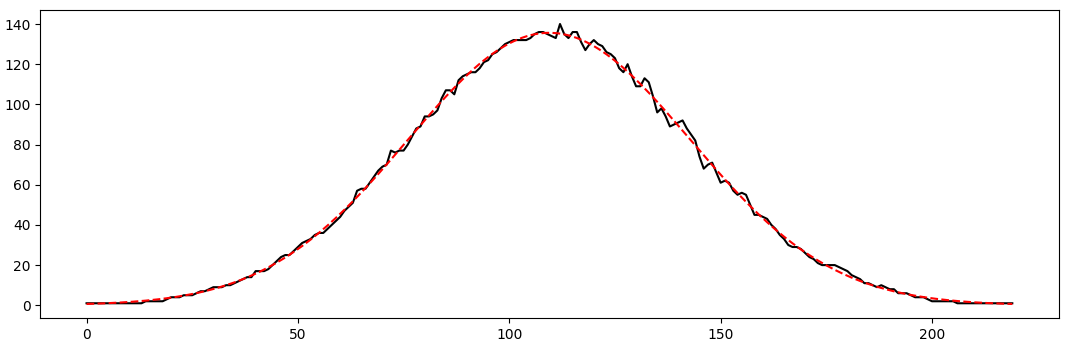
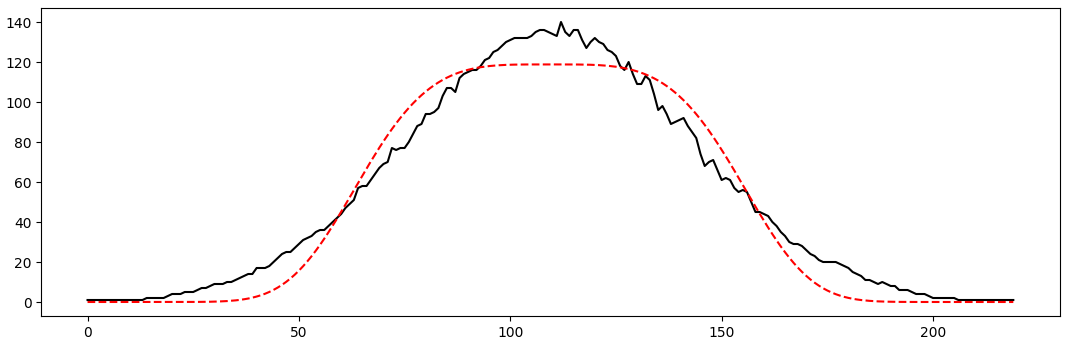
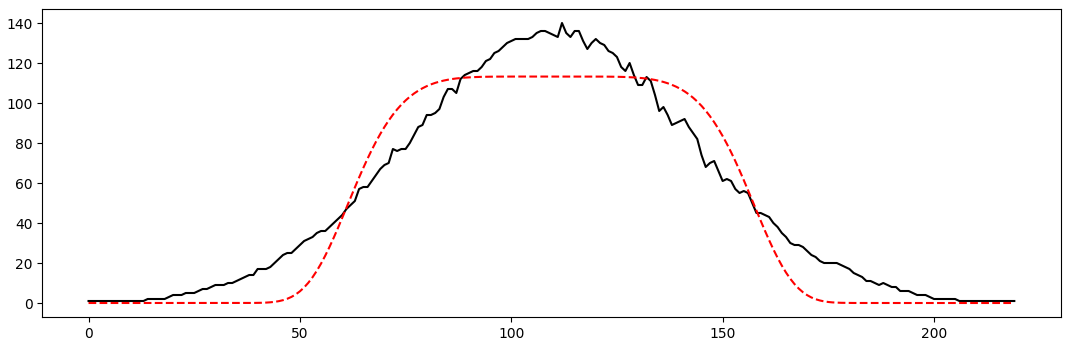
‘'vals’是你需要绘制的,那是拟合的超高斯函数。
这就是你在rank=1中得到的:
rank=2:
rank=3:
Stack Overflow用户
发布于 2021-03-21 18:27:02
纽维尔先生的回答非常适合我。
,但要小心!在super_gaussian函数的定义中,指数的商数中已经出现了抛物。
def super_gaussian(x, amplitude=1.0, center=0.0, sigma=1.0, expon=2.0):
    ...
    return ((amplitude/(np.sqrt(2*np.pi)*sigma))
            * np.exp(-abs(x-center)**expon / 2*sigma**expon))
应代之以
def super_gaussian(x, amplitude=1.0, center=0.0, sigma=1.0, expon=2.0):
    ...
    return (amplitude/(np.sqrt(2*np.pi)*sigma))
           * np.exp(-abs(x-center)**expon / (2*sigma**expon))
然后是超高斯函数的半高宽,它写道:
FWHM = 2.*sigma*(2.*np.log(2.))**(1/expon)算得很好,与情节非常吻合。
我很抱歉写了这篇课文作为回答。但是我的声誉分数很低,不能给M Newville贴上评论.
https://stackoverflow.com/questions/60771917
复制相似问题
腾讯云开发者

Copyright © 2013 - 2026 Tencent Cloud. All Rights Reserved. 腾讯云 版权所有
深圳市腾讯计算机系统有限公司 ICP备案/许可证号:粤B2-20090059  粤公网安备44030502008569号
腾讯云计算(北京)有限责任公司 京ICP证150476号 | 京ICP备11018762号