
KISSFFT中二维阵列间的单元相乘结果与SciPy FFT不同。
在不鼓励使用KISSFFT之后,我正在尝试在C++中使用FFTPACK处理二维数组。
我编写了一个元素级乘法函数,用于在两个二维数组被kiss_fftnd()转换后乘以它们。然后用反FFT函数将乘法的结果转换回来。不幸的是,我从kissfft在C中获得的结果与我在python中的SciPy中得到的结果不同,如下面的图片所示:
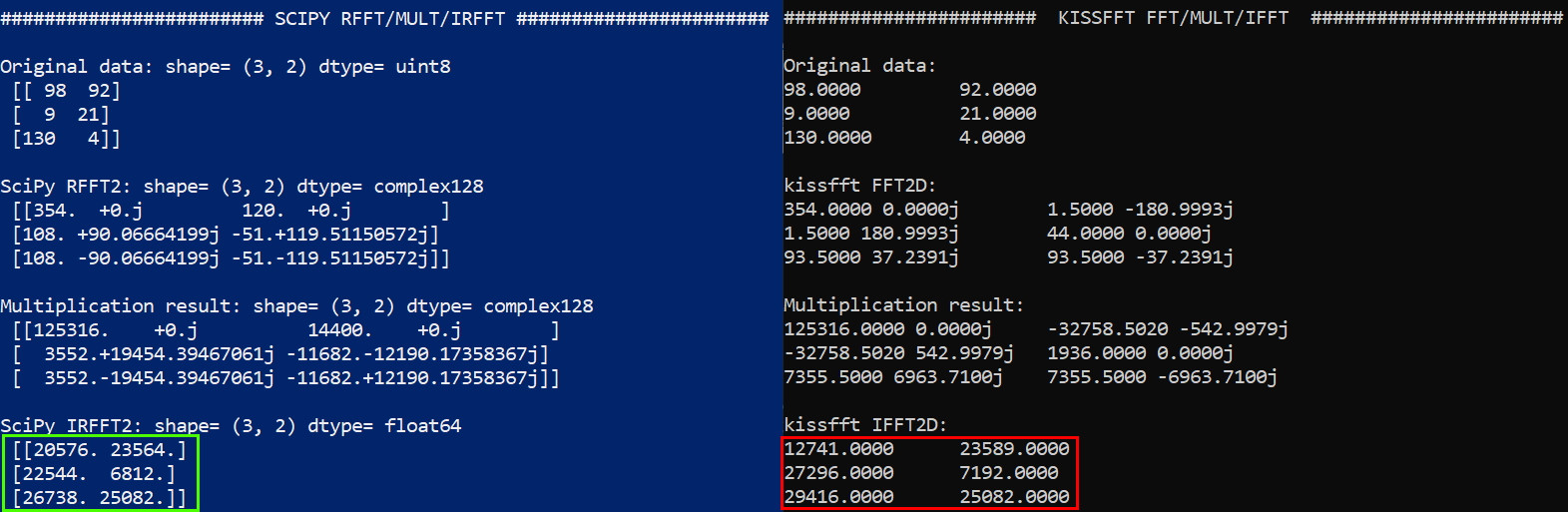
为了测试乘法函数,在对2D输入数组进行转换后,为了简单起见,我将它与自己相乘。下面是Python的一个简化版本,以说明该算法:
import numpy as np
from scipy import fft as scipy_fft

in1 = np.array([[  98,  92], \
                [   9,  21], \
                [ 130,   4]], dtype=np.uint8)

fft_out = scipy_fft.rfft2(in1)
fft_mult = fft_out * fft_out
ifft_data = scipy_fft.irfft2(fft_mult, in1.shape)
print('\nSciPy IRFFT2: shape=', ifft_data.shape, 'dtype=', ifft_data.dtype, '\n', ifft_data)我想不出为什么这个简单的操作不能用kissfft完成,这意味着我的乘法方法可能是错误的。由于kiss_fftnd()的输出是一维数组而不是2D,所以我用来迭代这个数组和执行元素方向乘法的逻辑可能是不正确的。
为什么这些结果不同,我如何使kissfft返回与SciPy相同的值?
如果您知道kissfft中已经正确执行乘法的函数,那么我也可以使用它。请不要建议其他图书馆来做这项工作。我正在寻找一个专门处理kissfft的答案。
这是Python中的完整源代码:
import numpy as np
from scipy import fft as scipy_fft

# complex_mult: multiplies two complex numbers
def complex_mult(n1, n2):
     real_part = n1.real*n2.real - n1.imag*n2.imag
     imag_part = n1.real*n2.imag + n2.real*n1.imag
     return complex(real_part, imag_part)

# fft2d_mult: multiplies two 2D arrays of complex numbers
def fft2d_mult(array1, array2):
    array_mult = np.empty(array1.shape, dtype=array1.dtype)
    h, w = in1.shape
    for j in range(h):
        for i in range(w):
            array_mult[j,i] = complex_mult(array1[j,i], array2[j,i])
    return array_mult


print("\n######################## SCIPY RFFT/MULT/IRFFT #######################\n");

# initialize input data
in1 = np.array([[  98,  92], \
                [   9,  21], \
                [ 130,   4]], dtype=np.uint8)

print('Original data: shape=', in1.shape, 'dtype=', in1.dtype, '\n', in1)

# perform 2D RFFT
fft_out = scipy_fft.rfft2(in1)
print('\nSciPy RFFT2: shape=', fft_out.shape, 'dtype=', fft_out.dtype, '\n', fft_out)

# perform element-wise multiplication
fft_mult = fft2d_mult(fft_out, fft_out) # equivalent to: fft_mult = fft_out * fft_out
print('\nMultiplication result: shape=', fft_mult.shape, 'dtype=', fft_mult.dtype, '\n', fft_mult)

# perform inverse 2D RFFT
ifft_data = scipy_fft.irfft2(fft_mult, in1.shape)
print('\nSciPy IRFFT2: shape=', ifft_data.shape, 'dtype=', ifft_data.dtype, '\n', ifft_data)
这是C++中的完整源代码:
// compile with: g++ so_issue.cpp -o so_issue -I kissfft kissfft/kiss_fft.c kissfft/tools/kiss_fftnd.c
#include "kissfft/kiss_fft.h"
#include "kissfft/tools/kiss_fftnd.h"

// fft2d: receives a 2D array of floats, performs the forward transform with kiss_fftnd() and converts it into a kiss_fft_cpx array
kiss_fft_cpx* fft2d(float* input, int width, int height)
{
    const int numDim = 2;
    int shape[numDim] = { width, height };
    int nfft = width * height;

    // allocate 2D input array for FFT
    kiss_fft_cpx* cin = new kiss_fft_cpx[nfft];
    memset(cin, 0, nfft * sizeof(kiss_fft_cpx));

    // allocate 2D output array for FFT
    kiss_fft_cpx* cout = new kiss_fft_cpx[nfft];
    memset(cout, 0, nfft * sizeof(kiss_fft_cpx));

    // copy the input data to cin
    int k = 0;
    int idx = 0;
    for (int j = 0; j < height; ++j)
    {
        for (int i = 0; i < width; ++i)
        {
            idx = i + width * j; // access 1D array as 2D
            cin[k++].r = input[idx];
        }
    }

    // execute 2D FFT
    bool inverse_fft = false;
    kiss_fftnd_cfg cfg_f = kiss_fftnd_alloc(shape, numDim, inverse_fft, 0, 0);
    kiss_fftnd(cfg_f, cin , cout);

    // release resources
    kiss_fft_free(cfg_f);
    delete[] cin;

    return cout;
}

// fft2d: receives an array of kiss_fft_cpx elements, performs the inverse transform with kiss_fftnd() and returns the result in a new kiss_fft_cpx array
kiss_fft_cpx* ifft2d(kiss_fft_cpx* input, int width, int height)
{
    const int numDim = 2;
    int shape[numDim] = { width, height };
    int nfft = width * height;

    // allocate 2D output array for FFT
    kiss_fft_cpx* cout = new kiss_fft_cpx[nfft];
    memset(cout, 0, nfft * sizeof(kiss_fft_cpx));

    // execute inverse 2D FFT
    bool inverse_fft = true;
    kiss_fftnd_cfg cfg_i = kiss_fftnd_alloc(shape, numDim, inverse_fft, 0, 0);
    kiss_fftnd(cfg_i, input , cout);

    // release resources
    kiss_fft_free(cfg_i);

    return cout;
}

// complex_mult: performs element-wise multiplication between two complex numbers
kiss_fft_cpx complex_mult(const kiss_fft_cpx& a, const kiss_fft_cpx& b)
{
    kiss_fft_cpx c;

    // real_part = a.real*b.real - a.imag*b.imag
    c.r = a.r*b.r - a.i*b.i;

    // imag_part = a.real*b.imag + b.real*a.imag
    c.i = a.r*b.i + b.r*a.i;

    return c;
}

// complex_mult: performs element-wise multiplication between two kiss_fft_cpx arrays
kiss_fft_cpx* fft2d_mult(kiss_fft_cpx* input1, kiss_fft_cpx* input2, int width, int height)
{
    int nfft = width * height;
    kiss_fft_cpx* output = new kiss_fft_cpx[nfft];
    memset(output, 0, nfft * sizeof(kiss_fft_cpx));

    int idx = 0;
    for (int j = 0; j < height; ++j)
    {
        for (int i = 0; i < width; ++i)
        {
            idx = i + width * j; // access 1D array as 2D
            output[idx] = complex_mult(input1[idx], input2[idx]);
        }
    }

    return output;
}

void run_test(float* in1, const int& w, const int& h)
{
printf("\n#######################  KISSFFT FFT/MULT/IFFT  #######################\n\n");

    printf("Original data:\n");
    int idx = 0;
    for (int j = 0; j < h; ++j)
    {
        for (int i = 0; i < w; ++i)
        {
            idx = i + w * j;
            printf("%.4f  \t", in1[idx]);
        }
        printf("\n");
    }

    /* perform FFT */

    kiss_fft_cpx* cout = fft2d((float*)in1, w, h);

    printf("\nkissfft FFT2D:\n");
    for (int j = 0; j < h; ++j)
    {
        for (int i = 0; i < w; ++i)
        {
            idx = i + w * j;
            printf("%.4f %.4fj  \t", cout[idx].r,  cout[idx].i);
        }
        printf("\n");
    }

    /* perform element-wise multiplication */

    kiss_fft_cpx* cout_mult = fft2d_mult(cout, cout, w, h);

    printf("\nMultiplication result:\n");
    for (int j = 0; j < h; ++j)
    {
        for (int i = 0; i < w; ++i)
        {
            idx = i + w * j;
            printf("%.4f %.4fj  \t", cout_mult[idx].r,  cout_mult[idx].i);
        }
        printf("\n");
    }

    /* perform inverse FFT */

    kiss_fft_cpx* cinput = ifft2d(cout_mult, w, h);

    printf("\nkissfft IFFT2D:\n");

    int nfft = w * h;
    for (int j = 0; j < h; ++j)
    {
        for (int i = 0; i < w; ++i)
        {
            idx = i + w * j;
            printf("%.4f  \t", cinput[idx].r / nfft); // div by N to scale data back to the original range
        }
        printf("\n");
    }

    // release resources
    delete[] cout_mult;
    delete[] cinput;
    delete[] cout;
}

int main()
{
    int h = 3,  w = 2;
    float in1[h][w] =
    {
        {  98,  92 },
        {   9,  21 },
        { 130,  4  }
    };

    run_test((float*)in1, w, h);

    return 0;
}回答 1
Stack Overflow用户
发布于 2020-05-18 21:40:07
问题在于width和height在shape中的使用顺序。这个变量后来作为参数传递给kiss_fftnd_alloc(),必须首先定义height:
const int numDim = 2;
int shape[numDim] = { height, width };在fft2d()和ifft2d()中进行此更改后,应用程序将显示正确的结果。
https://stackoverflow.com/questions/61872422
复制相似问题
腾讯云开发者

Copyright © 2013 - 2026 Tencent Cloud. All Rights Reserved. 腾讯云 版权所有
深圳市腾讯计算机系统有限公司 ICP备案/许可证号:粤B2-20090059  粤公网安备44030502008569号
腾讯云计算(北京)有限责任公司 京ICP证150476号 | 京ICP备11018762号