
GLCM特征提取
GLCM特征提取
提问于 2021-11-01 11:35:58
所以我正在读一篇研究论文[链接],它有下面的Algo来获取图像的纹理。
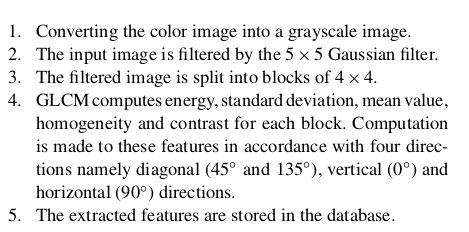
所以我从上面了解到的是,我需要建立4x4的网格,然后为每个4x4子矩阵找到GLCM矩阵,然后计算这些属性。
但是我对这个方法的问题是,图像的大小是256x384,它给出了64*96个网格,计算一个GLCM矩阵64*96次,计算量非常大,特别是因为我有900幅这样的图像。
守则如下:
def texture_extract(img):
    distance = [1]
    angles = [0, np.pi/4, np.pi/2, 3*np.pi/4]
    properties = ['correlation', 'homogeneity', 'contrast', 'energy', 'dissimilarity']

    gray_img = cv2.cvtColor(img, cv2.COLOR_BGR2GRAY)
    blur = cv2.GaussianBlur(gray_img, (5,5), 0)

    texture_features = []
    for i in range(0, blur.shape[0], 4):
        for j in range(0, blur.shape[1], 4):
            block = blur[i:i+4, j:j+4]

            glcm_mat = greycomatrix(block, distances=distance, angles=angles, symmetric=True, normed=True)
            block_glcm = np.hstack([greycoprops(glcm_mat, props).ravel() for props in properties])
            texture_features.append(block_glcm)

    return np.concatenate(texture_features)
我只想知道,我对算法的理解是正确的,还是我在某个地方犯了一个愚蠢的错误。
回答 1
Stack Overflow用户
发布于 2022-06-23 19:49:34
我就是这样用的,一般的方式和你的一样。
GLCM性质定义
import numpy as np
from skimage.feature import greycomatrix, greycoprops
from skimage import io, color, img_as_ubyte

# GLCM properties
def contrast_feature(matrix_coocurrence):
    contrast = greycoprops(matrix_coocurrence, 'contrast')
    return contrast

def dissimilarity_feature(matrix_coocurrence):
    dissimilarity = greycoprops(matrix_coocurrence, 'dissimilarity')
    return dissimilarity

def homogeneity_feature(matrix_coocurrence):
    homogeneity = greycoprops(matrix_coocurrence, 'homogeneity')
    return homogeneity

def energy_feature(matrix_coocurrence):
    energy = greycoprops(matrix_coocurrence, 'energy')
    return energy

def correlation_feature(matrix_coocurrence):
    correlation = greycoprops(matrix_coocurrence, 'correlation')
    return correlation

def asm_feature(matrix_coocurrence):
    asm = greycoprops(matrix_coocurrence, 'ASM')
    return asm

bins32 = np.array([0, 8, 16, 24, 32, 40, 48, 56, 64, 72, 80, 88, 96, 104, 112, 120, 128, 136, 144, 152, 160,
            168, 176, 184, 192, 200, 208, 216, 224, 232, 240, 248, 255]) #32-bit
GLCM性质的计算
from skimage.feature import greycomatrix, greycoprops
from skimage import data
from skimage import util, exposure, data
import pywt
from skimage import io
from skimage.color import rgb2gray

lenx = x_train.shape[0] # Your image array!
X_correlationTRAIN = np.zeros((lenx, 4))
...

for i in range(lenx):
    image32 = x_train[i] # Your image array!
    image32 = rgb2gray(image32)
    np.clip(image32, 0, 255, out=image32)
    image = image32.astype('uint8')
    inds = np.digitize(image, bins32)

    max_value = inds.max()+1
    matrix_coocurrence = greycomatrix(inds, [1], [0, np.pi/4, np.pi/2, 3*np.pi/4], levels=max_value, normed=False, symmetric=False)

    X_correlationTRAIN[i] = correlation_feature(matrix_coocurrence)
    ...
...页面原文内容由Stack Overflow提供。腾讯云小微IT领域专用引擎提供翻译支持
原文链接:
https://stackoverflow.com/questions/69796388
复制相关文章
相似问题
腾讯云开发者

Copyright © 2013 - 2026 Tencent Cloud. All Rights Reserved. 腾讯云 版权所有
深圳市腾讯计算机系统有限公司 ICP备案/许可证号:粤B2-20090059  粤公网安备44030502008569号
腾讯云计算(北京)有限责任公司 京ICP证150476号 | 京ICP备11018762号