
可变Borrow不一致性
可变Borrow不一致性
提问于 2022-04-12 17:15:58
下面的program_pass在Rust中编译。
fn main() {
    let mut x = 0;
    let mut y = &mut x;
    let mut z = &mut y;
    let mut last = &mut z;

    let mut alt_y = &mut x;
    let mut alt_z = &mut alt_y;

    z = &mut alt_y;  // *last = &mut alt_y;

}
下面的program_error没有。
fn main() {
    let mut x = 0;
    let mut y = &mut x;
    let mut z = &mut y;
    let mut last = &mut z;

    let mut alt_y = &mut x;
    let mut alt_z = &mut alt_y;

    *last = &mut alt_y;   // z = &mut alt_y;

}
什么是违反在program_error,而不是在program_pass?刚刚开始,但这确实违背了我对锈病的理解。
回答 1
Stack Overflow用户
回答已采纳
发布于 2022-04-12 18:35:51
这是而不是的不一致性,而是意图的行为。
在第一种情况下,不使用可变引用。实际上没有问题,所以生锈编译器是快乐的。
在第二种情况下,生锈编译器会看到可变引用last被取消引用,因此它被视为值访问。正如我们所知,铁锈不允许这两个可变的借款。
参考资料:德夫
来证明我的观点对你的程序有一点微调
fn main() {
    let mut x = 0;
    let mut y = &mut x;
    let mut z = &mut y;
    let mut last = &mut z;

    let mut alt_y = &mut x;
    let mut alt_z = &mut alt_y;

    // notice the RHS here assigning
    // mutable reference of i32 literal
    *last = &mut &mut 4;
    //                ^ not related to x anyhow
}
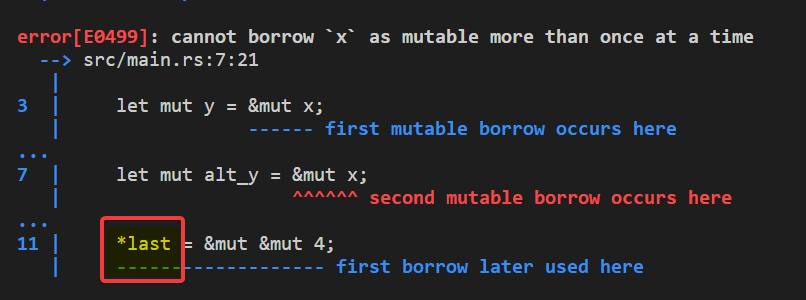
现在这个错误会揭示问题背后的原因\
error[E0499]: cannot borrow `x` as mutable more than once at a time
  --> src/main.rs:7:21
   |
3  |     let mut y = &mut x;
   |                 ------ first mutable borrow occurs here
...
7  |     let mut alt_y = &mut x;
   |                     ^^^^^^ second mutable borrow occurs here
...
11 |     *last = &mut &mut 4;
   |     ------------------- first borrow later used here
页面原文内容由Stack Overflow提供。腾讯云小微IT领域专用引擎提供翻译支持
原文链接:
https://stackoverflow.com/questions/71846769
复制相关文章
相似问题
腾讯云开发者

Copyright © 2013 - 2026 Tencent Cloud. All Rights Reserved. 腾讯云 版权所有
深圳市腾讯计算机系统有限公司 ICP备案/许可证号:粤B2-20090059  粤公网安备44030502008569号
腾讯云计算(北京)有限责任公司 京ICP证150476号 | 京ICP备11018762号