【C++容器和算法】关联容器:map类型

【C++容器和算法】关联容器:map类型

byte轻骑兵
发布于 2026-01-21 16:24:33
发布于 2026-01-21 16:24:33
在 C++ 标准库中,map 是一种高效的关联容器,基于红黑树(Red-Black Tree)实现。它能够将键值对(Key-Value)按照特定顺序存储,支持快速查找、插入和删除操作。本文将从底层原理到高级应用,全面解析 map 的核心特性。
一、map容器概述
1.1 基本概念
map是C++ STL中的一种关联容器,用于存储键值对。每个键(key)必须是唯一的,而值(value)可以重复。map中的元素会根据键自动排序,默认按键的升序排列。其底层实现通常基于红黑树(一种自平衡二叉搜索树),保证了高效的操作性能。
1.2 特点
- 有序性:元素按键的升序自动排列,支持顺序访问。
- 高效性:插入、删除和查找操作的时间复杂度均为O(log n),其中n为容器中的元素数量。
- 唯一性:每个键必须是唯一的,不允许重复。
- 双向迭代器:支持向前和向后遍历容器中的元素。
1.3 与multimap的区别
map不允许容器中有重复的键,而multimap允许容器中有重复的键。multimap的查找操作可能会返回一个迭代器范围,表示所有匹配键的值集合。
1.4 关联容器体系定位
C++ STL容器分为序列容器和关联容器两大类。map作为关联容器的核心类型,提供基于键值对的快速查找能力,与unordered_map形成有序/无序的互补结构。
// STL容器分类简图
/*
关联容器
├─ 有序关联容器
│  ├─ map
│  ├─ set
│  ├─ multimap
│  └─ multiset
└─ 无序关联容器
   ├─ unordered_map
   └─ unordered_set
*/
1.5 模板参数解析
map的标准声明格式:
template<
    class Key,
    class T,
    class Compare = std::less<Key>,
    class Allocator = std::allocator<std::pair<const Key, T>>
> class map;-
Key:不可变键类型,需满足严格弱序 -
T:映射值类型 -
Compare:比较函数对象(默认std::less) -
Allocator:内存分配器
1.6 pair的构造艺术
pair提供多种构造方式,灵活适配不同场景:
①默认构造
std::pair<int, std::string> p1; // first=0, second=""②值初始化构造
std::pair<double, char> p2(3.14, 'A');③拷贝构造
std::pair<const char*, size_t> p3("hello", 5);
std::pair<const char*, size_t> p4(p3);  // 深拷贝
④模板推导构造(C++11起)
auto p5 = std::make_pair(42, "answer"); // 自动推导类型为pair<int, const char*>1.7 map容器的实际应用场景
- 字典实现:
map容器非常适合实现字典功能,其中键为单词,值为单词的解释。 - 配置文件解析:在解析配置文件时,可以使用
map容器来存储配置项及其对应的值。 - 缓存机制:在实现缓存机制时,可以使用
map容器来存储缓存数据,并根据键快速查找和更新缓存。 - 排序和统计:
map容器可以方便地用于数据的排序和统计,例如统计单词出现的频率。
二、map容器的成员函数
map容器提供了丰富的成员函数,用于操作容器中的元素。以下是一些常用的成员函数。
2.1 构造与赋值
- 默认构造函数:创建一个空的
map容器。
std::map<int, std::string> myMap;- 拷贝构造函数:用另一个
map容器的内容初始化当前容器。
std::map<int, std::string> myMap1 = {{1, "one"}, {2, "two"}};
std::map<int, std::string> myMap2(myMap1); // 拷贝构造- 赋值运算符:将一个
map容器的内容赋值给另一个容器。
std::map<int, std::string> myMap1 = {{1, "one"}, {2, "two"}};
std::map<int, std::string> myMap2;
myMap2 = myMap1; // 赋值操作
2.2 插入元素
- insert()函数:插入一个键值对。
std::map<int, std::string> myMap;
myMap.insert(std::pair<int, std::string>(1, "one"));
myMap.insert(std::make_pair(2, "two"));- emplace()函数:就地构造元素并插入,避免复制和移动操作。
std::map<int, std::string> myMap;
myMap.emplace(3, "three"); // 直接构造键值对并插入- operator[]运算符:通过键访问或插入元素。如果键不存在,会插入一个默认值。
std::map<int, std::string> myMap;
myMap[4] = "four"; // 插入或更新键值对
2.3 删除元素
- erase()函数:删除指定位置的元素、指定键的元素或指定范围内的元素。
std::map<int, std::string> myMap = {{1, "one"}, {2, "two"}, {3, "three"}};
myMap.erase(myMap.begin()); // 删除第一个元素
myMap.erase(2); // 删除键为2的元素
myMap.erase(myMap.begin(), myMap.end()); // 清空容器- clear()函数:清空容器中的所有元素。
std::map<int, std::string> myMap = {{1, "one"}, {2, "two"}};
myMap.clear(); // 清空容器
2.4 查找元素
- find()函数:查找指定键的元素,返回指向该元素的迭代器。
std::map<int, std::string> myMap = {{1, "one"}, {2, "two"}};
auto it = myMap.find(1);
if (it != myMap.end()) {
    std::cout << "Found: " << it->second << std::endl;
} else {
    std::cout << "Not found." << std::endl;
}- count()函数:统计指定键的元素数量(对于
map,结果要么是0,要么是1)。
std::map<int, std::string> myMap = {{1, "one"}, {2, "two"}};
int count = myMap.count(1);
std::cout << "Count of key 1: " << count << std::endl;
2.5 其他成员函数
- size()函数:返回容器中元素的数量。
std::map<int, std::string> myMap = {{1, "one"}, {2, "two"}};
std::cout << "Size of the map: " << myMap.size() << std::endl;- empty()函数:判断容器是否为空。
std::map<int, std::string> myMap;
if (myMap.empty()) {
    std::cout << "The map is empty." << std::endl;
} else {
    std::cout << "The map is not empty." << std::endl;
}- swap()函数:交换两个
map容器的内容。
std::map<int, std::string> myMap1 = {{1, "one"}, {2, "two"}};
std::map<int, std::string> myMap2 = {{3, "three"}, {4, "four"}};
myMap1.swap(myMap2); // 交换两个容器的内空
2.6 map容器的性能分析
①时间复杂度
- 插入、删除和查找操作:由于
map基于红黑树实现,这些操作的时间复杂度均为O(log n),其中n为容器中的元素数量。 - 遍历操作:遍历
map容器的时间复杂度为O(n),因为需要访问每个元素。
②内存占用
map容器的内存占用通常比unordered_map(基于哈希表实现)更紧凑,因为红黑树不需要额外的存储空间来处理碰撞冲突。
③线程安全性
map容器不是线程安全的,在多线程环境下使用时需要采取额外的同步措施,如使用互斥锁来保护对容器的访问。
三、map 的底层实现原理与基础操作
3.1 数据结构选择
map 采用红黑树作为底层数据结构,这是一种平衡二叉搜索树(Balanced BST)。红黑树的每个节点都有一个颜色属性(红或黑),通过颜色翻转和旋转操作保持树的平衡。其核心特性包括:
- 所有叶子节点(NIL)为黑色
- 红色节点的子节点必须为黑色
- 从任一节点到其每个叶子的所有路径包含相同数量的黑色节点
3.2 时间复杂度
- 插入:O(log n)
- 删除:O(log n)
- 查找:O(log n)
3.3 定义与初始化
#include <map>
#include <string>

// 基本定义
std::map<int, std::string> scores;

// 初始化方式
std::map<int, std::string> studentScores = {
    {1001, "Alice"},
    {1002, "Bob"}
};
3.4 插入元素
方式一:insert 方法
// 插入键值对
scores.insert(std::pair<int, std::string>(1003, "Charlie"));

// 插入初始化列表
scores.insert({1004, "David"});方式二:operator[]
// 若键不存在则插入默认值
scores[1005] = "Eve";
3.5 访问元素
// 通过键访问值
std::cout << scores[1001] << std::endl;  // 输出:Alice

// 安全访问(检查键是否存在)
auto it = scores.find(1006);
if (it != scores.end()) {
    std::cout << "Found: " << it->second << std::endl;
} else {
    std::cout << "Key not found" << std::endl;
}
3.6 删除元素
// 删除指定键
scores.erase(1002);

// 删除迭代器指向的元素
auto eraseIt = scores.find(1003);
if (eraseIt != scores.end()) {
    scores.erase(eraseIt);
}
四、迭代器操作详解
4.1 遍历方式
// 正向遍历
for (const auto& entry : scores) {
    std::cout << entry.first << ": " << entry.second << std::endl;
}

// 逆向遍历
for (auto it = scores.rbegin(); it != scores.rend(); ++it) {
    std::cout << it->first << ": " << it->second << std::endl;
}
4.2 迭代器类型
类型 | 描述 |
|---|---|
iterator | 普通迭代器(可读可写) |
const_iterator | 常量迭代器(只读) |
reverse_iterator | 反向迭代器 |
五、高级应用技巧
5.1 自定义键类型
示例:使用结构体作为键
struct Student {
    int id;
    std::string name;
    bool operator<(const Student& other) const {
        return id < other.id;
    }
};

std::map<Student, double> studentGrades;

// 插入数据
studentGrades[{1001, "Alice"}] = 95.5;
5.2 自定义比较函数
场景:降序排序
struct CompareDesc {
    bool operator()(int a, int b) const {
        return a > b;
    }
};

std::map<int, std::string, CompareDesc> reverseMap;
reverseMap.insert({1, "A"});
reverseMap.insert({2, "B"});
// 输出顺序:2 -> B,1 -> A
5.3 性能优化技巧
预分配内存
// 预先分配足够空间
scores.reserve(1000);
批量插入
std::vector<std::pair<int, std::string>> data = {
    {1001, "A"}, {1002, "B"}
};
scores.insert(data.begin(), data.end());
六、map vs unordered_map
特性 | map | unordered_map |
|---|---|---|
底层结构 | 红黑树 | 哈希表 |
有序性 | 按键有序 | 无序 |
查找时间 | O(log n) | O (1)(平均情况) |
插入 / 删除时间 | O(log n) | O (1)(平均情况) |
七、常见问题与陷阱
7.1 operator [] 的潜在风险
// 若键不存在,会插入默认构造的值
int value = scores[1006];  // 可能意外插入键 1006
7.2 自定义比较函数的严格弱序
确保比较函数满足:
- 非自反性:!(a < a)
- 传递性:若 a < b 且 b < c,则 a < c
- 反对称性:若 a < b,则 b 不小于 a
八、总结与最佳实践
- 选择原则:需要有序性时用
map,追求速度时用unordered_map - 性能优化:预分配内存、批量操作、避免不必要的拷贝
- 代码规范:优先使用
insert而非operator[]进行插入操作 - 异常安全:在可能抛出异常的操作中使用
insert的返回值检查
map容器是C++ STL中一种非常重要的关联容器,它以键值对的形式存储数据,并根据键自动排序。map提供了丰富的成员函数,支持高效的插入、删除和查找操作。在实际应用中,map可以用于字典实现、配置文件解析、缓存机制等多种场景。
九、完整示例代码
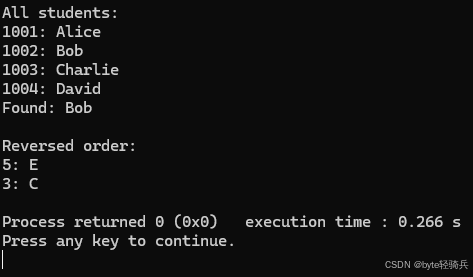
#include <iostream>
#include <map>
#include <string>

// 自定义降序比较函数结构体
struct DescCompare {
    // 重载函数调用运算符,实现降序比较
    bool operator()(int a, int b) const {
        return a > b;
    }
};

int main() {
    // 初始化一个存储学生信息的 map,键为学生 ID,值为学生姓名
    std::map<int, std::string> students = {
        {1001, "Alice"},
        {1002, "Bob"}
    };

    // 插入新的学生信息
    // 使用 insert 函数插入键值对
    students.insert({1003, "Charlie"});
    // 使用 [] 运算符插入键值对
    students[1004] = "David";

    // 遍历输出所有学生信息
    std::cout << "All students:" << std::endl;
    // 使用迭代器遍历 map
    for (auto it = students.begin(); it != students.end(); ++it) {
        std::cout << it->first << ": " << it->second << std::endl;
    }

    // 查找指定 ID 的学生信息
    auto findIt = students.find(1002);
    if (findIt != students.end()) {
        std::cout << "Found: " << findIt->second << std::endl;
    }

    // 删除指定 ID 的学生信息
    students.erase(1001);

    // 创建一个使用自定义降序比较函数的 map
    std::map<int, std::string, DescCompare> reversedMap;
    // 插入元素到降序 map 中
    reversedMap.insert({5, "E"});
    reversedMap.insert({3, "C"});

    // 遍历输出降序 map 中的元素
    std::cout << "\nReversed order:" << std::endl;
    for (auto it = reversedMap.begin(); it != reversedMap.end(); ++it) {
        std::cout << it->first << ": " << it->second << std::endl;
    }

    return 0;
}
十、参考资料
- 《C++ Primer(第 5 版)》这本书是 C++ 领域的经典之作,对 C++ 的基础语法和高级特性都有深入讲解。
- 《Effective C++(第 3 版)》书中包含了很多 C++ 编程的实用建议和最佳实践。
- 《C++ Templates: The Complete Guide(第 2 版)》该书聚焦于 C++ 模板编程,而
using声明在模板编程中有着重要应用,如定义模板类型别名等。 - C++ 官方标准文档:C++ 标准文档是最权威的参考资料,可以查阅最新的 C++ 标准(如 C++11、C++14、C++17、C++20 等)文档。例如,ISO/IEC 14882:2020 是 C++20 标准的文档,可从相关渠道获取其详细内容。
- :这是一个非常全面的 C++ 在线参考网站,提供了详细的 C++ 语言和标准库文档。
- :该网站提供了系统的 C++ 教程,配有丰富的示例代码和清晰的解释,适合初学者学习和理解相关知识。
- 《Effective STL》Scott Meyers
- 开源项目STL源码分析
本文参与 腾讯云自媒体同步曝光计划,分享自作者个人站点/博客。
原始发表:2025-04-19,如有侵权请联系 cloudcommunity@tencent.com 删除
评论
登录后参与评论
推荐阅读
目录
腾讯云开发者

Copyright © 2013 - 2026 Tencent Cloud. All Rights Reserved. 腾讯云 版权所有
深圳市腾讯计算机系统有限公司 ICP备案/许可证号:粤B2-20090059  粤公网安备44030502008569号
腾讯云计算(北京)有限责任公司 京ICP证150476号 | 京ICP备11018762号