
子图的子图Matplotlib / Seaborn
子图的子图Matplotlib / Seaborn
提问于 2019-05-26 18:55:23
我正在尝试创建一个子图的网格。每个子图看起来都像这个站点上的那个。
https://python-graph-gallery.com/24-histogram-with-a-boxplot-on-top-seaborn/
例如,如果我有10套不同的情节,我想把它们做成5x2。
我已经阅读了Matplotlib的文档,似乎无法理解如何做到这一点。我可以循环子图并获得每个输出,但不能将其放入行和列中。
进口熊猫为pd进口numpy为np进口海运为sns
df = pd.DataFrame(np.random.randint(0,100,size=(100, 10)),columns=list('ABCDEFGHIJ'))

for c in df :
    # Cut the window in 2 parts
    f, (ax_box,
        ax_hist) = plt.subplots(2,
                                sharex=True,
                                gridspec_kw={"height_ratios":(.15, .85)},
                                figsize = (10, 10))
    # Add a graph in each part
    sns.boxplot(df[c], ax=ax_box)
    ax_hist.hist(df[c])
    # Remove x axis name for the boxplot
plt.show()
结果只需使用这个循环,并将它们放在一组行和列中,在本例中是5x2。
回答 1
Stack Overflow用户
回答已采纳
发布于 2019-05-26 19:48:37
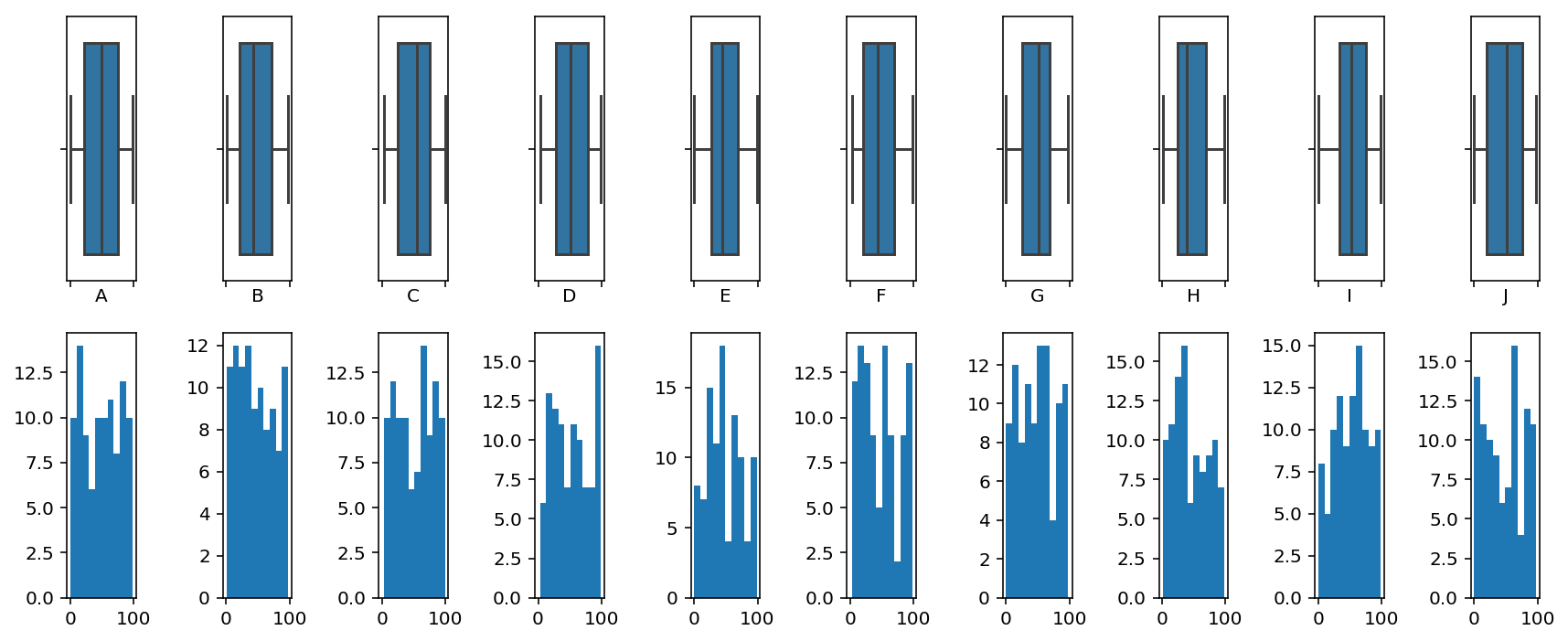
您有10列,每个列创建两个子图:一个方框图和一个直方图。所以你总共需要20位数。您可以通过创建一个由2行10列组成的网格来做到这一点。
完整答案:(根据口味调整figsize和height_ratios )
import pandas as pd
import seaborn as sns
import numpy as np
import matplotlib.pyplot as plt

f, axes = plt.subplots(2, 10, sharex=True, gridspec_kw={"height_ratios":(.35, .35)},
                                    figsize = (12, 5))

df = pd.DataFrame(np.random.randint(0,100,size=(100, 10)),columns=list('ABCDEFGHIJ'))

for i, c in enumerate(df):
    sns.boxplot(df[c], ax=axes[0,i])
    axes[1,i].hist(df[c])
plt.tight_layout()
plt.show()
页面原文内容由Stack Overflow提供。腾讯云小微IT领域专用引擎提供翻译支持
原文链接:
https://stackoverflow.com/questions/56316493
复制相关文章
相似问题
腾讯云开发者

Copyright © 2013 - 2026 Tencent Cloud. All Rights Reserved. 腾讯云 版权所有
深圳市腾讯计算机系统有限公司 ICP备案/许可证号:粤B2-20090059  粤公网安备44030502008569号
腾讯云计算(北京)有限责任公司 京ICP证150476号 | 京ICP备11018762号