
理解单链队列函数的实现
理解单链队列函数的实现
提问于 2019-05-09 01:14:17
我在这里有以下问题:
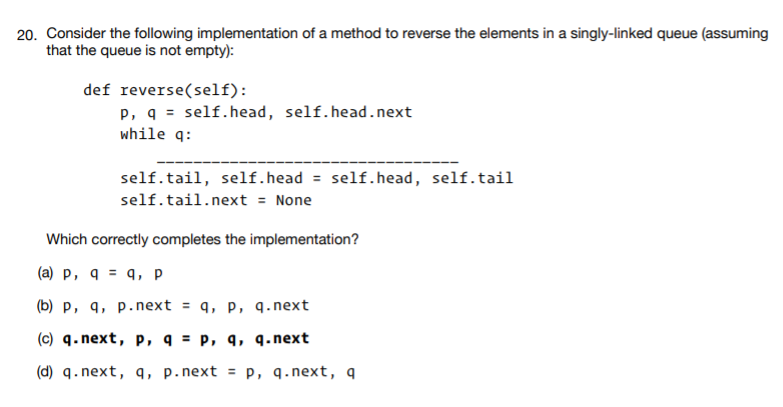
我不知道为什么这个答案是正确的,甚至不知道如何可视化这个函数的执行。在while循环中如何显示多个赋值表达式?
回答 2
Stack Overflow用户
回答已采纳
发布于 2019-05-09 01:23:35
多个赋值类似于单个赋值,但可以同时提供一个值元组,并同时分配相同长度的值元组:
a, b, c = 1, 2, 3
a == 1  # True
b == 2  # True
c == 3  # True
下面是这个函数所做的工作:
def reverse(self):
    p, q = self.head, self.head.next  # initialize p and q as first two elements of queue
    while q:  # iterate until q is None (that is, until we reach the end of the list)
              # This indicates that we will need to have a way for q to advance
              #   towards the end of the list. Presumably we'll be setting q as
              #   something that will eventually be None.
              # We know that the `next` of the last element in the list will be
              #   None, so that's a good starting point.
        _____________________  # blank line to fill in
    self.head, self.tail = self.tail, self.head  # swap head and tail of list with each other
self.tail.next = None # set the next element of the tail to None, as it should be.那么,空白处是什么呢?好吧,我们可以找出每一个变量都需要改变什么。我们将要采取的方法是改变我们遇到的每个元素的方向--而不是.next指向下一个元素,而是指向前一个元素。因此,我们希望
q.next = p因为q是列表中的第二个元素,而p是它前面的元素。然后,我们只想将p和q提升到列表中的下两个元素:
p = q
q = q.next通常,如果我们在单独的语句中执行这些操作,则需要一个临时变量来存储q.next的值--但是多个赋值允许我们绕过这一点:
q.next, p, q = p, q, q.next在这个过程的最后,我们颠倒了元素之间的所有联系,我们只是颠倒了头尾。并将self.tail.next设置为None,因为self.tail是过去为self.head的元素,我们最初跳过了它。
Stack Overflow用户
发布于 2019-05-09 01:22:47
一旦您以列表的形式在纸上可视化了单链接列表,您就会注意到,在每次迭代中,它所做的就是还原连接:
initial setup:

(1) -> (2) -> (3) -> (4) -> (5) -> nil
 p      q


step 1:

(1) <- (2) -> (3) -> (4) -> (5) -> nil
        p      q


step 2:

(1) <- (2) <- (3) -> (4) -> (5) -> nil
               p      q


step 3:

(1) <- (2) <- (3) <- (4) -> (5) -> nil
                      p      q


step 4:

(1) <- (2) <- (3) <- (4) <- (5)    nil
                             p      q
这里,
q.next = p的意思是“反向连接”;p, q = q, q.next的意思是“向前推进一个节点”。
页面原文内容由Stack Overflow提供。腾讯云小微IT领域专用引擎提供翻译支持
原文链接:
https://stackoverflow.com/questions/56050906
复制相关文章
相似问题
腾讯云开发者

Copyright © 2013 - 2026 Tencent Cloud. All Rights Reserved. 腾讯云 版权所有
深圳市腾讯计算机系统有限公司 ICP备案/许可证号:粤B2-20090059  粤公网安备44030502008569号
腾讯云计算(北京)有限责任公司 京ICP证150476号 | 京ICP备11018762号