
图像拼接
我录制了视频,而瓶子是rotated.Then,我从视频中获得帧,并从所有图像中切割中央块。
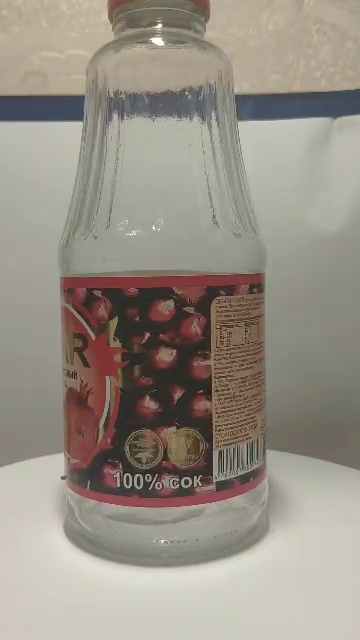
因此,对于所有的帧,我得到了以下图像:

我试过给他们缝制全景图,但结果很糟糕。我使用了以下程序:
import glob

#rom panorama import Panorama
import sys
import numpy
import imutils
import cv2


def readImages(imageString):
    images = []

    # Get images from arguments.
    for i in range(0, len(imageString)):
        img = cv2.imread(imageString[i])
        images.append(img)

    return images


def findAndDescribeFeatures(image):
    # Getting gray image
    grayImage = cv2.cvtColor(image, cv2.COLOR_BGR2GRAY)

    # Find and describe the features.
    # Fast: sift = cv2.xfeatures2d.SURF_create()
    sift = cv2.xfeatures2d.SIFT_create()

    # Find interest points.
    keypoints = sift.detect(grayImage, None)

    # Computing features.
    keypoints, features = sift.compute(grayImage, keypoints)

    # Converting keypoints to numbers.
    keypoints = numpy.float32([kp.pt for kp in keypoints])

    return keypoints, features


def matchFeatures(featuresA, featuresB):
    # Slow: featureMatcher = cv2.DescriptorMatcher_create("BruteForce")
    featureMatcher = cv2.DescriptorMatcher_create("FlannBased")
    matches = featureMatcher.knnMatch(featuresA, featuresB, k=2)
    return matches


def generateHomography(allMatches, keypointsA, keypointsB, ratio, ransacRep):
    if not allMatches:
        return None
    matches = []

    for match in allMatches:
        # Lowe's ratio test
        if len(match) == 2 and (match[0].distance / match[1].distance) < ratio:
            matches.append(match[0])

    pointsA = numpy.float32([keypointsA[m.queryIdx] for m in matches])
    pointsB = numpy.float32([keypointsB[m.trainIdx] for m in matches])

    if len(pointsA) > 4:
        H, status = cv2.findHomography(pointsA, pointsB, cv2.RANSAC, ransacRep)
        return matches, H, status
    else:
        return None


paths = glob.glob("C:/Users/andre/Desktop/Panorama-master/frames/*.jpg")
images = readImages(paths[::-1])

while len(images) > 1:
    imgR = images.pop()
    imgL = images.pop()

    interestsR, featuresR = findAndDescribeFeatures(imgR)
    interestsL, featuresL = findAndDescribeFeatures(imgL)
    try:
        try:
            allMatches = matchFeatures(featuresR, featuresL)
            _, H, _ = generateHomography(allMatches, interestsR, interestsL, 0.75, 4.0)

            result = cv2.warpPerspective(imgR, H,
                                     (imgR.shape[1] + imgL.shape[1], imgR.shape[0]))
            result[0:imgL.shape[0], 0:imgL.shape[1]] = imgL
            images.append(result)
        except TypeError:
            pass
    except cv2.error:
        pass
result = imutils.resize(images[0], height=260)
cv2.imshow("Result", result)
cv2.imwrite("Result.jpg", result)

cv2.waitKey(0)
我的结果是:
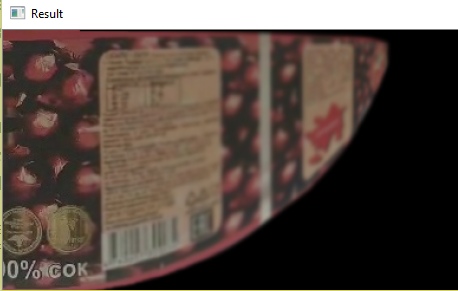
也许是有人知道热辣才能做得更好?我认为从车架上用小块可以消除圆度.但是..。
回答 1
Stack Overflow用户
发布于 2019-05-06 20:22:53
我设法取得了很好的成绩。我只是稍微重写了您的代码,下面是修改后的部分:
def generateTransformation(allMatches, keypointsA, keypointsB, ratio):
    if not allMatches:
        return None
    matches = []

    for match in allMatches:
        # Lowe's ratio test
        if len(match) == 2 and (match[0].distance / match[1].distance) < ratio:
            matches.append(match[0])

    pointsA = numpy.float32([keypointsA[m.queryIdx] for m in matches])
    pointsB = numpy.float32([keypointsB[m.trainIdx] for m in matches])

    if len(pointsA) > 2:
        transformation = cv2.estimateRigidTransform(pointsA, pointsB, True)
        if transformation is None or transformation.shape[1] < 1 or transformation.shape[0] < 1:
            return None
        return transformation
    else:
        return None


paths = glob.glob("a*.jpg")
images = readImages(paths[::-1])
result = images[0]

while len(images) > 1:
    imgR = images.pop()
    imgL = images.pop()

    interestsR, featuresR = findAndDescribeFeatures(imgR)
    interestsL, featuresL = findAndDescribeFeatures(imgL)
    allMatches = matchFeatures(featuresR, featuresL)

    transformation = generateTransformation(allMatches, interestsR, interestsL, 0.75)
    if transformation is None or transformation[0, 2] < 0:
        images.append(imgR)
        continue
    transformation[0, 0] = 1
    transformation[1, 1] = 1
    transformation[0, 1] = 0
    transformation[1, 0] = 0
    transformation[1, 2] = 0
    result = cv2.warpAffine(imgR, transformation, (imgR.shape[1] +
                int(transformation[0, 2] + 1), imgR.shape[0]))
    result[:, :imgL.shape[1]] = imgL
    cv2.imshow("R", result)
    images.append(result)
    cv2.waitKey(1)

cv2.imshow("Result", result)所以我改变的关键是图像的转换。我使用estimateRigidTransform()而不是findHomography()来计算图像的转换。从该转换矩阵中,我只提取x坐标转换,它位于生成的仿射变换矩阵 transformation的[0, 2]单元格中。我将其他转换矩阵元素设置为恒等变换(没有缩放、没有透视图、没有旋转或y平移)。然后,我将它传递给warpAffine(),以像对待warpPerspective()那样转换imgR。
你可以这样做,因为你有稳定的相机和旋转的物体位置,你用一个直视的物体捕捉。这意味着您不必进行任何透视图/缩放/旋转图像校正,只需通过x轴将它们“粘合”在一起。
我认为你的方法失败了,因为你实际上观察到瓶子有一个稍微向下倾斜的摄像头视图,或者瓶子不在屏幕的中间。我试着用图像来描述。我在瓶子上写了一些红色的文字。例如,该算法在捕获的圆形对象底部找到匹配点对(绿色)。注意,这个点不仅移动正确,而且对角也向上移动。然后,该程序计算转换,同时考虑到稍微向上移动的点。这种情况继续一帧一帧地恶化。
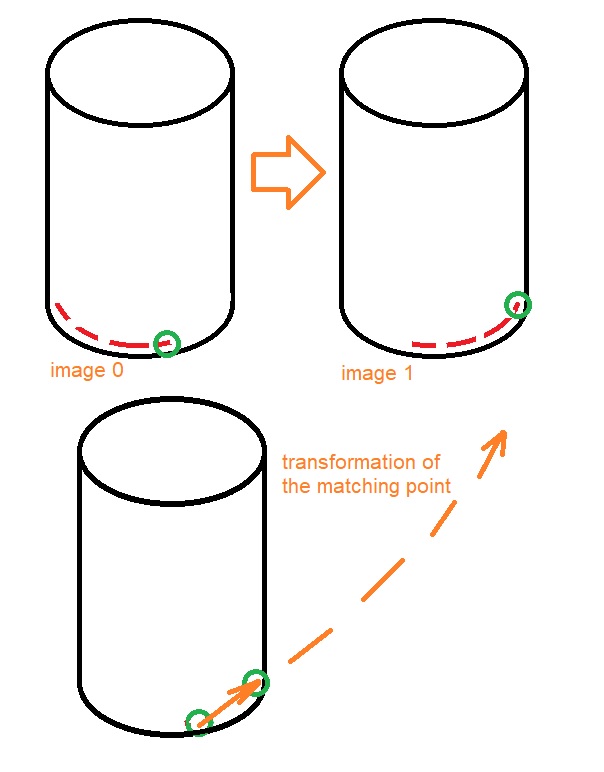
匹配图像点的识别也可能有点不准确,所以只提取x翻译会更好,因为您为算法提供了实际情况的线索。这使得它不太适用于另一种情况,但在您的情况下,它大大改善了结果。
另外,我还使用if transformation[0, 2] < 0检查筛选出一些不正确的结果(它只能旋转一个方向,如果这是负值的话,代码就不能工作)。
https://stackoverflow.com/questions/55996873
复制相似问题
腾讯云开发者

Copyright © 2013 - 2026 Tencent Cloud. All Rights Reserved. 腾讯云 版权所有
深圳市腾讯计算机系统有限公司 ICP备案/许可证号:粤B2-20090059  粤公网安备44030502008569号
腾讯云计算(北京)有限责任公司 京ICP证150476号 | 京ICP备11018762号