
从DAG提取树木
我有一个DAG表示为节点和它们的后继边。通过一个简单的递归函数,可以将其归为嵌套的数据结构。
#tree1.pl
#!/usr/bin/env perl
use 5.028; use strictures; use Moops; use Kavorka qw(fun); use List::AllUtils qw(first);
class Node :ro {
    has label => isa => Str;
    has children => isa => ArrayRef[Str];
}
fun N($label, $children) {
    return Node->new(label => $label, children => $children);
}

# list is really flat, but
# indentation outlines desired tree structure
our @dag = (
    N(N0 => ['N1']),
        N(N1 => ['N2']),
            N(N2 => ['N3']),
                N(N3 => ['N4', 'N5']),
                    N(N4 => []),
                    N(N5 => []),
);

fun tree(Node $n) {
    return bless [
        map {
            my $c = $_;
            tree(first {
                $_->label eq $c
            } @dag)
        } $n->children->@*
    ] => $n->label;
}

tree($dag[0]);
# bless([ #N0
#     bless([ #N1
#         bless([ #N2
#             bless([ #N3
#                 bless([] => 'N4'),
#                 bless([] => 'N5'),
#             ] => 'N3')
#         ] => 'N2')
#     ] => 'N1')
# ] => 'N0')
这是小事一桩。
在我的应用程序中,我遇到了DAG包含具有相同标签的多个节点的复杂性。
our @dag = (
    N(N0 => ['N1']),
    N(N1 => ['N2']),
    ︙
    N(N1 => ['N6', 'N5']),
    ︙
请注意,这并不意味着在适当的意义上存在多个边。
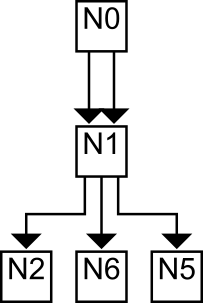
这是错误的,因为现在N1似乎有三个平等的孩子。
不能将N1节点折叠到一个节点中进行图遍历,只用于标记输出树;换句话说,这些节点必须具有不同的标识。让我们用颜色来想象这一切。
our @dag = (
    N(N0 => ['N1']),
    N([N1 => 'red'] => ['N2']),
    ︙
    N([N1 => 'blue'] => ['N6', 'N5']),
    ︙
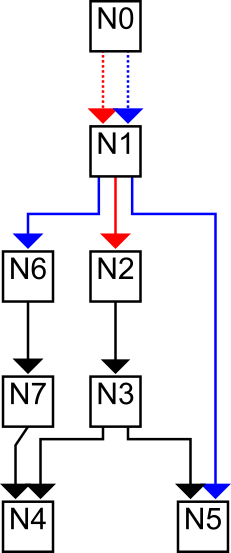
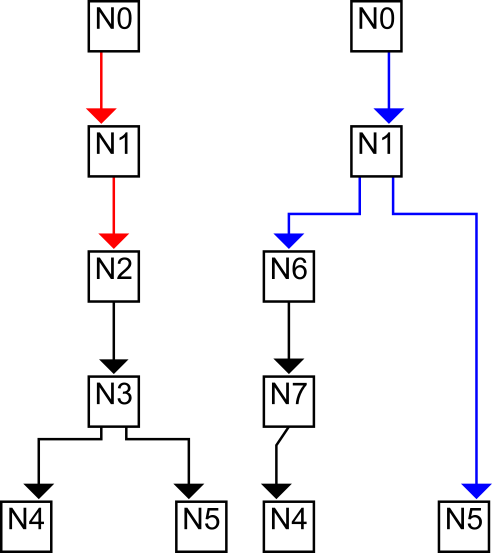
目标是将这个DAG具体化为两棵树。在单独的通道中,遵循每条虚线后继边。实现这一目标的方法是,在传递节点时记住节点上一种颜色的索引数,在下一次树构造期间,我按顺序选择下一种颜色。
#tree2.pl
#!/usr/bin/env perl
use 5.028; use strictures; use Moops; use Kavorka qw(fun); use List::AllUtils qw(first);
class Node :ro {
    has label => isa => Str;
    has col => isa => Maybe[Str];
    has children => isa => ArrayRef[Str];
    has col_seen => is => 'rw', isa => Int;
}
fun N($c_l, $children) {
    return ref $c_l
        ? Node->new(label => $c_l->[0], col => $c_l->[1], children => $children)
        : Node->new(label => $c_l, children => $children);
}

# indentation outlines desired tree structure
our @dag = (
    ### start 1st tree
    N(N0 => ['N1']),
        N([N1 => 'red'] => ['N2']),
            N(N2 => ['N3']),
                N(N3 => ['N4', 'N5']),
                    N(N4 => []),
                    N(N5 => []),
    ### end 1st tree

    ### start 2nd tree
    # N0
        N([N1 => 'blue'] => ['N6', 'N5']),
            N(N6 => ['N7']),
                N(N7 => ['N4']),
                    # N4
            # N5
    ### end 2nd tree
);

fun tree(Node $n) {
    return bless [
        map {
            my $c = $_;
            my @col = map { $_->col } grep { $_->label eq $c } @dag;
            if (@col > 1) {
                $n->col_seen($n->col_seen + 1);
                die 'exhausted' if $n->col_seen > @col;
                tree(first {
                    $_->label eq $c && $_->col eq $col[$n->col_seen - 1]
                } @dag);
            } else {
                tree(first { $_->label eq $c } @dag);
            }
        } $n->children->@*
    ] => $n->label;
}

tree($dag[0]);
# bless([ #N0
#     bless([ #N1
#         bless([ #N2
#             bless([ #N3
#                 bless([] => 'N4'),
#                 bless([] => 'N5')
#             ] => 'N3')
#         ] => 'N2')
#     ] => 'N1')
# ] => 'N0')

tree($dag[0]);
# bless([ #N0
#     bless([ #N1
#         bless([ #N6
#             bless([ #N7
#                 bless([] => 'N4')
#             ] => 'N7')
#         ] => 'N6'),
#         bless([] => 'N5')
#     ] => 'N1')
# ] => 'N0')

tree($dag[0]);
# exhausted
密码有效,我有两棵树。
但是,当我有几个具有有色后继的节点时,我的代码出现了问题。与上面相同的代码,只是输入不同:
#tree3.pl

︙

our @dag = (
    N(N0 => ['N1']),
        N([N1 => 'red'] => ['N2']),
            N(N2 => ['N3']),
                N(N3 => ['N4', 'N5']),
                    N(N4 => []),
                    N(N5 => []),
    # N0
        N([N1 => 'blue'] => ['N6', 'N5']),
            N(N6 => ['N7']),
                N(N7 => ['N8', 'N4']),
                    N([N8 => 'purple'] => ['N5']),
                        # N5
                    N([N8 => 'orange'] => []),
                    N([N8 => 'cyan'] => ['N5', 'N5']),
                        # N5
                        # N5
                    # N4
            # N5
);

︙

tree($dag[0]);
# bless([ #N0
#     bless([ #N1
#         bless([ #N2
#             bless([ #N3
#                 bless([] => 'N4'),
#                 bless([] => 'N5')
#             ] => 'N3')
#         ] => 'N2')
#     ] => 'N1')
# ] => 'N0')
tree($dag[0]);
# bless([ #N0
#     bless([ #N1
#         bless([ #N6
#             bless([ #N7
#                 bless([ #N8
#                     bless([] => 'N5')
#                 ] => 'N8'),
#                 bless([] => 'N4')
#             ] => 'N7')
#         ] => 'N6'),
#         bless([] => 'N5')
#     ] => 'N1')
# ] => 'N0')
tree($dag[0]);
# exhausted
问题是搜索只需要两棵树,虽然我应该得到四棵树:
- 红路
- 穿过蓝色,然后是紫色
- 穿过蓝色,然后是橙色
- 穿过蓝色的小路,然后是青色
您可以使用任何编程语言进行回答。
回答 1
Stack Overflow用户
发布于 2019-01-05 04:36:57
以下是你的目标吗?(python 3)
from collections import defaultdict
from itertools import product

class bless:
    def __init__(self, label, children):
        self.label = label
        self.children = children

    def __repr__(self):
        return self.__str__()

    # Just pretty-print stuff
    def __str__(self):
        formatter = "\n{}\n" if self.children else "{}"
        formatted_children = formatter.format(",\n".join(map(str, self.children)))
        return "bless([{}] => '{}')".format(formatted_children, self.label)

class Node:
    def __init__(self, label, children):
        self.label = label
        self.children = children

class DAG:
    def __init__(self, nodes):
        self.nodes = nodes

        # Add the root nodes to a singular, generated root node (for simplicity)
        # This is not necessary to implement the color-separation logic,
        # it simply lessens the number of edge cases I must handle to demonstate
        # the logic. Your existing code will work fine without this "hack"
        non_root = {child for node in self.nodes for child in node.children}
        root_nodes = [node.label for node in self.nodes if node.label not in non_root]
        self.root = Node("", root_nodes)

        # Make a list of all the trees
        self.tree_list = self.make_trees(self.root)

    def tree(self):
        if self.tree_list:
            return self.tree_list.pop(0)
        return list()

    # This is the meat of the program, and is really the logic you are after
    # Its a recursive function that parses the tree top-down from our "made-up"
    # root, and makes <bless>s from the nodes. It returns a list of all separately
    # colored trees, and if prior (recusive) calls already made multiple trees, it
    # will take the cartesian product of each tree per label
    def make_trees(self, parent):
        # A defaultdict is just a hashtable that's empty values
        # default to some data type (list here)
        trees = defaultdict(list)
        # This is some nasty, inefficient means of fetching the children
        # your code already does this more efficiently in perl, and since it
        # contributes nothing to the answer, I'm not wasting time refactoring it
        for node in (node for node in self.nodes if node.label in parent.children):
            # I append the tree(s) found in the child to the list of <label>s trees
            trees[node.label] += self.make_trees(node)
        # This line serves to re-order the trees since the dictionary doesn't preserve
        # ordering, and also restores any duplicated that would be lost
        values = [trees[label] for label in parent.children]
        # I take the cartesian product of all the lists of trees each label
        # is associated with in the dictionary. So if I have
        #    [N1-subtree] [red-N2-subtree, blue-N2-subtree] [N3-subtree]
        # as children of N0, then I'll return:
        # [bless(N0, [N1-st, red-N2-st, N3-st]), bless(N0, [N1-st, blue-N2-st, N3-st])]
        return [bless(parent.label, prod) for prod in product(*values)]

if __name__ == "__main__":
    N0  = Node('N0', ['N1'])
    N1a = Node('N1', ['N2'])
    N2  = Node('N2', ['N3'])
    N3  = Node('N3', ['N4', 'N5'])
    N4  = Node('N4', [])
    N5  = Node('N5', [])

    N1b = Node('N1', ['N6', 'N5'])
    N6  = Node('N6', ['N7'])
    N7  = Node('N7', ['N8', 'N4'])
    N8a = Node('N8', ['N5'])
    N8b = Node('N8', [])
    N8c = Node('N8', ['N5', 'N5'])

    dag = DAG([N0, N1a, N2, N3, N4, N5, N1b, N6, N7, N8a, N8b, N8c])

    print(dag.tree())
    print(dag.tree())
    print(dag.tree())
    print(dag.tree())
    print(dag.tree())
    print(dag.tree())
我通过注释相当彻底地解释了逻辑,但只是为了澄清--我一次使用根上的递归DFS生成所有可能的树。为了确保只有一个根,我创建了一个“虚构的”根,它包含没有父节点的所有其他节点,然后在该节点上开始搜索。这不是算法工作所必需的,我只是想简化与你的问题没有直接关系的逻辑。
在这个DFS中,我创建了每个标签列表的哈希表/字典,并存储从这些列表中的每个子列表中可以生成的所有不同的子树。对于大多数节点,此列表的长度为1,因为大多数节点将生成一棵树,除非它们的标签或(子)子节点有重复的标签。无论如何,我采用所有这些列表的笛卡儿积,并形成新的bless对象(从每个产品)。我返回这个列表,这个过程会重复调用堆栈,直到我们最终得到完整的树列表。
所有的打印逻辑都是不必要的(显然),但我想让您更容易地验证这是否确实是您想要的行为。我不能(很容易)将它缩进嵌套的bless,但是手动调整应该很简单。唯一真正感兴趣的部分是make_trees()函数,其余的只是设置用于验证的东西,或者使代码尽可能容易地与我所能管理的perl代码进行比较。
格式化输出:
bless([
    bless([
        bless([
            bless([
                bless([
                    bless([] => 'N4'),
                    bless([] => 'N5')
                ] => 'N3')
            ] => 'N2')
        ] => 'N1')
    ] => 'N0')
] => '')
bless([
    bless([
        bless([
            bless([
                bless([
                    bless([
                        bless([] => 'N5')
                    ] => 'N8'),
                    bless([] => 'N4')
                ] => 'N7')
            ] => 'N6'),
            bless([] => 'N5')
        ] => 'N1')
    ] => 'N0')
] => '')
bless([
    bless([
        bless([
            bless([
                bless([
                    bless([] => 'N8'),
                    bless([] => 'N4')
                ] => 'N7')
            ] => 'N6'),
            bless([] => 'N5')
        ] => 'N1')
    ] => 'N0')
] => '')
bless([
    bless([
        bless([
            bless([
                bless([
                    bless([
                        bless([] => 'N5'),
                        bless([] => 'N5')
                    ] => 'N8'),
                    bless([] => 'N4')
                ] => 'N7')
            ] => 'N6'),
            bless([] => 'N5')
        ] => 'N1')
    ] => 'N0')
] => '')
[]
[]https://stackoverflow.com/questions/54010961
复制相似问题
腾讯云开发者

Copyright © 2013 - 2026 Tencent Cloud. All Rights Reserved. 腾讯云 版权所有
深圳市腾讯计算机系统有限公司 ICP备案/许可证号:粤B2-20090059  粤公网安备44030502008569号
腾讯云计算(北京)有限责任公司 京ICP证150476号 | 京ICP备11018762号