
C++,BTree插入
嗨,这是我的SearchTree类的代码。节点*是一种结构,具有m_info类型int,以及m_left(按信息划分的较小节点)和m_right(按信息划分的更大的节点)。
void SearchTree::insert(const int &x) {
  Node* tempo = m_root;
  while (tempo != nullptr) {
    if (tempo->m_info >= x) {
      tempo = tempo->m_left;
    } else {
      tempo = tempo->m_right;
    }
  }
  tempo = new Node(x);
}
我正在尝试在树中插入一个新节点。但是看起来我在内存管理上遗漏了一些东西。节奏是一个指向新节点的指针,但是它与m_root无关。我在这里很困惑。我真的很喜欢c++的力量,但它扭曲了我的逻辑。
我在这里错过了什么?
回答 2
Stack Overflow用户
发布于 2018-12-07 13:28:32
不能只以速度保存指针。节奏是树中当前位置的副本。你必须把它赋值给实际的变量。
对于这个问题,我的解决方案是在迭代之前检查子节点是否为nullptr。
void SearchTree::insert(const int &x) {
  if (!m_root) {
      m_root = new Node(x);
      return;
  }
  Node* tempo = m_root;
  while (true) {
    if (tempo->m_info >= x) {
      if (!tempo->m_left) {
        tempo->m_left = new Node(x);
        return;
      }
      tempo = tempo->m_left;
    } else {
      if (!tempo->m_right) {
        tempo->m_right = new Node(x);
        return;
      }
      tempo = tempo->m_right;
    }
  }
}
此外,您应该使用智能指针,而不是原始指针。
另一个解决方案是指向指针的指针。我没有测试但你可以试试
void SearchTree::insert(const int &x) {
  Node** tempo = &m_root;
  while (*tempo) {
    if ((*tempo)->m_info >= x) {
      tempo = &(*tempo)->m_left;
    } else {
      tempo = &(*tempo)->m_right;
    }
  }
  *tempo = new Node(x);
}
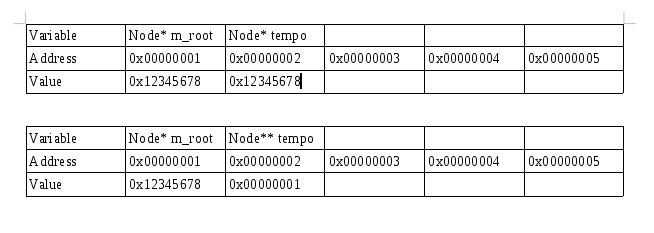
在这张图片里你可以看到。如果使用Node* tempo = m_root,则tempo将包含m_root中值的副本。如果您更改了tempo,那么m_root将保持不变。
如果您使用Node** tempo = &m_root,那么tempo就是指向m_root的指针。您可以通过m_root更改tempo。
Stack Overflow用户
发布于 2018-12-07 13:20:19
您一直推进tempo,直到它等于nullptr为止。在这一点上,你已经离开了树,而你手中的只有一个指向虚无的指针。特别要注意的是,该程序无法确定上次访问哪个节点导致tempo成为null。
您需要做的是提前一步停止:虽然tempo仍然指向一个节点,但下一步将使其指向null。现在,您仍然拥有树的一个有效节点,并且可以将新分配的节点附加到它。
https://stackoverflow.com/questions/53670321
复制相似问题
腾讯云开发者

Copyright © 2013 - 2026 Tencent Cloud. All Rights Reserved. 腾讯云 版权所有
深圳市腾讯计算机系统有限公司 ICP备案/许可证号:粤B2-20090059  粤公网安备44030502008569号
腾讯云计算(北京)有限责任公司 京ICP证150476号 | 京ICP备11018762号