
BayesServer: InvalidNetworkException: Node [Knowledge]具有空分布
我试图建立一个动态贝叶斯网络使用BayesServer库在C#为我的Unity3D游戏。我有以下实现网络的方法
// numberOfDistractors and levelId will be used later for added complexity in modeling
void InitializeNetworkForLevel(int numberOfDistractors, int levelId)
{
    beliefNet = new BayesServer.Network();

    // add a knowledge node which is a latent variable (parameter to be learned from observed values
    KTrue = new State("KTrue");
    KFalse = new State("KFalse");
    knowledge = new Variable("Knowledge", KTrue, KFalse);
    knowledgeNode = new Node(knowledge)
    {
        TemporalType = TemporalType.Temporal // this is a time series node, hence re-used for each time slice
    };
    beliefNet.Nodes.Add(knowledgeNode);

    // add a question node, which denotes the oberved variable whether the question is answered correctly or not
    // this node has two states, namely correct or incorrect
    QTrue = new State("QTrue");
    QFalse = new State("QFalse");
    question = new Variable("Question", QTrue, QFalse);
    questionNode = new Node(question)
    {
        TemporalType = TemporalType.Temporal  // this is a time series node, hence re-used for each time slice
    };
    beliefNet.Nodes.Add(questionNode);

    // add a link from knowledge node to question node
    beliefNet.Links.Add(new Link(knowledgeNode, questionNode, 0));
    for (int i = 1; i <= 5; i++)
        beliefNet.Links.Add(new Link(knowledgeNode, knowledgeNode, i)); // time series link (order/lag i)
    QueryNetwork(true);
}
还有另一种推理方法:
void QueryNetwork(bool isAnswerCOrrect)
{

    StateContext kTrueTime0 = new StateContext(KTrue, 0);
    StateContext kFalseTime0 = new StateContext(KFalse, 0);

    Table priorKnowledge = knowledgeNode.NewDistribution(0).Table;
    priorKnowledge[kTrueTime0] = 0.5;
    priorKnowledge[kFalseTime0] = 0.5;
    // NewDistribution does not assign the new distribution, so it still must be assigned
    knowledgeNode.Distribution = priorKnowledge;

    // the second is specified for time >= 1
    Table learnRate = knowledgeNode.NewDistribution(1).Table;
    // when specifying temporal distributions, variables which belong to temporal nodes must have times associated
    // NOTE: Each time is specified relative to the current point in time which is defined as zero,
    // therefore the time for variables at the previous time step is -1
    StateContext kTrueTime1 = new StateContext(KTrue, -1);
    StateContext kFalseTime1 = new StateContext(KFalse, -1);
    learnRate[kTrueTime1, kTrueTime0] = 0.5;
    learnRate[kFalseTime1, kTrueTime0] = 0.5;
    learnRate[kTrueTime1, kFalseTime0] = 0.5;
    learnRate[kFalseTime1, kFalseTime0] = 0.5;
    knowledgeNode.Distributions[1] = learnRate;

    Table answerStatus = questionNode.NewDistribution().Table;
    StateContext qTrue = new StateContext(QTrue, 0);
    StateContext qFalse = new StateContext(QFalse, 0);
    answerStatus[qTrue, kTrueTime0] = 0.5;
    answerStatus[qFalse, kTrueTime0] = 0.5;
    answerStatus[qTrue, kFalseTime0] = 0.5;
    answerStatus[qFalse, kFalseTime0] = 0.5;
    questionNode.Distribution = answerStatus;

    // optional check to validate network
    beliefNet.Validate(new ValidationOptions());
    // at this point the network has been fully specified

    // we will now perform some queries on the network
    RelevanceTreeInference inference = new RelevanceTreeInference(beliefNet);
    RelevanceTreeQueryOptions queryOptions = new RelevanceTreeQueryOptions();
    RelevanceTreeQueryOutput queryOutput = new RelevanceTreeQueryOutput();

    // set some temporal evidence
    if (isAnswerCOrrect)
        inference.Evidence.Set(question, new double?[] { 1, 0 }, 0, 0, 2);
    else
        inference.Evidence.Set(question, new double?[] { 0, 1 }, 0, 0, 2);

    queryOptions.LogLikelihood = true; // only ask for this if you really need it
    inference.Query(queryOptions, queryOutput); // note that this can raise an exception (see help for details)

    Debug.Log("LogLikelihood: " + queryOutput.LogLikelihood.Value);
}但是,在尝试用QueryNetwork方法验证网络时,我会得到以下异常:
InvalidNetworkException:节点知识具有空分布。 BayesServer.Network.Validate (BayesServer.ValidationOptions选项) (at :0) BayesNet.QueryNetwork (System.Boolean isAnswerCOrrect) (在资产/脚本/BayesNet.cs:97) BayesNet.InitializeNetworkForLevel (System.Int32 numberOfDistractors,System.Int32 levelId) (资产/脚本/BayesNet.cs:59) BayesNet.Start () (见资产/脚本/BayesNet.cs:21)
当我已经在QueryNetwork方法中指定知识节点时,它为什么说它有空分布。尽管我能够使用以下代码来修复这个问题:
ValidationOptions opt = new ValidationOptions();
opt.AllowNullDistributions = true;
// optional check to validate network
beliefNet.Validate(opt);
此外,我假设第一级的概率为50%,我将如何根据第一级的推断来改变第二级的这些值?
最后,我想构建一个类似于下图所示的网络,在这些网络中,每个级别的分心者的数量是不同的(如果太复杂的话,也可能是相同的):
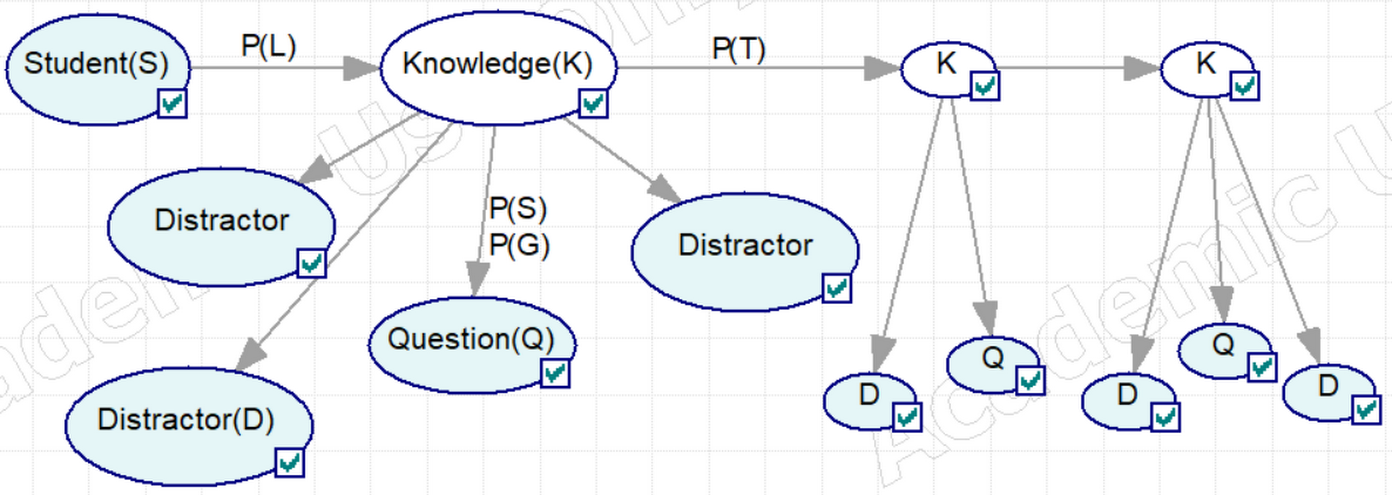
回答 1
Stack Overflow用户
发布于 2018-11-06 21:08:26
看起来您在添加延迟1到5,而我怀疑您只需要在潜在节点上添加滞后1。虽然推断不是必需的,但为了测试这一点,我建议在用户界面中展开网络,以检查DBN是否如您所期望的那样。请注意,仅添加滞后1并不限制时间步骤的数量,只是每个步骤只连接到前一个时间步骤。
https://stackoverflow.com/questions/53163622
复制相似问题
腾讯云开发者

Copyright © 2013 - 2026 Tencent Cloud. All Rights Reserved. 腾讯云 版权所有
深圳市腾讯计算机系统有限公司 ICP备案/许可证号:粤B2-20090059  粤公网安备44030502008569号
腾讯云计算(北京)有限责任公司 京ICP证150476号 | 京ICP备11018762号