
脉冲序列的C++模拟
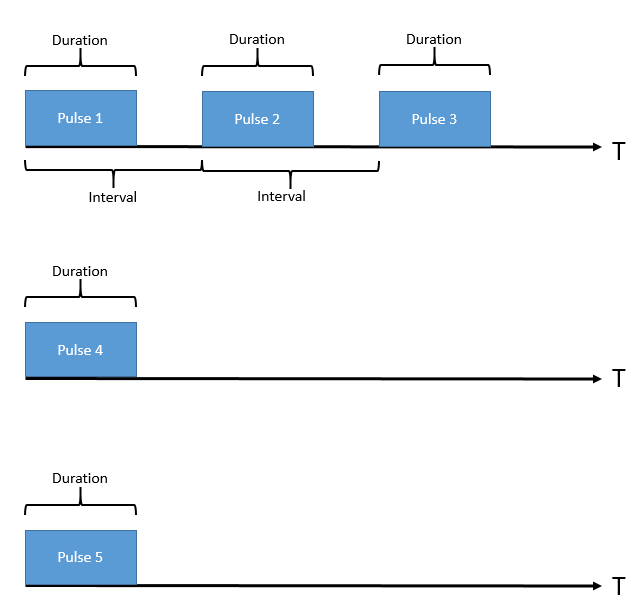
我试图在我的应用程序中建模一个脉冲波形,我需要一种方法来跟踪脉冲,以便我可以重复它们的序列。从下图中,我想做的是模拟前三个脉冲(脉冲1-3),然后在脉冲3之后立即模拟脉冲4,在4之后立即模拟脉冲5,然后重复整个序列N次。
如图所示,我有以秒为单位的间隔,第一个脉冲的开始时间(以秒为单位),以及每个脉冲的持续时间(以秒为单位)。我的应用程序将在运行循环中实时运行,它将以1Hz的速度执行。
我的问题是,我如何跟踪所有的脉冲,并确保它们都是相互模拟的?我的意思是,例如,我想在前三个脉冲的持续时间内打印一条简单的语句,对于脉冲4和5也是这样。有人能为这个操作提供一个伪算法吗?
回答 2
Stack Overflow用户
发布于 2018-11-03 02:59:30
定义类sequence如下所示,我们可以通过sequence::isActive简单地检查每个脉冲的活动。DEMO is here.
class sequence
{
    int period_;
    int start_;
    int end_;
    std::array<std::pair<int,int>, 5> pulses;

public:
    sequence(int start, int duration, int interval, int repeat)
        : period_(2*interval+3*duration),
          start_(start),
          end_(start+repeat*period_),
          pulses
          {{
              {0                    , duration             }, // pulse 1
              {interval             , interval  +  duration}, // pulse 2
              {2*interval           , 2*interval+  duration}, // pulse 3
              {2*interval+  duration, 2*interval+2*duration}, // pulse 4
              {2*interval+2*duration, period_              }  // pulse 5
          }}
    {
        if(duration <= 0){
            throw std::runtime_error("Duration must be positive integer.");
        }

        if(interval < 0){
            throw std::runtime_error("Interval must be non negative integer.");
        }
    }

    bool isActive(int time, std::size_t idx) const
    {
        const auto& pulse = pulses[idx];

        // 0 for each start time of sequence (pulse 1)
        const auto refTime = (time - start_)%period_;

        return (pulse.first <= refTime) && (refTime < pulse.second) && (time < end_);
    }

    int getPeriod() const{
        return period_;
    }

    int getStartTime() const{
        return start_;
    }

    int getEndTime() const{
        return end_;
    }

    std::size_t getPulseNum() const{
        return pulses.size();
    }
};Stack Overflow用户
发布于 2018-10-31 04:40:30
假设我正确理解了这个问题,我将使用模块化算法,并将每个脉冲序列描述为一个布尔函数,将时间戳作为函数的一个参数,例如:
// Returns true iff the pulse is present at the specified time
bool IsPulseActiveAtTime(long int theTime);
这样做的好处是,您可以模拟无限系列脉冲,而只使用一个小的,固定的内存。它还允许您有效地询问在任何过去/未来时间(不只是当前时间)每个脉冲序列的预期状态是什么,如果您需要这样做的话。
下面是一个简单的演示程序,它在100秒的模拟过程中打印出一个由四个脉冲组成的刻录机磁带:
#include <stdio.h>

class PulseSequence
{
public:
   PulseSequence(long int startTime, long int duration, long int interval)
      : _startTime(startTime)
      , _duration(duration)
      , _interval(interval)
   {
      // empty
   }

   bool IsPulseActiveAtTime(long int theTime) const
   {
      if (theTime < _startTime) return false;
      return ((theTime-_startTime) % _interval) < _duration;
   }

private:
   const long int _startTime;  // time at which the first pulse starts
   const long int _duration;   // length of each pulse
   const long int _interval;   // difference between the start-time of one pulse and the start-time of the next
};

// Unit test/example
int main(int, char **)
{
   const int NUM_PULSE_SEQUENCES = 4;

   const PulseSequence sequences[NUM_PULSE_SEQUENCES] = {
      PulseSequence(0, 3, 5),
      PulseSequence(1, 2, 6),
      PulseSequence(3, 3, 4),
      PulseSequence(5, 1, 3),
   };

   for (long int curTime = 0; curTime < 100; curTime++)
   {
      printf("curTime=%02li: [", curTime);
      for (int i=0; i<NUM_PULSE_SEQUENCES; i++) putchar(sequences[i].IsPulseActiveAtTime(curTime)?('0'+i):' ');
      printf("]\n");
   }
   return 0;
}
输出如下所示:
$ ./a.out
curTime=00: [0   ]
curTime=01: [01  ]
curTime=02: [01  ]
curTime=03: [  2 ]
curTime=04: [  2 ]
curTime=05: [0 23]
curTime=06: [0   ]
curTime=07: [012 ]
curTime=08: [ 123]
curTime=09: [  2 ]
curTime=10: [0   ]
curTime=11: [0 23]
curTime=12: [0 2 ]
curTime=13: [ 12 ]
[...]https://stackoverflow.com/questions/53076170
复制相似问题
腾讯云开发者

Copyright © 2013 - 2026 Tencent Cloud. All Rights Reserved. 腾讯云 版权所有
深圳市腾讯计算机系统有限公司 ICP备案/许可证号:粤B2-20090059  粤公网安备44030502008569号
腾讯云计算(北京)有限责任公司 京ICP证150476号 | 京ICP备11018762号