
使用Clojure中指定大小的随机AST生成
我想要生成一个随机的抽象语法树
(def terminal-set #{'x 'R})
(def function-arity {'+ 2, '- 2, '* 2, '% 2})
(def function-set (into #{} (keys function-arity)))
(def terminal-vec (into [] terminal-set))
(def function-vec (into [] function-set))

;; protected division
(defn % [^Number x ^Number y]
  (if (zero? y)
    0
    (/ x y)))
具有指定大小的
(defn treesize [tree] (count (flatten tree)))继Sean,2013年“元启发式的要点”一书中的算法,Lulu,第二版,可在https://cs.gmu.edu/~sean/book/metaheuristics/上找到
我们随机扩展无叶节点树的地平线,直到非叶节点的数目,加上剩余的点,大于或等于所需的大小。然后,我们用叶节点填充剩余的插槽:
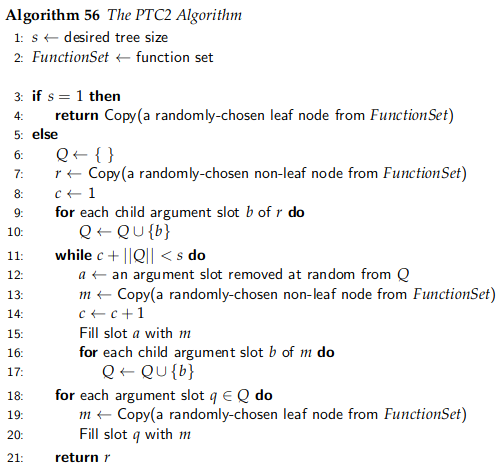
例如
(+ (* x (+ x x)) x)是七号的。
书中的算法使用了指针/参考Q,在那里非常方便。在我的例子中,我必须使用某种递归来构造树。问题是,我不能在使用递归的所有算法之间保持树的状态size,这会导致更大的树:
(defn ptc2-tree
  "Generate a random tree up to its `max-size`.
  Note: `max-size` is the number of nodes, not the same as its depth."
  [max-size]
  (if (> 2 max-size)
    (rand-nth terminal-vec)
    (let [fun   (rand-nth function-vec)
          arity (function-arity fun)]
(cons fun (repeatedly arity #(ptc2-tree (- max-size arity 1)))))))我也尝试使用atom来表示大小,但是仍然无法得到我想要的树大小,它要么太小,要么太大,这取决于实现。
除此之外,我还必须以某种方式将插入新节点/树的位置随机化。
我怎么写这个算法?
编辑:--对正确解决方案的最后触摸:
(defn sequentiate [v]
(map #(if (seqable? %) (sequentiate %) %) (seq v)))回答 2
Stack Overflow用户
发布于 2018-09-01 11:14:14
下面或多或少是本文中PTC2算法的逐字翻译.它不是完全惯用的blocks代码;您可能希望将其拆分为函数/小块,这是您认为合理的。
(defn ptc2 [target-size]
  (if (= 1 target-size)
    (rand-nth terminal-vec)
    (let [f (rand-nth function-vec)
          arity (function-arity f)]
      ;; Generate a tree like [`+ nil nil] and iterate upon it
      (loop [ast (into [f] (repeat arity nil))
             ;; q will be something like ([1] [2]), being a list of paths to the
             ;; nil elements in the AST
             q (for [i (range arity)] [(inc i)])
             c 1]
        (if (< (+ c (count q)) target-size)
          ;; Replace one of the nils in the tree with a new node
          (let [a (rand-nth q)
                f (rand-nth function-vec)
                arity (function-arity f)]
            (recur (assoc-in ast a (into [f] (repeat arity nil)))
                   (into (remove #{a} q)
                         (for [i (range arity)] (conj a (inc i))))
                   (inc c)))
          ;; In the end, fill all remaining slots with terminals
          (reduce (fn [t path] (assoc-in t path (rand-nth terminal-vec)))
ast q))))))您可以使用Clojure的loop构造(或者reduce来保持迭代的状态--在这个算法中,状态包括:
ast,它是一个嵌套向量,表示正在构建的公式,其中尚未完成的节点被标记为nil;q,它对应于伪代码中的Q,是指向ast中未完成节点的路径列表,- 和
c,它是树中非叶节点的计数。
结果,您得到的结果如下:
(ptc2 10) ;; => [* [- R [% R [% x x]]] [- x R]]我们使用向量(而不是列表)来创建AST,因为它允许我们使用assoc-in逐步构建树;如果需要,您可能希望自己将其转换为嵌套列表。
Stack Overflow用户
发布于 2018-09-01 21:36:47
巧合的是,我一直在用图佩洛森林图书馆编写AST操作代码。你可以参见这里的示例代码和这里有一段2017年Clojure/Conj的视频。
下面展示了我将如何解决这个问题。我试着使名字尽可能的不言自明,所以应该很容易理解算法是如何进行的。
基本要素:
(def op->arity {:add 2
                :sub 2
                :mul 2
                :div 2
                :pow 2})
(def op-set (set (keys op->arity)))
(defn choose-rand-op [] (rand-elem op-set))

(def arg-set #{:x :y})
(defn choose-rand-arg [] (rand-elem arg-set))

(defn num-hids [] (count (all-hids)))
帮助者职能:
(s/defn hid->empty-kids :- s/Int
  [hid :- HID]
  (let [op             (hid->attr hid :op)
        arity          (grab op op->arity)
        kid-slots-used (count (hid->kids hid))
        result         (- arity kid-slots-used)]
    (verify (= 2 arity))
    (verify (not (neg? result)))
    result))

(s/defn node-has-empty-slot? :- s/Bool
  [hid :- HID]
  (pos? (hid->empty-kids hid)))

(s/defn total-empty-kids :- s/Int
  []
  (reduce +
    (mapv hid->empty-kids (all-hids))))

(s/defn add-op-node :- HID
  [op :- s/Keyword]
  (add-node {:tag :op :op op} )) ; add node w no kids

(s/defn add-leaf-node :- tsk/KeyMap
  [parent-hid :- HID
   arg :- s/Keyword]
  (kids-append parent-hid [(add-leaf {:tag :arg :arg arg})]))

(s/defn need-more-op? :- s/Bool
  [tgt-size :- s/Int]
  (let [num-op            (num-hids)
        total-size-so-far (+ num-op (total-empty-kids))
        result            (< total-size-so-far tgt-size)]
    result))
主要算法:
(s/defn build-rand-ast :- tsk/Vec ; bush result
  [ast-size]
  (verify (<= 3 ast-size)) ; 1 op & 2 args minimum;  #todo refine this
  (with-debug-hid
    (with-forest (new-forest)
      (let [root-hid (add-op-node (choose-rand-op))] ; root of AST
        ; Fill in random op nodes into the tree
        (while (need-more-op? ast-size)
          (let [node-hid (rand-elem (all-hids))]
            (when (node-has-empty-slot? node-hid)
              (kids-append node-hid
                [(add-op-node (choose-rand-op))]))))
        ; Fill in random arg nodes in empty leaf slots
        (doseq [node-hid (all-hids)]
          (while (node-has-empty-slot? node-hid)
            (add-leaf-node node-hid (choose-rand-arg))))
        (hid->bush root-hid)))))

(defn bush->form [it]
  (let [head (xfirst it)
        tag  (grab :tag head)]
    (if (= :op tag)
      (list (kw->sym (grab :op head))
        (bush->form (xsecond it))
        (bush->form (xthird it)))
      (kw->sym (grab :arg head)))))

(dotest
  (let [tgt-size 13]
    (dotimes [i 5]
      (let [ast     (build-rand-ast tgt-size)
            res-str (pretty-str ast)]
        (nl)
        (println res-str)
        (println (pretty-str (bush->form ast))) ))))
它打印结果的两种等级的“灌木”格式,以及语言形式以及。以下是两个典型的结果:
[{:tag :op, :op :mul}
 [{:tag :op, :op :div}
  [{:tag :op, :op :pow}
   [{:tag :op, :op :sub}
    [{:tag :arg, :arg :y, :value nil}]
    [{:tag :arg, :arg :x, :value nil}]]
   [{:tag :op, :op :div}
    [{:tag :arg, :arg :y, :value nil}]
    [{:tag :arg, :arg :y, :value nil}]]]
  [{:tag :arg, :arg :y, :value nil}]]
 [{:tag :op, :op :pow}
  [{:tag :arg, :arg :x, :value nil}]
  [{:tag :arg, :arg :y, :value nil}]]]

(mul (div (pow (sub y x) (div y y)) y) (pow x y))


[{:tag :op, :op :div}
 [{:tag :op, :op :mul}
  [{:tag :op, :op :pow}
   [{:tag :arg, :arg :x, :value nil}]
   [{:tag :arg, :arg :y, :value nil}]]
  [{:tag :op, :op :add}
   [{:tag :op, :op :div}
    [{:tag :arg, :arg :x, :value nil}]
    [{:tag :arg, :arg :y, :value nil}]]
   [{:tag :arg, :arg :x, :value nil}]]]
 [{:tag :op, :op :mul}
  [{:tag :arg, :arg :x, :value nil}]
  [{:tag :arg, :arg :y, :value nil}]]]

(div (mul (pow x y) (add (div x y) x)) (mul x y))为了简单起见,我使用了三个字母的操作码,而不是数学符号,但是它们可以很容易地被Clojure函数符号名代替,以便输入到eval。
https://stackoverflow.com/questions/52126382
复制相似问题
腾讯云开发者

Copyright © 2013 - 2026 Tencent Cloud. All Rights Reserved. 腾讯云 版权所有
深圳市腾讯计算机系统有限公司 ICP备案/许可证号:粤B2-20090059  粤公网安备44030502008569号
腾讯云计算(北京)有限责任公司 京ICP证150476号 | 京ICP备11018762号