
C中的串行读取不返回数据
我使用C语言中的termios编写一个简单的程序,将其写入串口并读取返回的数据。与串行线路上的设备的通信以回车结束。该程序很简单,目前看起来如下:
#include <stdlib.h>
#include <stdio.h>
#include <sys/socket.h>
#include <termios.h>
#include <unistd.h>
#include <sys/stat.h>
#include <fcntl.h>

int main(void)
{

  struct termios s_alicat;
  int tty_fd, count;

  // Ports connected in USB as sudo
  if ((tty_fd = open("/dev/ttyUSB0", O_RDWR | O_NOCTTY | O_NDELAY)) < 0)
  {
    printf("Line failed to open with %d\n", tty_fd);
    return -1;
  }
  else
  {
    printf("fd is %d\n", tty_fd);
  }

  s_alicat.c_cflag = B19200 | CS8 | CREAD | CLOCAL;

  //No parity 8N1:
  s_alicat.c_cflag &= ~PARENB;
  s_alicat.c_cflag &= ~CSTOPB;
  s_alicat.c_cflag &= ~CSIZE;

  s_alicat.c_iflag = IGNPAR | ICRNL; // Ignore parity errors

  //Disable hardware flow control
  s_alicat.c_cflag &= ~CRTSCTS;

  //Disable software flow control
  s_alicat.c_iflag &= ~(IXON | IXOFF | IXANY);

  //Raw output
  s_alicat.c_oflag &= ~OPOST;

  //Raw input
  s_alicat.c_lflag &= ~(ICANON | ECHO | ECHOE | ISIG);

  tcflush(tty_fd, TCIFLUSH);
  tcsetattr(tty_fd, TCSANOW, &s_alicat);


  unsigned char transmit[2] = "C\r";
  if ((count = write(tty_fd, &transmit, 2)) < 0)
  {
    printf("Failed to write to device");
  }

  printf("Transmited %d characters\n", count);

  usleep(500000);

  unsigned char receive[255];

  if ((count = read(tty_fd, &receive, 255) < 0))
  {
    printf("Error receiving text %d", count);
  }
  else
  {
    if (count == 0)
    {
      printf("No data read in...\n");
    }
    else
    {
      printf("%s", receive);
    }
  }
  printf("Closting port...\n");
  close(tty_fd);

  return 0;
}
所以:
- 端口正确打开。
- 我能够写数据(物理上可以看到它通过发光二极管穿过线,当数据被发送和接收时点亮)。
- 读取返回0个字符。
如果我通过使用19.2,8N1设置的另一个程序(没有流控制)发送相同的命令(C\r),我将得到以下字符串(或类似的内容)
C\s+012.05\s+031.73\s+000.01\s+000.01\s010.24\s\s\s\s\sAir\r
我在这里做错什么了?这是否与IO被终止回车这一事实有关?还是我的配置不正确?
编辑:所以,如果我看字符设备(/dev/ttyUSB0),我实际上可以看到数据回来-见下面的快照。所以,看起来我的问题是从读缓冲区中读取和获取信息。
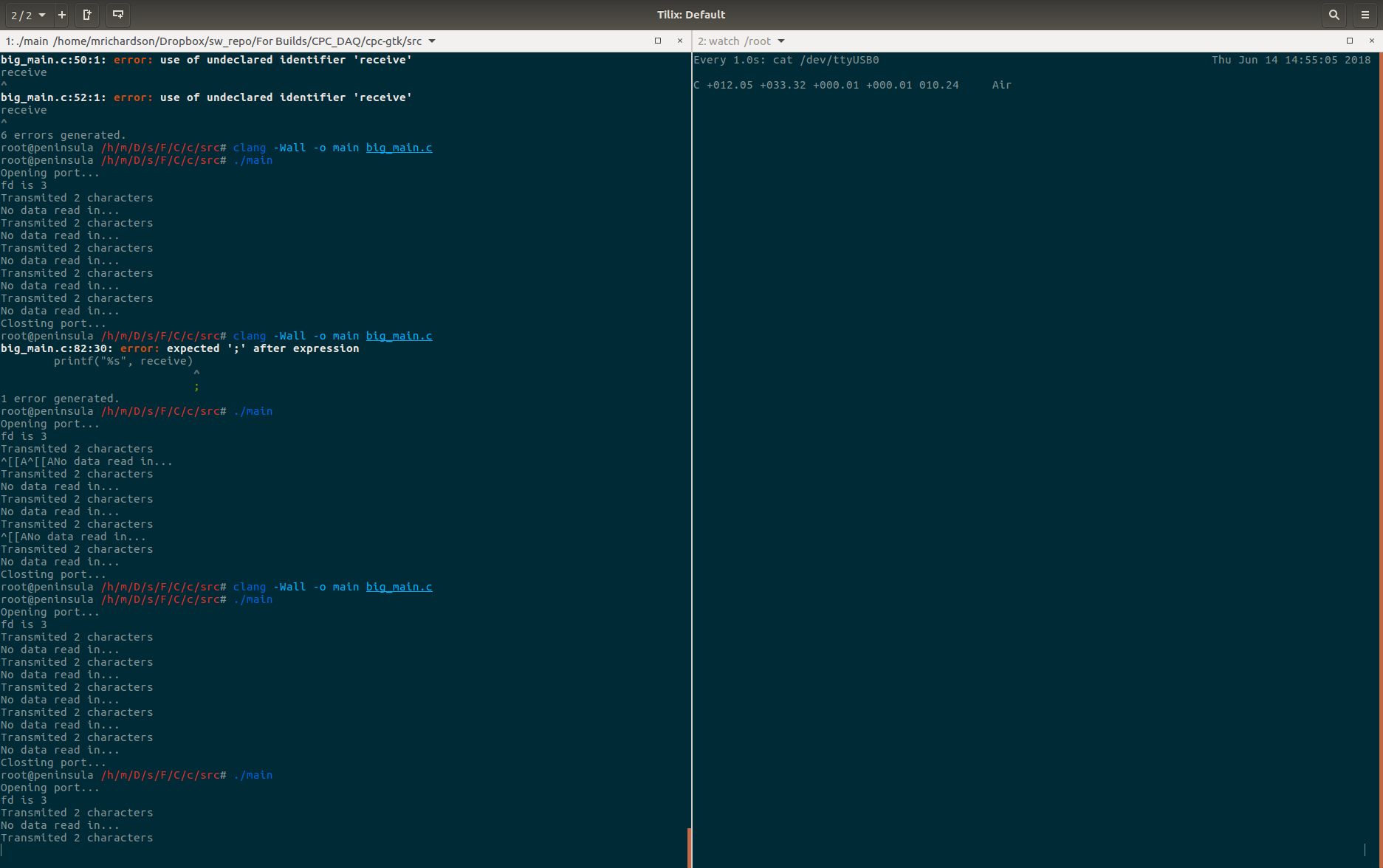
回答 2
Stack Overflow用户
发布于 2018-06-14 21:07:51
还是我的配置不正确?
是。
问题是您的程序使用非阻塞模式。
open("/dev/ttyUSB0", O_RDWR | O_NOCTTY | O_NDELAY)并与非规范模式相结合。
s_alicat.c_lflag &= ~(ICANON | ECHO | ECHOE | ISIG);即使您声明输入行以“带(a)回车”结尾。
“ReadReportwith0个字符”对于非阻塞的原始读取(就像您的配置)来说是可预测的和正常的,只要没有可用的数据。详细信息请参见这个答案。
若要更正程序,请使用阻塞模式。
在获得文件描述符后插入以下语句:
fcntl(tty_fd, F_SETFL, 0); /* set blocking mode */有关解释,请参见这。
至于termios配置,您的程序有一个严重的错误:它使用未经初始化的termios结构s_alicat。
正确的方法是使用tcgetattr()。
请参阅正确设置终端模式和POSIX操作系统串行编程指南。
#include <errno.h>
#include <string.h>

...

  if (tcgetattr(tty_fd, &s_alicat) < 0) {
      printf("Error from tcgetattr: %s\n", strerror(errno));
      return -1;
  }
  cfsetospeed(&s_alicat, B19200);
  cfsetispeed(&s_alicat, B19200);

  s_alicat.c_cflag |= (CLOCAL | CREAD);
  s_alicat.c_cflag &= ~CSIZE;
  s_alicat.c_cflag |= CS8;         /* 8-bit characters */
  s_alicat.c_cflag &= ~PARENB;     /* no parity bit */
  s_alicat.c_cflag &= ~CSTOPB;     /* only need 1 stop bit */

  s_alicat.c_iflag |= ICRNL;       /* CR is a line terminator */
  s_alicat.c_iflag |= IGNPAR;      // Ignore parity errors

  // no flow control
  s_alicat.c_cflag &= ~CRTSCTS;
  s_alicat.c_iflag &= ~(IXON | IXOFF | IXANY);

  // canonical input & output
  s_alicat.c_lflag |= ICANON;
  s_alicat.c_lflag &= ~(ECHO | ECHOE | ISIG);
  s_alicat.c_oflag |= OPOST;

  if (tcsetattr(tty_fd, TCSANOW, &s_alicat) != 0) {
      printf("Error from tcsetattr: %s\n", strerror(errno));
      return -1;
  }
代码中的其他错误包括在数组地址足够时使用指向数组地址的指针(即地址地址)。
write(tty_fd, &transmit, 2)
read(tty_fd, &receive, 255)
应该是分别的
write(tty_fd, transmit, 2)
read(tty_fd, receive, 255)
read() syscall不返回或存储字符串,但是您的程序假定它返回或存储字符串。
代码(更正了优先级错误)应该是:
if ((count = read(tty_fd, receive, sizeof(receive) - 1)) < 0) {
    printf("Error receiving text %s\n", strerror(errno));
} else {
    receive[count] = 0;  /* terminate string */
    printf("Received %d: \"%s\"\n", count, receive);
}
请注意,读取请求长度小于缓冲区大小,以便为终止空字节保留空间。
增编
您的代码有一个优先级/括号错误,这个错误一直传递到我的代码中。冒犯的说法是:
if ((count = read(tty_fd, &receive, 255) < 0))变量count的赋值应该是来自read() syscall的返回代码,而不是对逻辑表达式read() < 0的计算。
如果没有适当的括号,则首先执行比较,因为小于运算符的优先级高于赋值运算符。
这个错误导致count,当有一个好的读取(即一个正的、非零的返回代码)时,总是将值指定为0(即为false的整数值)。
从这个答案中修改的代码与您的代码合并后进行了测试,并确认其功能与预期的功能相同,文本以回车结束。
Stack Overflow用户
发布于 2018-06-15 23:00:19
@锯末-谢谢你的帮助。我将在这里张贴我的工作代码与一些初步意见。
问题是您的程序使用非阻塞模式。
这其实不是问题,这正是我想要的。我不希望读取阻塞,因为这可能导致程序挂起,如果设备没有响应。这段代码只是用来测试我的串行接口是否良好。因此,使用fcntl(tty_fd, F_SETFL, 0)将标志设置为0是我不想做的。
变量计数的赋值应该是来自
read()syscall的返回代码。
我想我是跟着你来的,但措辞很奇怪。是的,括号放得不对--谢谢你指出这一点。但是,关于“返回代码”,我假设您的意思是-1还是接收到的字节数?根据您最新的答复,我认为是这样的。
这是最后的代码。我相信我把你提供的反馈意见纳入其中。如果你看到任何奇怪的东西,可以自由地提供更多。此运行时函数的返回如下所示
root@cirrus /h/m/D/s/F/C/c/src# ./main
fd is 3
count is 49
String is C +012.17 +030.85 +000.00 +000.00 010.24     Air
Closing port...
守则:
#include <stdlib.h>
#include <stdio.h>
#include <termios.h>
#include <unistd.h>
#include <sys/stat.h>
#include <fcntl.h>
#include <errno.h>
#include <string.h>

#define PORT "/dev/ttyUSB0"

int main(void)
{

  struct termios s_alicat;
  int tty_fd, count;
  char receive[255], transmit[2];

  // Ports connected in USB as sudo
  if ((tty_fd = open(PORT, O_RDWR | O_NOCTTY | O_NDELAY)) < 0)
  {
    printf("Line failed to open with %d\n", tty_fd);
    return -1;
  }
  else
  {
    printf("fd is %d\n", tty_fd);
  }

  if (tcgetattr(tty_fd, &s_alicat) < 0)
  {
    printf("Error from tcgetattr: %s\n", strerror(errno));
    return -1;
  }

  cfsetospeed(&s_alicat, B19200);
  cfsetispeed(&s_alicat, B19200);

  // Set up receiver and set to local mode
  s_alicat.c_cflag |= (CLOCAL | CREAD | CS8);

  s_alicat.c_iflag |= IGNPAR | ICRNL; // Ignore parity errorss

  tcflush(tty_fd, TCIFLUSH); //discard file information not transmitted
  if (tcsetattr(tty_fd, TCSANOW, &s_alicat) != 0)
  {
    printf("Error from tcsetattr: %s\n", strerror(errno));
    return -1;
  }

  // Clear the port before kicking off communications
  strcpy(transmit, "\r\r");
  write(tty_fd, transmit, 2);

  strcpy(transmit, "C\r");

  if ((count = write(tty_fd, transmit, 2)) < 0)
  {
     printf("Failed to write to device");
  }

  int j = 0;
  count = 0;

  /* Attempt to read data at most 3 times if there is no data
   * coming back.
   */

  while (count == 0 && j < 3)
  {

    usleep(100000);
    if ((count = read(tty_fd, receive, sizeof(receive) - 1)) < 0)
    {
      printf("Error receiving text %d", count);
    }
    else
    {
      printf("count is %d\n",  count);
      receive[count] = 0;
      printf("String is %s", receive);
    }
    j++;
  }

  printf("Closing port...\n");
  int p = 0;
  if ((p = close(tty_fd)) < 0)
  {
    printf("Port failed to close %d\n", p);
    return -1;
  }

  return 0;
}
编辑
通过cfsetospeed和cfsetispeed增加了波特率的显式设置。
另一位编辑
摆脱了多余的tcgetattr呼叫。
https://stackoverflow.com/questions/50863379
复制相似问题
腾讯云开发者

Copyright © 2013 - 2026 Tencent Cloud. All Rights Reserved. 腾讯云 版权所有
深圳市腾讯计算机系统有限公司 ICP备案/许可证号:粤B2-20090059  粤公网安备44030502008569号
腾讯云计算(北京)有限责任公司 京ICP证150476号 | 京ICP备11018762号