
属性可以用于ALFA中的几个类别吗?
属性可以用于ALFA中的几个类别吗?
提问于 2018-05-24 08:43:08
doctor可以属于subjectCat (试图获得访问权限的用户)或resourceCat (对象试图访问的医学检查的推荐医生)。
在我看来,为了支持这两种情况,我需要为每个类别分别定义doctor:
namespace subject {
     namespace doctor {
          attribute id {
                    category = subjectCat
                    id = "id"
                    type = string
          }
          attribute lastname {
                    category = subjectCat
                    id = "lastname"
                    type = string
          }
          //and 20 more attributes...
      }
}


namespace resource {
     namespace doctor {
          attribute id {
                    category = resourceCat //this line is the only difference
                    id = "id"
                    type = string
          }
          attribute lastname {
                    category = resourceCat //this line is the only difference
                    id = "lastname"
                    type = string
          }
          //and 20 more attributes...
      }
}
这很麻烦,而且有很多冗余。有什么我能避免的吗?
回答 1
Stack Overflow用户
回答已采纳
发布于 2018-05-24 16:48:12
你是正确的。您将重新定义属性。在某种程度上,您正在使用来自您的信息模型(例如,医生)的相同对象,但在一种情况下,该对象(医生)充当一个主体。在另一种情况下,它充当您正在保护的对象。
- 医生可以查看他们被指派的病人的病历。
- 人力资源人员可以查看医生的薪水。
是的,这意味着您必须在多个类别中定义属性本身。您仍然可以利用命名空间结构,只要名称空间和名称的组合仍然是唯一的。
您可以执行acme.user.staff.doctor和属性name。然后您可以执行acme.object.doctor和属性name。
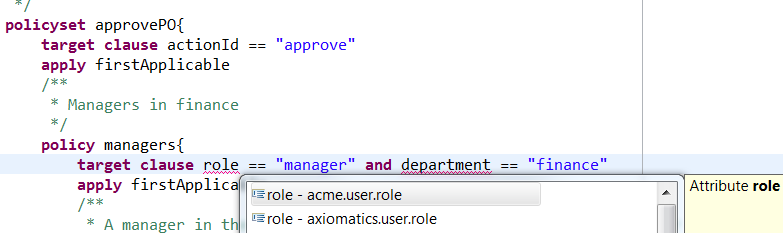
请注意,Eclipse也将允许您完成自动完成操作:
页面原文内容由Stack Overflow提供。腾讯云小微IT领域专用引擎提供翻译支持
原文链接:
https://stackoverflow.com/questions/50504810
复制相关文章
相似问题
腾讯云开发者

Copyright © 2013 - 2026 Tencent Cloud. All Rights Reserved. 腾讯云 版权所有
深圳市腾讯计算机系统有限公司 ICP备案/许可证号:粤B2-20090059  粤公网安备44030502008569号
腾讯云计算(北京)有限责任公司 京ICP证150476号 | 京ICP备11018762号