
在IRouteConstraint上完全忽略了RouteAttribute的命令
我们有一个比它应该检查的更多的IRouteConstraint。在进一步的测试中,Order on [Route]似乎被路由约束忽略了。
例如,如果我有以下约束:
public class TestConstraint : IRouteConstraint {
    public bool Match(
        HttpContextBase httpContext,
        Route route,
        string parameterName,
        RouteValueDictionary values,
        RouteDirection routeDirection
    ) {
        Debug.WriteLine("TestConstraint");
        return true;
    }
}
并将其连接起来:
constraintResolver.ConstraintMap.Add("testConstraint", typeof(TestConstraint));并有下列路线:
public partial class HomeController {
    [Route("test/0", Order = 1)]
    public ActionResult Test0() {
        return Content("Test0");
    }

    [Route("{someParam}/{test:testConstraint}", Order = 10)]
    public ActionResult Test1() {
        return Content("Test1");
    }
}然后向http://localhost/test/0发出请求,它将返回正确的内容(Test0),但是TestContraint.Match()仍然被执行。
我认为只有在RouteTable中遇到路由时才会执行路由约束,但它似乎会在每个与[Route]模式匹配的请求上运行它。
如果有区别的话,我们使用的是ASP.NET MVC版本5.2.4。
回答 1
Stack Overflow用户
发布于 2018-04-17 15:29:30
在ASP.NET MVC管道中,路由阶段和调用控制器动作的选择阶段是分开的。在路由阶段,您不能只选择第一个匹配操作并停止进一步的查找。发现的动作(严格地说是方法)可以在后期进行过滤。例如,它可能不能满足应用的动作选择器(例如,NonAction属性)。
这就是为什么基本操作选择算法如下:
- 通过配置的路由传递请求URL并选择所有匹配的操作。
- 通过操作选择器传递所有匹配操作,筛选出不匹配。
- 通过路由顺序命令候选操作。
现在有以下选择:
- 没有找到匹配的操作。请求结果为404错误。
- 多个匹配操作共享相同的最高顺序。抛出异常(“当前请求在下列操作方法之间不明确.”)。
- 确切地说,一个匹配操作具有最高的顺序(或者一个操作完全匹配)。该操作被选中并执行。
如果您对通信ASP.NET MVC源代码感兴趣,以下是一些参考资料:
IRouteConstraint.Match()由ProcessConstraint()方法在System.Web.Routing.Route中调用。调用堆栈中最接近的方法(在路由收集级别上操作)是System.Web.Mvc.Routing.RouteCollectionRoute类中的System.Web.Mvc.Routing.RouteCollectionRoute方法:
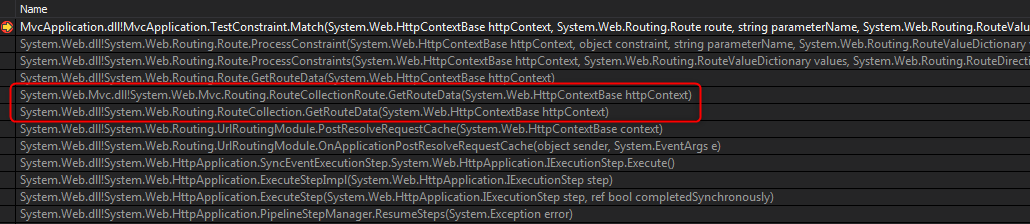
这是它的源代码
public override RouteData GetRouteData(HttpContextBase httpContext)
{
    List<RouteData> matches = new List<RouteData>();
    foreach (RouteBase route in _subRoutes)
    {
        var match = route.GetRouteData(httpContext);
        if (match != null)
        {
            matches.Add(match);
        }
    }

    return CreateDirectRouteMatch(this, matches);
}
正如您所看到的,当找到匹配的路由时,循环不会中断。
应用动作选择器、执行排序和选择动作候选的代码驻留在DirectRouteCandidate.SelectBestCandidate() (源代码)中:
public static DirectRouteCandidate SelectBestCandidate(List<DirectRouteCandidate> candidates, ControllerContext controllerContext)
{
    Debug.Assert(controllerContext != null);
    Debug.Assert(candidates != null);

    // These filters will allow actions to opt-out of execution via the provided public extensibility points.
    List<DirectRouteCandidate> filteredByActionName = ApplyActionNameFilters(candidates, controllerContext);
    List<DirectRouteCandidate> applicableCandidates = ApplyActionSelectors(filteredByActionName, controllerContext);

    // At this point all of the remaining actions are applicable - now we're just trying to find the
    // most specific match.
    //
    // Order is first, because it's the 'override' to our algorithm
    List<DirectRouteCandidate> filteredByOrder = FilterByOrder(applicableCandidates);
    List<DirectRouteCandidate> filteredByPrecedence = FilterByPrecedence(filteredByOrder);

    if (filteredByPrecedence.Count == 0)
    {
        return null;
    }
    else if (filteredByPrecedence.Count == 1)
    {
        return filteredByPrecedence[0];
    }
    else
    {
        throw CreateAmbiguiousMatchException(candidates);
    }
}https://stackoverflow.com/questions/49869484
复制相似问题
腾讯云开发者

Copyright © 2013 - 2026 Tencent Cloud. All Rights Reserved. 腾讯云 版权所有
深圳市腾讯计算机系统有限公司 ICP备案/许可证号:粤B2-20090059  粤公网安备44030502008569号
腾讯云计算(北京)有限责任公司 京ICP证150476号 | 京ICP备11018762号