
$group在MongoDB中的范围
$group在MongoDB中的范围
提问于 2018-04-10 08:20:49
我正在构建一个游戏应用程序,其数据库在Mongodb中。我有一个为玩家设定等级的模型。
const mongoose = require('mongoose');

// Ranks Schema -- Sub Schema of ContestsType
const rankSchema = mongoose.Schema({
  rank:{
    type: Number,
    required: true
  },
  pAmt:{
    type: Number,
    required: true
  }
});


// ContestsType Schema
const ContestsTypeSchema = mongoose.Schema({
  contestTypeName:{
    type: String,
    required: true
  },
  noOfWinners:{
    type: Number,
    required: true
  },
  ranks : [rankSchema]
});
这是上述模式的示例数据:
{
    "_id" : ObjectId("5a83e99e64b803361cd82e7c"),
    "noOfWinners" : 15.0,
    "ranks" : [
        {
            "rank" : 1.0,
            "pAmt" : 1000.0
        },
        {
            "rank" : 2.0,
            "pAmt" : 500.0
        },
        {
            "rank" : 3.0,
            "pAmt" : 50.0
        },
        {
            "rank" : 4.0,
            "pAmt" : 50.0
        },
        {
            "rank" : 5.0,
            "pAmt" : 50.0
        },
        {
            "rank" : 6.0,
            "pAmt" : 25.0
        },
        {
            "rank" : 7.0,
            "pAmt" : 25.0
        },
        {
            "rank" : 8.0,
            "pAmt" : 25.0
        },
        {
            "rank" : 9.0,
            "pAmt" : 25.0
        },
        {
            "rank" : 10.0,
            "pAmt" : 25.0
        }
    ],
    "contestTypeName" : "20 Teams | 15 Winners",
}
正如你所看到的,我有等级,我想把它们分成几个等级,比如等级1是1000,等级2是500,而等级3-5是50。
因此,我想以范围格式向用户显示等级,即
Rank 1 : 1000
Rank 2 : 500
Rank 3-5 : 50
Rank 5-10 : 25
这是我写的Mongo聚合管道。
db.contestTypes.aggregate(

// Pipeline
[
    // Stage 1
    {
        $match: {
            _id : ObjectId("5a83e99e64b803361cd82e7c"),
        }
    },

    // Stage 2
    {
        $unwind: {
            path : "$ranks",
        }
    },

    // Stage 3
    {
        $group: {

                  _id : "$ranks.pAmt"


        }
    },

]
);
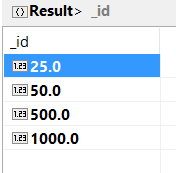
这至少给了我以下的结果
回答 1
Stack Overflow用户
发布于 2018-04-10 09:16:22
您可以使用MongoDB 3.4中引入的聚合阶段。
这使您可以根据boundaries中定义的范围对数据进行分组。
首先,使用$unwind展开数组,然后应用$bucket:
db.collection.aggregate([{
        "$unwind": "$ranks"
    },
    {
        "$bucket": {
            "groupBy": "$ranks.rank",
            "boundaries": [1, 2, 5, 10, 15],
            "default": 0,
            "output": {
                "pAmt": {
                    "$first": "$ranks.pAmt"
                }
            }
        }
    }
])
这一产出:
[
  {
    "_id": 1,
    "pAmt": 1000
  },
  {
    "_id": 2,
    "pAmt": 500
  },
  {
    "_id": 5,
    "pAmt": 50
  },
  {
    "_id": 10,
    "pAmt": 25
  }
]你可以在这里试试:Mongoplayplace.net/p/v3ZoV8bhlVS
页面原文内容由Stack Overflow提供。腾讯云小微IT领域专用引擎提供翻译支持
原文链接:
https://stackoverflow.com/questions/49748725
复制相关文章
相似问题
腾讯云开发者

Copyright © 2013 - 2026 Tencent Cloud. All Rights Reserved. 腾讯云 版权所有
深圳市腾讯计算机系统有限公司 ICP备案/许可证号:粤B2-20090059  粤公网安备44030502008569号
腾讯云计算(北京)有限责任公司 京ICP证150476号 | 京ICP备11018762号