
rgeos::gCentroid()和sf::st_centroid()返回的值不同吗?
问题
rgeos::gCentroid()和sf::st_centroid()返回的值不同吗?如果是这样的话,是怎么做的?
上下文
在阅读了维基中的维基部分之后,我兴奋地看到,我只需要sf包--而不再需要导入rgeos包--来计算给定几何的质心。
然而,sf::st_centroid()的使用给了我这个警告,这是这里的地址
Warning message:
   In st_centroid.sfc(x = comarea606$geometry) :
   st_centroid does not give correct centroids for longitude/latitude data
这一警告导致我测试了两个质心检索方法之间的相等性,只是为了确保无论该方法的坐标是否相同。
虽然我对identical()和%in%的使用导致了不完全相同的匹配,但是all.equal()和一张从每种方法中绘制出质心的地图--看起来都是--表明这两种方法几乎是相同的。
一个方法为什么会返回与另一个方法不同的值,有什么原因吗?
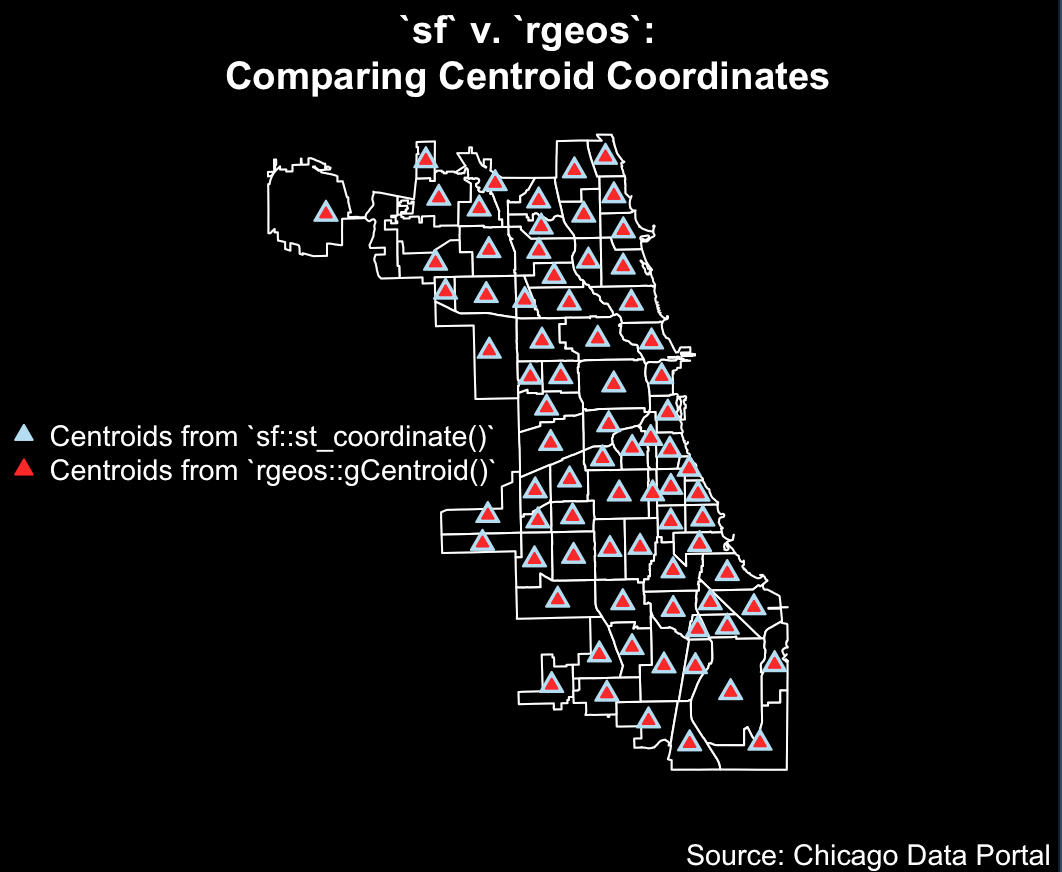
可复制示例
# load neccessary packages
library( sf )
library( rgeos )

# load data
comarea606 <-
    read_sf(
      dsn = "https://data.cityofchicago.org/api/geospatial/cauq-8yn6?method=export&format=GeoJSON"
      , layer = "OGRGeoJSON"
    )

# find the centroid of each polygon
comarea606$centroids <-
  st_centroid( x = comarea606$geometry ) %>%
  st_geometry()

# Warning message:
#   In st_centroid.sfc(x = comarea606$geometry) :
#   st_centroid does not give correct centroids for longitude/latitude data

# Ensure the st_centroid() method
# contains identical values to gCentroid()
sf.centroids <-
  st_coordinates( x = comarea606$centroids )

rgeos.centroids <-
  gCentroid(
    spgeom = methods::as(
      object = comarea606
      , Class = "Spatial"
    )
    , byid = TRUE
  )@coords


# ensure the colnames are the same
colnames( rgeos.centroids ) <-
  colnames( sf.centroids )

# Test for equality
identical(
  x = sf.centroids
  , y = rgeos.centroids
) # [1] FALSE

all.equal(
  target = sf.centroids
  , current = rgeos.centroids
) # [1] TRUE

# View the first six results
head( sf.centroids )
#           X        Y
# 1 -87.61868 41.83512
# 2 -87.60322 41.82375
# 3 -87.63242 41.80909
# 4 -87.61786 41.81295
# 5 -87.59618 41.80892
# 6 -87.68752 41.97517
head( rgeos.centroids )
#           X        Y
# 1 -87.61868 41.83512
# 2 -87.60322 41.82375
# 3 -87.63242 41.80909
# 4 -87.61786 41.81295
# 5 -87.59618 41.80892
# 6 -87.68752 41.97517

# Identify the numbers which aren't identical
sf.centroids[ , "X" ] %in% rgeos.centroids[ , "X" ]
# [1] FALSE FALSE FALSE FALSE FALSE FALSE FALSE FALSE FALSE FALSE
# [11] FALSE FALSE FALSE FALSE FALSE FALSE FALSE FALSE FALSE FALSE
# [21] FALSE FALSE FALSE FALSE FALSE FALSE FALSE FALSE FALSE FALSE
# [31] FALSE FALSE FALSE FALSE FALSE FALSE FALSE FALSE FALSE FALSE
# [41] FALSE FALSE FALSE FALSE FALSE FALSE FALSE FALSE FALSE FALSE
# [51] FALSE FALSE FALSE FALSE FALSE FALSE FALSE FALSE FALSE FALSE
# [61] FALSE FALSE FALSE FALSE FALSE FALSE FALSE FALSE FALSE FALSE
# [71] FALSE FALSE FALSE FALSE FALSE FALSE FALSE
sf.centroids[ , "Y" ] %in% rgeos.centroids[ , "Y" ]
# [1] FALSE FALSE FALSE FALSE FALSE FALSE FALSE FALSE FALSE FALSE
# [11] FALSE FALSE FALSE FALSE FALSE FALSE FALSE FALSE FALSE FALSE
# [21] FALSE FALSE FALSE FALSE FALSE FALSE FALSE FALSE FALSE FALSE
# [31] FALSE FALSE FALSE FALSE FALSE FALSE FALSE FALSE FALSE FALSE
# [41] FALSE FALSE FALSE FALSE FALSE FALSE FALSE FALSE FALSE FALSE
# [51] FALSE FALSE FALSE FALSE FALSE FALSE FALSE FALSE FALSE FALSE
# [61] FALSE FALSE FALSE FALSE FALSE FALSE FALSE FALSE FALSE FALSE
# [71] FALSE FALSE FALSE FALSE FALSE FALSE FALSE

# view results
par(
  mar = c( 2, 0, 3, 0 )
  , bg = "black"
)
plot(
  x = comarea606$geometry
  , main = "`sf` v. `rgeos`:\nComparing Centroid Coordinates"
  , col.main = "white"
  , col = "black"
  , border = "white"
)
plot(
  x = comarea606$centroids
  , add = TRUE
  , pch = 24
  , col = "#B4DDF2"
  , bg  = "#B4DDF2"
  , cex = 1.2
)
points(
  x = rgeos.centroids[ , "X" ]
  , y = rgeos.centroids[ , "Y" ]
  , pch = 24
  , col = "#FB0D1B"
  , bg  = "#FB0D1B"
  , cex = 0.6
)
legend(
  x = "left"
  , legend = c(
    "Centroids from `sf::st_coordinate()`"
    , "Centroids from `rgeos::gCentroid()`"
  )
  , col      = c( "#B4DDF2", "#FB0D1B" )
  , pt.bg    = c( "#B4DDF2", "#FB0D1B" )
  , pch      = 24
  , bty      = "n"
  , cex      = 0.9
  , text.col = "white"
)
mtext(
  adj    = 0.99
  , line = 1
  , side = 1
  , cex  = 0.9
  , text = "Source: Chicago Data Portal"
  , col  = "white"
)

# end of script #R version 3.4.4 (2018-03-15)
Platform: x86_64-apple-darwin15.6.0 (64-bit)
Running under: macOS High Sierra 10.13.2
Matrix products: default
BLAS: /System/Library/Frameworks/Accelerate.framework/Versions/A/Frameworks/vecLib.framework/Versions/A/libBLAS.dylib
LAPACK: /Library/Frameworks/R.framework/Versions/3.4/Resources/lib/libRlapack.dylib
locale:
[1] en_US.UTF-8/en_US.UTF-8/en_US.UTF-8/C/en_US.UTF-8/en_US.UTF-8
attached base packages:
[1] stats graphics grDevices utils datasets methods
[7] base
other attached packages:
[1] rgeos_0.3-26 sf_0.6-0
loaded via a namespace (and not attached):
[1] modeltools_0.2-21 kernlab_0.9-25 reshape2_1.4.3
[4] lattice_0.20-35 colorspace_1.3-2 htmltools_0.3.6
[7] stats4_3.4.4 viridisLite_0.3.0 yaml_2.1.18
[10] utf8_1.1.3 rlang_0.2.0 R.oo_1.21.0
[13] e1071_1.6-8 pillar_1.2.1 withr_2.1.2
[16] DBI_0.8 prabclus_2.2-6 R.utils_2.6.0
[19] sp_1.2-7 fpc_2.1-11 plyr_1.8.4
[22] robustbase_0.92-8 stringr_1.3.0 munsell_0.4.3
[25] gtable_0.2.0 raster_2.6-7 R.methodsS3_1.7.1
[28] devtools_1.13.5 mvtnorm_1.0-7 memoise_1.1.0
[31] evaluate_0.10.1 knitr_1.20 flexmix_2.3-14
[34] class_7.3-14 DEoptimR_1.0-8 trimcluster_0.1-2
[37] Rcpp_0.12.16 udunits2_0.13 scales_0.5.0
[40] backports_1.1.2 diptest_0.75-7 classInt_0.1-24
[43] squash_1.0.8 gridExtra_2.3 ggplot2_2.2.1
[46] digest_0.6.15 stringi_1.1.6 grid_3.4.4
[49] rprojroot_1.3-2 rgdal_1.2-18 cli_1.0.0
[52] tools_3.4.4 magrittr_1.5 lazyeval_0.2.1
[55] tibble_1.4.2 cluster_2.0.6 crayon_1.3.4
[58] whisker_0.3-2 dendextend_1.7.0 MASS_7.3-49
[61] assertthat_0.2.0 rmarkdown_1.9 rstudioapi_0.7
[64] viridis_0.5.0 mclust_5.4 units_0.5-1
[67] nnet_7.3-12 compiler_3.4.4 回答 1
Stack Overflow用户
发布于 2018-03-18 03:11:46
这个问题简化为:all.equal()与identical()有何不同,我们将查看这些函数的文档:
all.equal(x,y)是比较R对象x和y‘接近相等’的实用工具。
对于identical()
测试两个对象是否完全相等的安全可靠的方法。在这种情况下,它返回TRUE,在其他情况下返回FALSE。
让我们仔细看看all.equal.numeric(),这是对这两个对象调用的内容,因为它们都返回"double"和typeof()。我们看到在all.equal.numeric()中有一个all.equal.numeric()参数,默认情况下它被设置为sqrt(.Machine$double.eps)。.Machine$double.eps是您的机器可以添加到1中并能够将其与1区分开来的最小数字。虽然不准确,但就在这个数量级上。all.equal.numeric()本质上检查一个向量中的所有值是否都是near() --另一个向量中的所有值。您可以查看源代码(主要是错误检查),看看它是如何做到这一点的。
为了让自己确信它们实际上不是identical(),请尝试查看sf.centroids - rgeos.centroids的输出。
head(sf.centroids - rgeos.centroids)
#               X             Y
# 1 -5.056506e-10  2.623175e-09
# 2 -2.961613e-09 -4.269602e-09
# 3  4.235119e-10  4.358100e-09
# 4 -7.688925e-10 -1.051717e-09
# 5  1.226582e-09  1.668568e-10
# 6 -2.957009e-09  4.875247e-10
这两个矩阵无疑是非常接近相同的(但没有一个是完全相同的)。
https://stackoverflow.com/questions/49343958
复制相似问题
腾讯云开发者

Copyright © 2013 - 2026 Tencent Cloud. All Rights Reserved. 腾讯云 版权所有
深圳市腾讯计算机系统有限公司 ICP备案/许可证号:粤B2-20090059  粤公网安备44030502008569号
腾讯云计算(北京)有限责任公司 京ICP证150476号 | 京ICP备11018762号