
Hibernate,在一个事务中修改多个表的适当方法。
Hibernate,在一个事务中修改多个表的适当方法。
提问于 2018-03-13 22:27:30
对于使用Hibernate的项目,每个表模式都有一个DAO。在每个DAO调用中,我们创建一个事务并在它完成执行后提交。
现在,我们需要在同一个事务中更新两个表。这种情况很常见,我们需要发出一个销售检查,然后减少从我们的股票出售的对象数量。当然,这一切都必须在同一个事务中完成。
因此,我的问题是,在一个事务中修改多个表的正确方法是什么。这里是我们的一个DAO的例子,正如您所看到的,每个DAO只用于处理一个表。
我们既没有实现账单,也没有实现股票DAO。我们想知道,实现我们的需要的正确途径是什么。任何帮助,都会很好。
@Service
public class StoreDaoImplementation implements StoreDao {

// We are gonna use a session-per-request pattern, for each data access object (dao).
// In order to use it, we need an session factory that will provide us with sessions for each request.
private SessionFactory factory;

public StoreDaoImplementation() {
    try{
        factory = new Configuration().configure().buildSessionFactory();
    }catch(Exception e){
        e.printStackTrace();
    }
}

/**
 * {@inheritDoc}
 */
@Override
public Tienda findById(String storeId) {
    Session session = factory.getCurrentSession();
    Transaction tx = session.beginTransaction();
    try  {
        return session.get(Tienda.class, storeId);
    } catch (Exception e) {
        return null;
    } finally {
        tx.commit();
    }
}

/**
 * {@inheritDoc}
 */
@Override
public void insert(Tienda tienda) throws Exception {
    Session session = factory.getCurrentSession();
    Transaction tx = session.beginTransaction();
    session.persist(tienda);
    tx.commit();
}

/**
 * {@inheritDoc}
 */
@Override
public void delete(Tienda tienda) throws Exception {
    Session session = factory.getCurrentSession();
    Transaction tx = session.beginTransaction();
    session.delete(tienda);
    tx.commit();
}

/**
 * {@inheritDoc}
 */
@Override
public void update(Tienda tienda) throws Exception {
    Session session = factory.getCurrentSession();
    Transaction tx = session.beginTransaction();
    session.merge(tienda);
    tx.commit();
}

/**
 * {@inheritDoc}
 */
@Override
public void updateSupervisor(List<String> storeIds, String supervisorId) throws Exception {
    Session session = factory.getCurrentSession();
    Transaction tx = session.beginTransaction();
    Query query = session.createQuery("UPDATE Tienda SET supervisor.idEmpleadoPk = :supervisorId WHERE idTiendaPk IN (:storeIds)");
    query.setParameter("supervisorId", supervisorId);
    query.setParameter("storeIds", storeIds);
    query.executeUpdate();
    tx.commit();
}

/**
 * {@inheritDoc}
 */
@Override
public List<Tienda> getAllStores(Integer offset,
                                 Integer rowNumber,
                                 String franchise,
                                 String country,
                                 Boolean state,
                                 String storeName,
                                 Integer orderBy,
                                 Integer orderType) {
    // Always use getCurrentSession, instead of openSession.
    // Only in very odd cases, should the latter be used, then we must remember to close our session.
    // For more information, read the following docs.
    // http://docs.jboss.org/hibernate/core/3.3/reference/en/html/transactions.html#transactions-basics-uow
    Session session = factory.getCurrentSession();
    // All hibernate transactions must be executed in an active transaction.
    Transaction tx = session.beginTransaction();
    try {
        setSessionFilter(session, franchise, country, state, storeName);
        // NOTE: In this query I am using join fetch. This is due a Hibernate bug, that won't allow
        // setting the fetch type in the mapping file. What this does, is that instead of doing multiple selects
        // for each join, it just simply does a big join in the main query.
        // Much faster if you are working with a remote server.
        String hql = "from Tienda T join fetch T.supervisor join fetch T.franquiciaFK join fetch T.pais";
        switch ((orderBy != null) ? orderBy : 4) {
            case 0:
                hql += " order by T.franquiciaFK.franquiciaPk";
                break;
            case 1:
                hql += " order by T.pais.paisPk";
                break;
            case 2:
                hql += " order by T.provincia";
                break;
            case 3:
                hql += " order by T.supervisor.idEmpleadoPk";
                break;
            default:
                hql += " order by T.franquiciaFK.orden";
                break;
        }
        switch ((orderType != null) ? orderType : 0) {
            case 0:
                hql += " asc";
                break;
            case 1:
                hql += " desc";
                break;
        }
        Query query = session.createQuery(hql);
        query.setFirstResult(offset);
        query.setMaxResults(rowNumber-1);
        return query.list();
    } catch (Exception e) {
        return null;
    } finally {
        tx.commit();
    }
}

/**
 * {@inheritDoc}
 */
@Override
public List<Tienda> getStoresBySupervisor(String supervisorId) {
    Session session = factory.getCurrentSession();
    Transaction tx = session.beginTransaction();
    try {
        // NOTE: In this query I am using join fetch. This is due a Hibernate bug, that won't allow
        // setting the fetch type in the mapping file. What this does, is that instead of doing multiple selects
        // for each join, it just simply does a big join in the main query.
        // Much faster if you are working with a remote server.
        Query query = session.createQuery("from Tienda T join fetch T.supervisor join fetch T.franquiciaFK join fetch T.pais where T.supervisor.idEmpleadoPk = :supervisorId");
        query.setParameter("supervisorId", supervisorId);
        return query.list();
    } catch (Exception e) {
        return null;
    } finally {
        tx.commit();
    }
}

/**
 * {@inheritDoc}
 */
@Override
public Integer countAllStores(String franchise, String country, Boolean state, String storeName) {
    Session session = factory.getCurrentSession();
    Transaction tx = session.beginTransaction();
    try {
        // Check that the filters are not null.
        setSessionFilter(session, franchise, country, state, storeName);
        Query query = session.createQuery("select count(*) from Tienda");
        return ((Long) query.iterate().next()).intValue();
    } catch (Exception e) {
        return null;
    } finally {
        tx.commit();
    }
}

/**
 * Given that we already know the all filters we can use in our stores' queries,
 * we can make a method to configure them.
 * @param session Actual session that will query the DB.
 * @param franchise Franchise filter. Only returns those store of the specified franchise.
 * @param country Country filter. Only returns those store of the specified country.
 * @param state State filter. Only returns those stores of the specified state.
 */
private void setSessionFilter(Session session, String franchise, String country, Boolean state, String name) {
    if(franchise != null && !franchise.isEmpty()) {
        session.enableFilter("storeFranchiseFilter").setParameter("franchiseFilter", franchise);
    }
    if(country != null && !country.isEmpty()) {
        session.enableFilter("storeCountryFilter").setParameter("countryFilter", country);
    }
    if(state != null) {
        session.enableFilter("storeStateFilter").setParameter("stateFilter", state);
    }
    if(name != null && !name.isEmpty()) {
        session.enableFilter("storeNameFilter").setParameter("nameFilter", "%"+name+"%");
    }
}
}回答 1
Stack Overflow用户
回答已采纳
发布于 2018-03-13 22:49:18
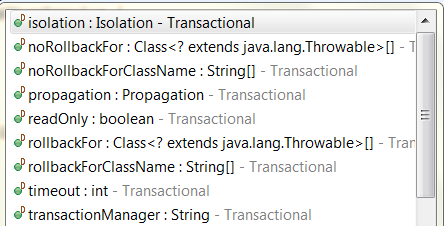
您可以使用Transactional注释,它提供了更多的控制,比如异常上的回滚,以及处理多个事务。
public interface BillingService {

    public BillingDAO getBalance();

}

@Service(value = "billingService")
@Transactional("transactionManager")
public class BillingServiceImpl implements BillingService {

    @Autowired
    private SessionFactory sessionFactory;

    @Override
    // Transactional // you can have method level transaction manager, which can be different from one method to another
    public BillingDAO getBalance(long id) {
        return sessionFactory.getCurrentSession().get(BillingDAO.class, id);
    }

}

public interface StockService {

    public StockDAO getStock();

}

@Service(value = "stockService")
@Transactional("transactionManager")
public class StockServiceImpl implements StockService {

    @Autowired
    private SessionFactory sessionFactory;

    @Autowired
    private BillingService billingService;

    @Override
    // Transactional
    public StockDAO getStock(long id) {

        // if you want to use billing related changes, use billing server which is autowired
        BillingDAO billingDAO = billingService.getBalance(id);

        return sessionFactory.getCurrentSession().get(StockDAO.class, billingDAO.getStockId());
    }

}

@Configuration
@EnableTransactionManagement
public class DatabaseConfig {

    @Autowired
    private ApplicationContext appContext;

    @Autowired
    private ApplicationProperties applicationProperties;

    @Bean
    public HikariDataSource getDataSource() {
        HikariDataSource dataSource = new HikariDataSource();

        dataSource
            .setDataSourceClassName(applicationProperties.getHibernateDatasource());
        dataSource.addDataSourceProperty("databaseName", applicationProperties.getRdbmsDatabase());
        dataSource.addDataSourceProperty("portNumber", applicationProperties.getRdbmsPort());
        dataSource.addDataSourceProperty("serverName", applicationProperties.getRdbmsServer());
        dataSource.addDataSourceProperty("user", applicationProperties.getRdbmsUser());
        dataSource.addDataSourceProperty("password", applicationProperties.getRdbmsPassword());

        return dataSource;
    }

    @Bean("transactionManager")
    public HibernateTransactionManager transactionManager() {
        HibernateTransactionManager manager = new HibernateTransactionManager();
        manager.setSessionFactory(hibernate5SessionFactoryBean().getObject());
        return manager;
    }

    @Bean(name = "sessionFactory")
    public LocalSessionFactoryBean hibernate5SessionFactoryBean() {
        LocalSessionFactoryBean localSessionFactoryBean = new LocalSessionFactoryBean();
        localSessionFactoryBean.setDataSource(appContext
                .getBean(HikariDataSource.class));
        localSessionFactoryBean.setAnnotatedClasses(BillingDAO.class);

        Properties properties = new Properties();

        // properties.put("hibernate.current_session_context_class","thread");
        // // because I am using Spring, it will take care of session context
        /*
         *
         * Spring will by default set its own CurrentSessionContext
         * implementation (the SpringSessionContext), however if you set it
         * yourself this will not be the case. Basically breaking proper
         * transaction integration.
         *
         * Ref:
         * https://stackoverflow.com/questions/18832889/spring-transactions-and-hibernate-current-session-context-class
         */
        properties.put("hibernate.dialect",
                applicationProperties.getHibernateDialect());

        properties.put("hibernate.hbm2ddl.auto", applicationProperties.getHibernateHbm2ddlAuto());
        properties.put("hibernate.show_sql", applicationProperties.getShowSql());
        // properties.put("hibernate.hbm2ddl.import_files",
        // "/resource/default_data.sql"); // this will execute only
        // when hbm2ddl.auto is set to "create" or "create-drop"
        // properties.put("connection.autocommit", "true");

        localSessionFactoryBean.setHibernateProperties(properties);
        return localSessionFactoryBean;
    }
}
页面原文内容由Stack Overflow提供。腾讯云小微IT领域专用引擎提供翻译支持
原文链接:
https://stackoverflow.com/questions/49266852
复制相关文章
相似问题
腾讯云开发者

Copyright © 2013 - 2026 Tencent Cloud. All Rights Reserved. 腾讯云 版权所有
深圳市腾讯计算机系统有限公司 ICP备案/许可证号:粤B2-20090059  粤公网安备44030502008569号
腾讯云计算(北京)有限责任公司 京ICP证150476号 | 京ICP备11018762号