
Python OpenCV中的阴影去除
Python OpenCV中的阴影去除
提问于 2017-12-11 02:07:44
我正在尝试使用Finlayson,et的熵最小化方法来实现python OpenCV中的阴影去除。艾尔:
“熵最小化的内在图像”,Finlayson等。阿尔。
我似乎无法与论文的结果相匹配。我的熵图和纸上的不匹配,我得到了错误的最小熵。
有什么想法吗?(根据要求,我有更多的源代码和文件)
#############
# LIBRARIES
#############
import numpy as np
import cv2
import os
import sys
import matplotlib.image as mpimg
import matplotlib.pyplot as plt
from PIL import Image
import scipy
from scipy.optimize import leastsq
from scipy.stats.mstats import gmean
from scipy.signal import argrelextrema
from scipy.stats import entropy
from scipy.signal import savgol_filter

root = r'\path\to\my_folder'
fl = r'my_file.jpg'

#############
# PROGRAM
#############
if __name__ == '__main__':

    #-----------------------------------
    ## 1. Create Chromaticity Vectors ##
    #-----------------------------------

    # Get Image
    img = cv2.imread(os.path.join(root, fl))
    img = cv2.cvtColor(img, cv2.COLOR_BGR2RGB)
    h, w = img.shape[:2]

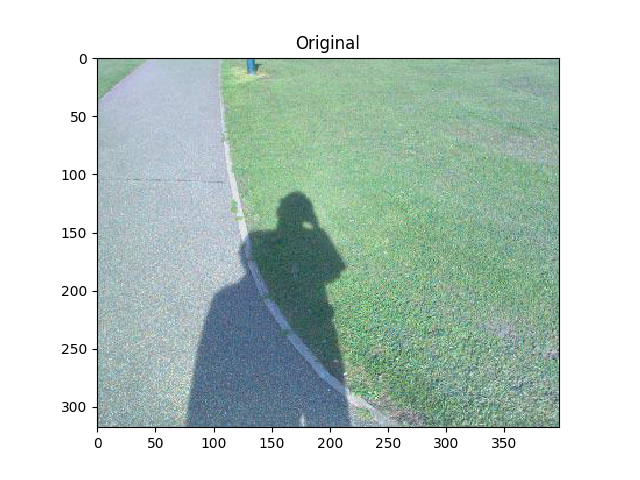
    plt.imshow(img)
    plt.title('Original')
    plt.show()

    img = cv2.GaussianBlur(img, (5,5), 0)

    # Separate Channels
    r, g, b = cv2.split(img)

    im_sum = np.sum(img, axis=2)
    im_mean = gmean(img, axis=2)

    # Create "normalized", mean, and rg chromaticity vectors
    #  We use mean (works better than norm). rg Chromaticity is
    #  for visualization
    n_r = np.ma.divide( 1.*r, g )
    n_b = np.ma.divide( 1.*b, g )

    mean_r = np.ma.divide(1.*r, im_mean)
    mean_g = np.ma.divide(1.*g, im_mean)
    mean_b = np.ma.divide(1.*b, im_mean)

    rg_chrom_r = np.ma.divide(1.*r, im_sum)
    rg_chrom_g = np.ma.divide(1.*g, im_sum)
    rg_chrom_b = np.ma.divide(1.*b, im_sum)

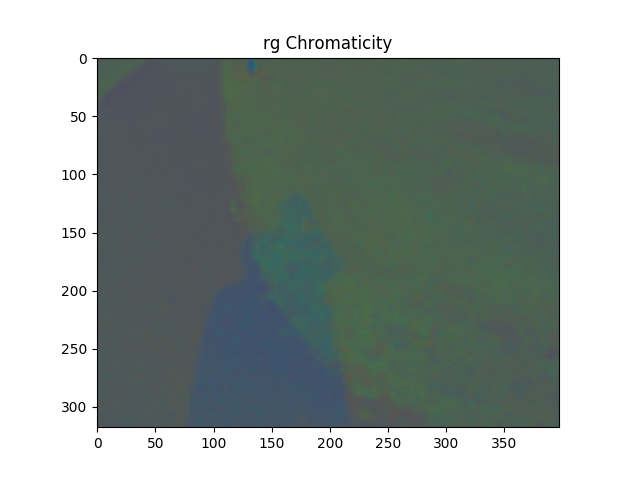
    # Visualize rg Chromaticity --> DEBUGGING
    rg_chrom = np.zeros_like(img)

    rg_chrom[:,:,0] = np.clip(np.uint8(rg_chrom_r*255), 0, 255)
    rg_chrom[:,:,1] = np.clip(np.uint8(rg_chrom_g*255), 0, 255)
    rg_chrom[:,:,2] = np.clip(np.uint8(rg_chrom_b*255), 0, 255)

    plt.imshow(rg_chrom)
    plt.title('rg Chromaticity')
    plt.show()

    #-----------------------
    ## 2. Take Logarithms ##
    #-----------------------

    l_rg = np.ma.log(n_r)
    l_bg = np.ma.log(n_b)

    log_r = np.ma.log(mean_r)
    log_g = np.ma.log(mean_g)
    log_b = np.ma.log(mean_b)

    ##  rho = np.zeros_like(img, dtype=np.float64)
    ##
    ##  rho[:,:,0] = log_r
    ##  rho[:,:,1] = log_g
    ##  rho[:,:,2] = log_b

    rho = cv2.merge((log_r, log_g, log_b))

    # Visualize Logarithms --> DEBUGGING
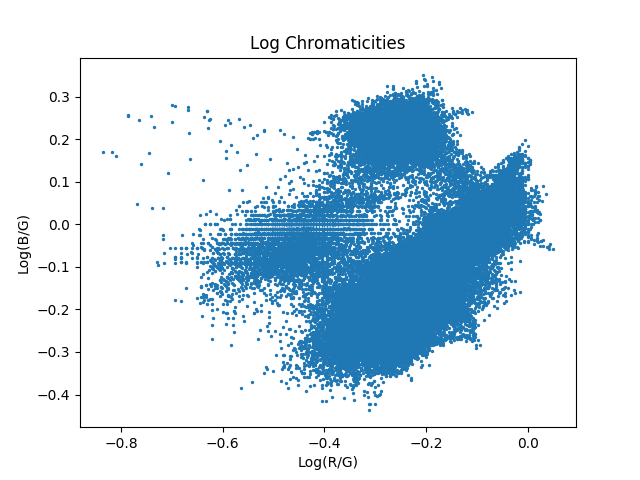
    plt.scatter(l_rg, l_bg, s = 2)
    plt.xlabel('Log(R/G)')
    plt.ylabel('Log(B/G)')
    plt.title('Log Chromaticities')
    plt.show()

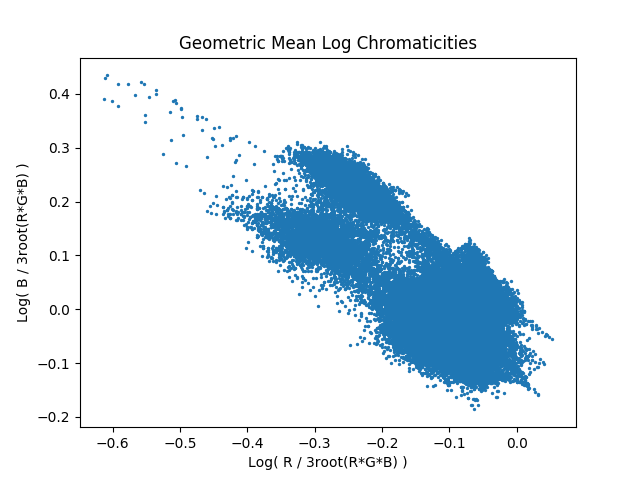
    plt.scatter(log_r, log_b, s = 2)
    plt.xlabel('Log( R / 3root(R*G*B) )')
    plt.ylabel('Log( B / 3root(R*G*B) )')
    plt.title('Geometric Mean Log Chromaticities')
    plt.show()

    #----------------------------
    ## 3. Rotate through Theta ##
    #----------------------------
    u = 1./np.sqrt(3)*np.array([[1,1,1]]).T
    I = np.eye(3)

    tol = 1e-15

    P_u_norm = I - u.dot(u.T)
    U_, s, V_ = np.linalg.svd(P_u_norm, full_matrices = False)

    s[ np.where( s <= tol ) ] = 0.

    U = np.dot(np.eye(3)*np.sqrt(s), V_)
    U = U[ ~np.all( U == 0, axis = 1) ].T

    # Columns are upside down and column 2 is negated...?
    U = U[::-1,:]
    U[:,1] *= -1.

    ##  TRUE ARRAY:
    ##
    ##  U = np.array([[ 0.70710678,  0.40824829],
    ##                [-0.70710678,  0.40824829],
    ##                [ 0.        , -0.81649658]])

    chi = rho.dot(U)

    # Visualize chi --> DEBUGGING
    plt.scatter(chi[:,:,0], chi[:,:,1], s = 2)
    plt.xlabel('chi1')
    plt.ylabel('chi2')
    plt.title('2D Log Chromaticities')
    plt.show()

    e = np.array([[np.cos(np.radians(np.linspace(1, 180, 180))), \
                   np.sin(np.radians(np.linspace(1, 180, 180)))]])

    gs = chi.dot(e)

    prob = np.array([np.histogram(gs[...,i], bins='scott', density=True)[0]
                      for i in range(np.size(gs, axis=3))])

    eta = np.array([entropy(p, base=2) for p in prob])

    plt.plot(eta)
    plt.xlabel('Angle (deg)')
    plt.ylabel('Entropy, eta')
    plt.title('Entropy Minimization')
    plt.show()

    theta_min = np.radians(np.argmin(eta))

    print('Min Angle: ', np.degrees(theta_min))

    e = np.array([[-1.*np.sin(theta_min)],
                  [np.cos(theta_min)]])

    gs_approx = chi.dot(e)

    # Visualize Grayscale Approximation --> DEBUGGING
    plt.imshow(gs_approx.squeeze(), cmap='gray')
    plt.title('Grayscale Approximation')
    plt.show()

    P_theta = np.ma.divide( np.dot(e, e.T), np.linalg.norm(e) )

    chi_theta = chi.dot(P_theta)
    rho_estim = chi_theta.dot(U.T)
    mean_estim = np.ma.exp(rho_estim)

    estim = np.zeros_like(mean_estim, dtype=np.float64)

    estim[:,:,0] = np.divide(mean_estim[:,:,0], np.sum(mean_estim, axis=2))
    estim[:,:,1] = np.divide(mean_estim[:,:,1], np.sum(mean_estim, axis=2))
    estim[:,:,2] = np.divide(mean_estim[:,:,2], np.sum(mean_estim, axis=2))

    plt.imshow(estim)
    plt.title('Invariant rg Chromaticity')
    plt.show()
输出:
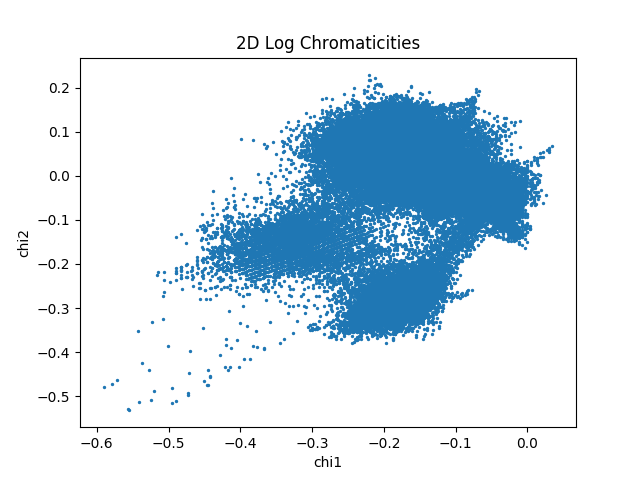
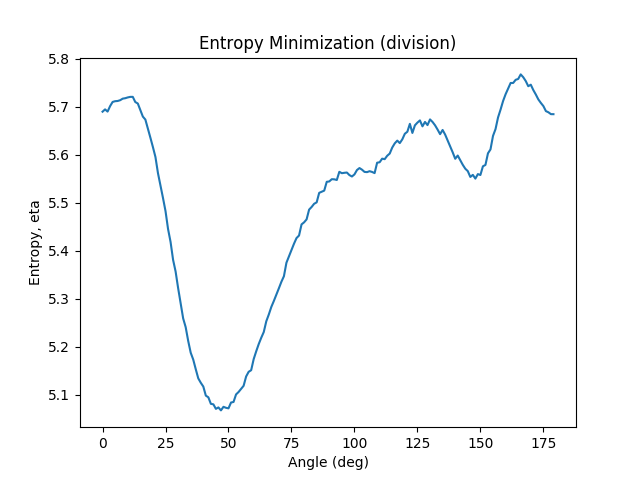
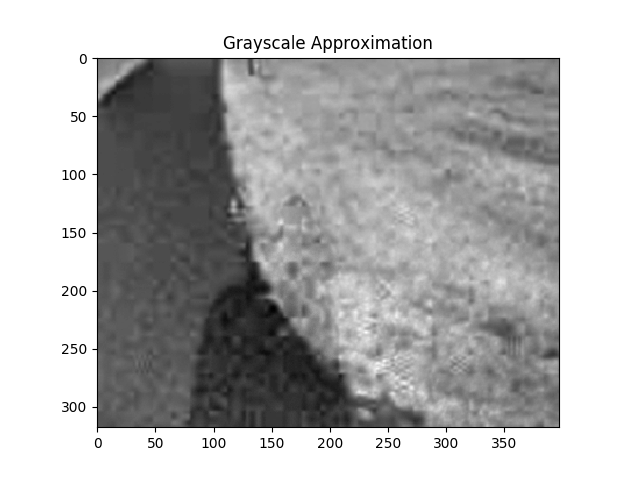
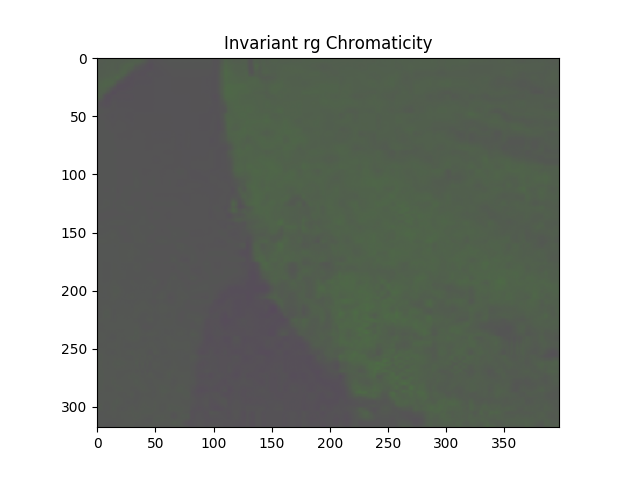
回答 1
Stack Overflow用户
发布于 2018-02-19 23:25:11
利用光照不变成像去除阴影(Ranaweera,Drew)在结果和讨论中注意到,由于JPEG压缩,来自JPEG图像和PNG图像的结果不同。因此,期望得到的结果与“熵最小化的内在图像”(Finlayson,et.A.)表演可能不合理。
我还注意到,您没有添加作者在其他文章中推荐的“额外光线”。
此外,在定义rg_chrom时,通道的顺序需要是BGR,而不是像您使用的那样。
我正在实现这篇论文,所以您的代码对我非常有用。谢谢你这么说
页面原文内容由Stack Overflow提供。腾讯云小微IT领域专用引擎提供翻译支持
原文链接:
https://stackoverflow.com/questions/47745541
复制相关文章
相似问题
腾讯云开发者

Copyright © 2013 - 2026 Tencent Cloud. All Rights Reserved. 腾讯云 版权所有
深圳市腾讯计算机系统有限公司 ICP备案/许可证号:粤B2-20090059  粤公网安备44030502008569号
腾讯云计算(北京)有限责任公司 京ICP证150476号 | 京ICP备11018762号