
Python代码-带有numpy的SVD
Python代码-带有numpy的SVD
提问于 2017-11-28 23:57:01
我想在Python的代码方面得到一些帮助。我是Python的新手。
在高级时,我从命令行读取一个(.png)文件,放入原始数组,计算svd,在命令行的基础上找到高等级的svd,与原始数组相乘,然后将文件和数组输出。
我的问题是:生成的文件被扭曲了,看起来不像我想要生成的真实图片。
我的问题是:我已经把我正在使用的代码片段放好了,你能指出我做的不对吗?
import sys
import os
import numpy
import numpy.linalg
import scipy.misc

def getOutputPngName(path, rank):
    filename, ext = os.path.splitext(path)
    return filename + '.' + str(rank) + '.png'

def getOutputNpyName(path, rank):
    filename, ext = os.path.splitext(path)
    return filename + '.' + str(rank) + '.npy'

if len(sys.argv) < 3:
    sys.exit('usage: task1.py <PNG inputFile> <rank>')

    inputfile = sys.argv[1]
    rank = int(sys.argv[2])
    outputpng = getOutputPngName(inputfile, rank)
    outputnpy = getOutputNpyName(inputfile, rank)

# Import pic.png into array im as command parameter
img = scipy.misc.imread(inputfile)

# Perform SVD on im and obtain individual matrices
P, D, Q = numpy.linalg.svd(img, full_matrices=False)

# Compute overall SVD matrix based on individual matrices
svd_decomp = numpy.dot(numpy.dot(P, numpy.diag(D)), Q)

# Keep Top entries in svd_decomp
initial = svd_decomp.argsort()
temp = numpy.array(initial)
svd_final = numpy.argpartition(temp,-rank)[-rank:]

# Multiply to obtain the best rank-k approximation of the original array
img = numpy.transpose(img)
final = (numpy.dot(svd_final,img))

#Saving the approximated array as a binary array file(1) and as a PNG file(2)
numpy.save(outputnpy, final)
scipy.misc.imsave(outputpng, final)回答 2
Stack Overflow用户
回答已采纳
发布于 2017-11-29 00:36:38
最大的问题是svd_decomp.argsort()。argsort(),没有任何参数,会使整个矩阵变得平坦,并像这样排序,这不是您想要做的事情。
实际上,您不需要进行任何排序,因为linalg的svd()函数可以为您完成排序。见文档。
每个矩阵的奇异值,按降序排序。
所以你只需做以下几件事
import sys
import os
import numpy
import numpy.linalg
import scipy.misc

def getOutputPngName(path, rank):
    filename, ext = os.path.splitext(path)
    return filename + '.' + str(rank) + '.png'

def getOutputNpyName(path, rank):
    filename, ext = os.path.splitext(path)
    return filename + '.' + str(rank) + '.npy'

if len(sys.argv) < 3:
    sys.exit('usage: task1.py <PNG inputFile> <rank>')

inputfile = sys.argv[1]
rank = int(sys.argv[2])
outputpng = getOutputPngName(inputfile, rank)
outputnpy = getOutputNpyName(inputfile, rank)

# Import pic.png into array im as command parameter
img = scipy.misc.imread(inputfile)

# Perform SVD on im and obtain individual matrices
P, D, Q = numpy.linalg.svd(img, full_matrices=True)

# Select top "rank" singular values
svd_decomp = numpy.matrix(P[:, :rank]) * numpy.diag(D[:rank]) * numpy.matrix(Q[:rank, :])

# Save the output
numpy.save(outputnpy, svd_decomp)
scipy.misc.imsave(outputpng, svd_decomp)
请注意,我们所做的只是选择“秩”奇异值,不需要排序。
示例输出:
基本图像:

等级=1
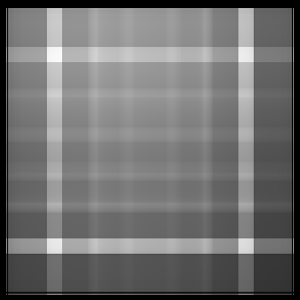
职级= 10
Stack Overflow用户
发布于 2017-12-04 20:56:53
不需要分类。只需计算你的矩阵超过秩。
svd_decomp = np.zeros((len(P), len(Q)))
for i in range(rank):
svd_decomp += D[i] * np.outer(P.T[i], Q[i])页面原文内容由Stack Overflow提供。腾讯云小微IT领域专用引擎提供翻译支持
原文链接:
https://stackoverflow.com/questions/47542927
复制相关文章
相似问题
腾讯云开发者

Copyright © 2013 - 2026 Tencent Cloud. All Rights Reserved. 腾讯云 版权所有
深圳市腾讯计算机系统有限公司 ICP备案/许可证号:粤B2-20090059  粤公网安备44030502008569号
腾讯云计算(北京)有限责任公司 京ICP证150476号 | 京ICP备11018762号