
使用Knex.js创建嵌套返回模型
我使用Knex.js查询Hapi.js路由中的MySQL数据库。以下代码工作正常,但需要嵌套查询:
{
    path: '/recipes',
    method: 'GET',
    handler: (req, res) => {
        const getOperation = Knex.from('recipes')
        // .innerJoin('ingredients', 'recipes.guid', 'ingredients.recipe')
        .select()
        .orderBy('rating', 'desc')
        .limit(10)
        .then((recipes) => {
            if (!recipes || recipes.length === 0) {
                res({
                    error: true,
                    errMessage: 'no recipes found'
                });
            }

            const recipeGuids = recipes.map(recipe => recipe.guid);
            recipes.forEach(r => r.ingredients = []);
            const getOperation2 = Knex.from('ingredients')
                .whereIn('recipe', recipeGuids)
                .select()
                .then((ingredients) => {
                    recipes.forEach(r => {
                        ingredients.forEach(i => {
                            if (i.recipe === r.guid) {
                                r.ingredients.push(i);
                            }
                        });
                    });
                    res({
                        count: recipes.length,
                        data: recipes
                    });
                });
        });
    }
}
是否有一种方法可以使用Knex.js创建一个返回模型,该模型的嵌套对象与父的id/guid相匹配,从而使我没有嵌套的承诺?
回答 3
Stack Overflow用户
发布于 2017-11-28 01:20:50
简短回答:不。
使用Knex,您可以检索与SQL相同的数据,SQL是基于记录的,而不是基于对象的,所以您可以使用一个join来只进行一个选择来检索具有元素的单个数组:菜谱、guids、成分。这将重复每个成分的配方& guid,您可以通过使用嵌套对象来避免这种情况。(有关此问题的示例,请参见下面@Fazal的回答。)
作为另一种选择,您可以将成分作为“blob”字段存储在配方表中,但我不认为MySQL将允许您创建一个数组字段,因此在检索数据时,必须将字段转换为数组。并在将其更新到表之前将其从Array中转换出来。喜欢:storableData = JSON.stringify(arrayData)和arrayData = JSON.parse(storableData)
不过,我还建议您做一些其他的事情来帮助您改进代码。(是的,我知道,这并不是真正的问题):
- 将路由功能与数据处理分开。
- 此外,将数据操作功能与检索分开。
- 使用抛出& .catch来创建和处理不成功的响应。
路由、数据检索、数据操作的分离使得测试、调试和未来理解变得更加容易,因为每个功能都有更多的原子用途。
抛出/.捕获不成功的进程条件使得拥有更全面的错误处理变得更加简单,因为它允许您(大多数情况下)在路由器响应处理中放置一个.catch (Hapi.js甚至可以为您执行此.catch??)。
另外,请参阅我为日志记录错误添加的另一个.catch和.on('query-error'。您可能要使用不同的日志机制,而不是控制台。我用温斯顿。请注意,.on('query-error'不是.catch。仍然会抛出一个错误(),并且必须在某个地方进行处理,这只会给您提供与源附近的故障有关的良好信息。
(对不起,下面的代码未经测试)
path: '/recipes',
method: 'GET',
handler: (req, res) => {
        return getRecipeNIngredients()
            .then((recipes) => {
                res({
                    count: recipes.length,
                    data: recipes
                });
            })
            .catch((ex) => {
                res({
                    error: true,
                    errMessage: ex.message
                });
            });
};

    function getRecipeNIngredients() {
        let recipes = null;
        return getRecipes()
            .then((recipeList) => {
                recipes = recipeList;
                const recipeGuids = recipes.map(recipe => recipe.guid);
                recipes.forEach(r => r.ingredients = []);
                return getIngredients(recipeGuids);
            })
            .then((ingredients) => {
                recipes.forEach(r => {
                    ingredients.forEach(i => {
                        if (i.recipe === r.guid) {
                            r.ingredients.push(i);
                        }
                    });
                });
                return recipes;
            })
            .catch((ex) => {
                console.log(".getRecipeNIngredients ERROR ex:",ex); // log and rethrow error.
                throw ex;
            });
    };

    function getRecipes() {
        return Knex.from('recipes')
            // .innerJoin('ingredients', 'recipes.guid', 'ingredients.recipe')
            .select()
            .orderBy('rating', 'desc')
            .limit(10)
            .on('query-error', function(ex, obj) {
                console.log("KNEX getRecipes query-error ex:", ex, "obj:", obj);
            })
            .then((recipes) => {
                if (!recipes || recipes.length === 0) {
                    throw new Error('no recipes found')
                }
            })
    };
    function getIngredients(recipeGuids) {
        return Knex.from('ingredients')
            .whereIn('recipe', recipeGuids)
            .select()
            .on('query-error', function(ex, obj) {
                console.log("KNEX getIngredients query-error ex:", ex, "obj:", obj);
            })
    };
我希望这是有用的!加里。
Stack Overflow用户
发布于 2019-11-26 08:56:42
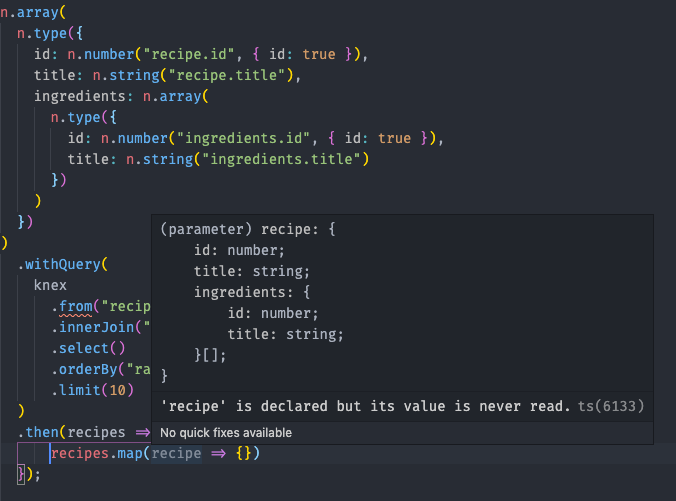
我创建了一个库,它返回嵌套对象,即使它有类型的类型。
import * as n from 'nested-knex';

n.array(
  n.type({
    id: n.number("recipe.id", { id: true }),
    title: n.string("recipe.title"),
    ingredients: n.array(
      n.type({
        id: n.number("ingredients.id", { id: true }),
        title: n.string("ingredients.title")
      })
    )
  })
)
  .withQuery(
    knex
      .from("recipes")
      .innerJoin("ingredients", "recipes.guid", "ingredients.recipe")
      .select()
      .orderBy("rating", "desc")
      .limit(10)
  )
  .then(recipes => {});
所以菜谱甚至有类型
Stack Overflow用户
发布于 2017-11-28 18:16:56
您可以轻松地避免嵌套查询。只需使用子查询作为-
knex.select('*')
  .from(function () {
    this.select('*').from('recipes').limit(10).as('recipes'); // limit here
  })
  .leftJoin('ingredients', 'ingredients.recipe_id', 'recipes.guid')
  .then((rec) => {
    console.log(rec);
  })
你看..。只有几行代码。
https://stackoverflow.com/questions/47503627
复制相似问题
腾讯云开发者

Copyright © 2013 - 2026 Tencent Cloud. All Rights Reserved. 腾讯云 版权所有
深圳市腾讯计算机系统有限公司 ICP备案/许可证号:粤B2-20090059  粤公网安备44030502008569号
腾讯云计算(北京)有限责任公司 京ICP证150476号 | 京ICP备11018762号