
多幅图像及其调色板的算法
对于一个项目,我正在寻找一个算法,以将许多图像转换为调色板图像,它可以共享相同的调色板。
短篇小说
Given:
- 一个图像列表(RGB),它已经具有应该使用的最终颜色。
结果:
- 图像列表(已指示)
- 调色板列表
- 多个RGB图像通过使用不同的调色板,可以转换为one表示的图像。
- 我想使用所需的最小数量的图像和最小数量的调色板。
Limitations:
- 有最多的n个调色板
- 每个调色板最多有m种颜色。
- 在结果中可以生成最大的u图像。
我的问题是什么:
- 我不知道如何构建这个算法,这样它就可以判断以前的任何决策对于将来的问题是否是错误的。(见下文)
- 我不知道如何解决调色板颜色和图像数据的重新排列问题,因为重新排列one图像数据可能会导致后续的重新排列问题,最终可能导致无休止的重新排列战斗:D (见下文)
以下是完整的故事
结果
这里应该是结果:在本例中,一个颜色索引表(也称为指示图像)使用两个不同的调色板生成两个不同的RGB图像。
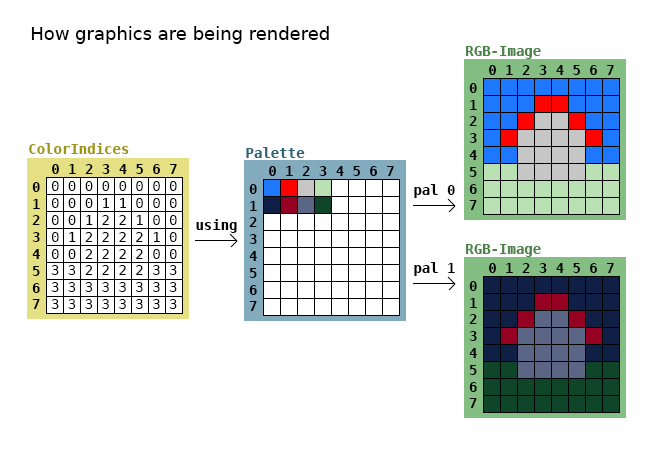
第一步
由于输入文件都是RGB图像,我们需要首先将它们转换为调色板,并将它们与颜色索引匹配。
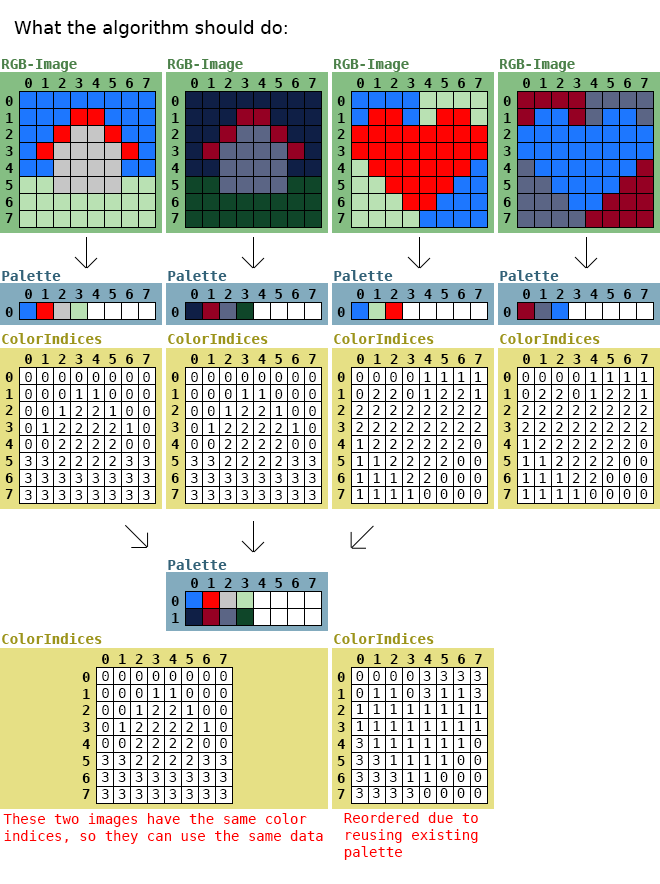
在下面的图像中,您可以看到算法如何开始处理前三幅图像:
- 将转换为调色板、和
- 检查2图像是否共享相同的颜色索引,如果是,我们可以重用颜色索引,但创建调色板(不需要!)
- 否则,我们可以将添加、四个新颜色、到第一个调色板、和,创建一个新的颜色索引。(未在此图像中显示)
- 对于第三个图像,我们找到了一个已经包含所有所需颜色的调色板,因此我们决定重用调色板,但是重新排列颜色索引以匹配现有的调色板。
让我们把事情弄复杂!
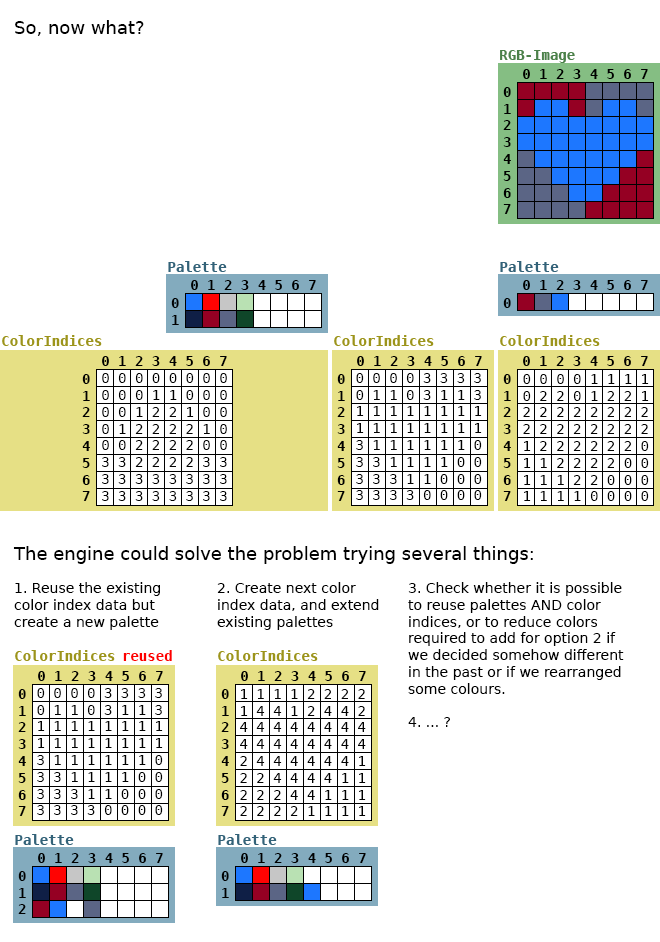
到目前一切尚好。但是,我们应该如何继续最后的形象呢?它可以共享上一个调色板的颜色索引,但它不匹配任何现有的调色板。实际上,它不匹配任何现有的调色板。
下面的图片描述了--的实际问题:如何决定什么是最适合图像的?创建一个新的调色板,创建一个新的颜色索引,如果我们过去的决定不是这样,那么一切都会好呢?我们怎么知道呢?
重排
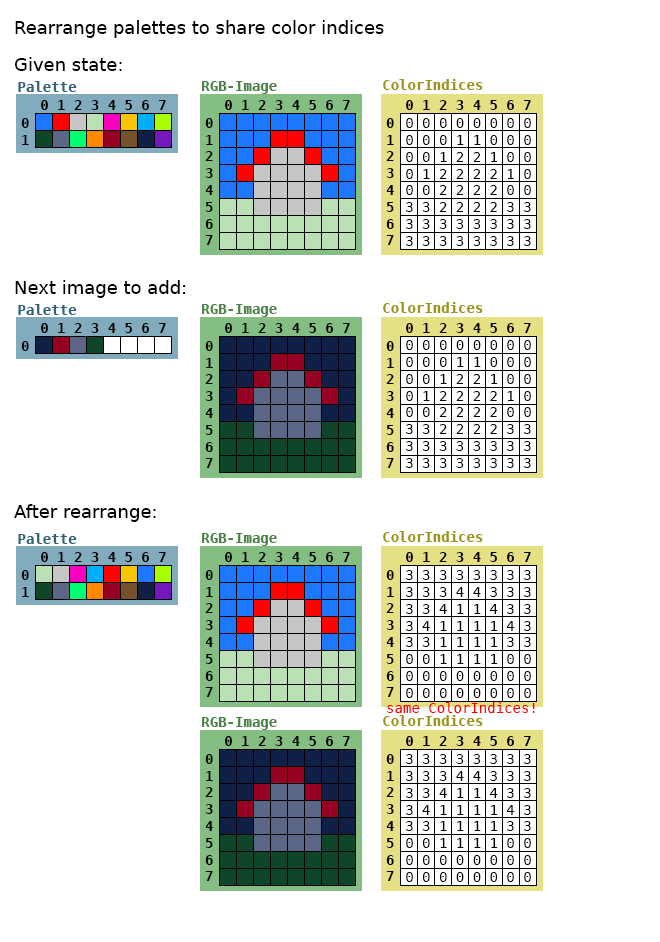
好吧,这四张照片仍然是简单的例子。让我们想象一下算法已经处理了很多图像,并生成了一个调色板。我们输入图像列表中的下一个图像找到了一个匹配的调色板,因此它可以很容易地创建新的颜色索引,并且很好。但是:结果应该是最少的图像和调色板,所以可以有另一种方式!
通过检查所有以前的图像,我们发现,我们可以使用上一个图像的现有调色板和颜色索引,但是我们必须重新排列调色板。重新排列要求我们检查所有的以前的图像,他们是否对重新排列的调色板是否满意。
如您所见:最后一步中的调色板已被重新排列,以与下面相同的颜色相匹配。但这可能是一个复杂的过程,重新安排了许多其他图像,以及。
预先感谢您关于如何实现这样一个算法、搜索什么或者已经存在的算法产生几乎相同结果的提示。
编辑
这里是一个真实的例子图像,一些图形被盗,从一个古老的阿米加游戏:
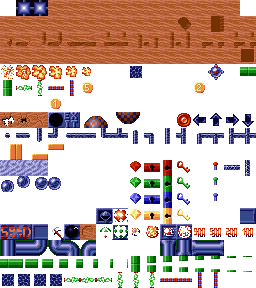
这个项目集包含256 RGB图像,16*16像素。这些图像中的每一幅都是应该由算法处理的块。前几个图像是相等的,但是后面有几个其他的图像。可以将调色板分解为,最多有6个调色板,有16种颜色的,但限制总是第一种颜色是透明的。(实际上每个调色板有15种颜色)
在本例中,对于4种颜色的键、门和钻石,很容易重用相同的ColorIndices。
这是一个生成调色板的示例:
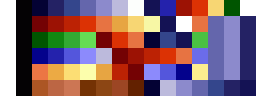
编辑第2号
下面是我从一个老游戏中学到的另一个例子:
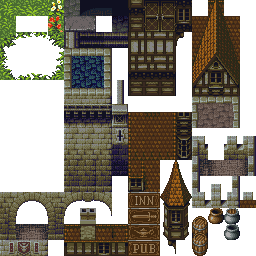
调色板看起来就像这个:

回答 1
Stack Overflow用户
发布于 2017-09-28 07:35:48
看起来,我对示例输入的第一种天真的方法甚至比您的引用更好:
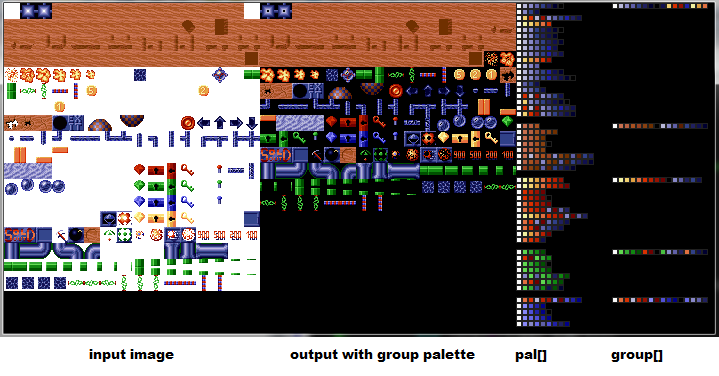
左边是您的输入图像,中间是使用全局group[]调色板的雪碧输出,而不是空的精灵。右边是按组排序的唯一调色板,右边的大多数列是代表该组的组调色板。
如您所见,我只有5x16色调色板,而不是6。第一个颜色索引0是为透明颜色保留的(我硬编码白色,因为我不能访问原始索引颜色)。算法如下:
- init精灵 每个精灵都必须使用它的调色板和全局调色板索引。
- 结构
为此我需要两个调色板列表。一个是同时使用的所有唯一调色板的列表(整个图像/帧),我称之为
pal[],另一个称为group[],并保存要使用的最终合并调色板。 pal[]填充 所以从所有精灵身上提取所有的调色板..。测试唯一性(这只是为了提高O(n^2)搜索的性能)。为此,我对调色板进行了排序,以便在O(n)而不是O(n^2)中直接比较它们。- 分组调色板
使用第一个未分组的调色板并使用它创建新的组。然后检查所有其他未分组调色板(
O(n^2)),如果合并,则合并它们。我的意思是,经过处理的pal[i]至少有50%的颜色存在于group[j]中,而所有缺失的颜色仍然可以容纳到group[j]中。如果大小写将pal[i]标记为group[j]成员并将缺失的颜色添加到group[j]中。然后重复#4,直到没有剩下未分组的调色板。 - 现在,
group[]重新索引精灵以匹配 palettes
这里是以下简单的C++代码:
//---------------------------------------------------------------------------
const int _sprite_size=16;      // resolution
const int _palette_size=16;     // colors per palette
//---------------------------------------------------------------------------
class palette   // sprite palette
    {
public:
    int pals;                   // num of colors
    DWORD pal[_palette_size];   // palete colors
    int group;                  // group index

    // inline constructors (you can ignore this)
    palette()   {}
    palette(palette& a) { *this=a; }
    ~palette()  {}
    palette* operator = (const palette *a) { *this=*a; return this; }
    //palette* operator = (const palette &a) { ...copy... return this; }

    void draw(TCanvas *can,int x,int y,int sz,int dir)  // render palette to GDI canvas at (x,y) with square size sz and direction dir = { 0,90,180,270 } deg
        {
        int i;
        color c;
        for (i=0;i<pals;i++)
            {
            c.dd=pal[i]; rgb2bgr(c);
            can->Pen->Color=TColor(0x00202020);
            can->Brush->Color=TColor(c.dd);
            can->Rectangle(x,y,x+sz,y+sz);
            if (dir==  0) x+=sz;
            if (dir== 90) y-=sz;
            if (dir==180) x-=sz;
            if (dir==270) y+=sz;
            }
        }
    void sort() // bubble sort desc
        {
        int i,e,n=pals; DWORD q;
        for (e=1;e;n--)
         for (e=0,i=1;i<n;i++)
          if (pal[i-1]<pal[i])
           { q=pal[i-1]; pal[i-1]=pal[i]; pal[i]=q; e=1; }
        }
    int operator == (palette &a) { if (pals!=a.pals) return 0; for (int i=0;i<pals;i++) if (pal[i]!=a.pal[i]) return 0; return 1; }
    int merge(palette &p)   // return true and merge if this and p are similar and mergable palettes
        {
        int equal=0,mising=0,i,j;
        DWORD m[_palette_size]; // mising palette colors
        for (i=0;i<p.pals;i++)
            {
            m[mising]=p.pal[i];
            mising++;
            for (j=0;j<pals;j++)
             if (p.pal[i]==pal[j])
                {
                mising--;
                equal++;
                }
            }
        if (equal+equal<p.pals) return 0;   // at least half of colors must be present
        if (pals+mising>_palette_size) return 0;    // and the rest must fit in
        for (i=0;i<mising;i++) { pal[pals]=m[i]; pals++; }
        return 1;
        }
    };
//---------------------------------------------------------------------------
class sprite    // sprite
    {
public:
    int xs,ys;                              // resoltuon
    BYTE pix[_sprite_size][_sprite_size];   // pixel data (indexed colors)
    palette pal;                            // original palette
    int gpal;                               // global palette

    // inline constructors (you can ignore this)
    sprite()    {}
    sprite(sprite& a) { *this=a; }
    ~sprite()   {}
    sprite* operator = (const sprite *a) { *this=*a; return this; }
    //sprite* operator = (const sprite &a) { ...copy... return this; }
    };
//---------------------------------------------------------------------------
List<sprite> spr;   // all sprites
List<palette> pal;  // all palettes
List<palette> group;// merged palettes
picture pic0,pic1,pic2; // input, output and debug images
//---------------------------------------------------------------------------
void compute() // this is the main code you need to call/investigate
    {
    bmp=new Graphics::TBitmap;
    bmp->HandleType=bmDIB;
    bmp->PixelFormat=pf32bit;

    int e,i,j,ix,x,y,xx,yy;
    palette p,*pp;
    DWORD c;
    // [load image and convert to indexed 16 color sprites]
    // you can ignore this part of code as you already got your sprites with palettes...
    pic0.load("SNES_images.png");
    // process whole image
    spr.num=0; sprite s,*ps;
    for (y=0;y<pic0.ys;y+=_sprite_size)
     for (x=0;x<pic0.xs;x+=_sprite_size)
        {
        // let white transparent color be always index 0
        s.pal.pals=1;
        s.pal.pal[0]=0x00F8F8F8;
        s.gpal=-1;
        e=0;
        // proces sprite image
        for (yy=0;yy<_sprite_size;yy++)
         for (xx=0;xx<_sprite_size;xx++)
            {
            // match color with palette
            c=pic0.p[y+yy][x+xx].dd&0x00F8F8F8; // 15 bit RGB 5:5:5 to 32 bit RGB
            for (ix=-1,i=0;i<s.pal.pals;i++)
             if (s.pal.pal[i]==c) { ix=i; break; }
            // add new color if no match found
            if (ix<0)
                {
                if (s.pal.pals>=_palette_size)
                    {
                    // fatal error: invalid input data
                    ix=-1;
                    break;
                    }
                 ix=s.pal.pals;
                 s.pal.pal[s.pal.pals]=c;
                 s.pal.pals++;
                 }
            s.pix[yy][xx]=ix; e|=ix;
            }
        if (e) spr.add(s);  // ignore empty sprites
        }

    // [global palette list]
    // here starts the stuff you need
    // cretae list pal[] of all unique palettes from sprites spr[]
    pal.num=0;
    for (i=0,ps=spr.dat;i<spr.num;i++,ps++)
        {
        p=ps->pal; p.sort(); ix=-1;
        for (x=0;x<pal.num;x++) if (pal[x]==p) { ix=x; break; }
        if (ix<0) { ix=pal.num; pal.add(p); }
        ps->gpal=ix;
        }

    // [palette gropus]
    // creates a list group[] with merged palette from all the pal[] in the same group
    group.num=0;
    for (i=0;i<pal.num;i++) pal[i].group=-1;
    for (i=0;i<pal.num;i++)
        {
        if (pal[i].group<0)
            {
            pal[i].group=group.num; group.add(pal[i]);
            pp=&group[group.num-1];
            }
        for (j=i+1;j<pal.num;j++)
         if (pal[j].group<0)
          if (pp->merge(pal[j]))
           pal[j].group=pp->group;
        }

    // [update sprites to match group palette]
    for (i=0,ps=spr.dat;i<spr.num;i++,ps++)
        {
        pp=&pal[ps->gpal];  // used global palette
        ps->gpal=pp->group; // update gpal in sprite to point to group palette (you can copy group palette into sprite instead)
        pp=&group[ps->gpal];// used group palette
        // compute reindex table
        int idx[_palette_size];
        for (x=0;x<ps->pal.pals;x++)
         for (idx[x]=0,y=0;y<pp->pals;y++)
          if (ps->pal.pal[x]==pp->pal[y])
           {idx[x]=y; break; }
        // proces sprite image
        for (yy=0;yy<_sprite_size;yy++)
         for (xx=0;xx<_sprite_size;xx++)
          if (ps->pix[yy][xx])  // ignore transparent pixels
           ps->pix[yy][xx]=idx[ps->pix[yy][xx]];
        }

    // [render groups]
    e=6;
    xx=(e*_palette_size);
    yy=(e*pal.num);
    pic2.resize(xx+e+xx,yy);
    pic2.clear(0);
    for (x=0,y=0,ix=0;ix<group.num;ix++,y+=e)
        {
        group[ix].draw(pic2.bmp->Canvas,x+xx,y,e,0);
        for (i=0;i<pal.num;i++)
         if (pal[i].group==ix)
            {
            pal[i].draw(pic2.bmp->Canvas,x,y,e,0);
            y+=e;
            }
        }

    // [render sprites to pic1 for visual comparison using merged palettes]
    pic1.resize(pic0.xs,pic0.ys);
    pic1.clear(0);
    for (x=0,y=0,i=0,ps=spr.dat;i<spr.num;i++,ps++)
        {
        pp=&group[ps->gpal];
        // proces sprite image
        for (yy=0;yy<_sprite_size;yy++)
         for (xx=0;xx<_sprite_size;xx++)
          if (ps->pix[yy][xx])  // ignore transparent pixels
           pic1.p[y+yy][x+xx].dd=pp->pal[ps->pix[yy][xx]];
        x+=_sprite_size; if (x+_sprite_size>pic1.xs) { x=0;
        y+=_sprite_size; if (y+_sprite_size>pic1.ys) break; }
        }
//---------------------------------------------------------------------------只需忽略VCL和GDI呈现内容即可。
我使用我自己的图片类来处理图像,所以有些成员是:
xs,ys是以像素为单位的图像大小。
p[y][x].dd是(x,y)位置的像素,为32位整数类型。
clear(color)用color清除整个图像
resize(xs,ys)将图像调整为新分辨率
bmp是VCL封装的带有Canvas访问的GDI位图。
pf保存图像的实际像素格式:
enum _pixel_format_enum
    {
    _pf_none=0, // undefined
    _pf_rgba,   // 32 bit RGBA
    _pf_s,      // 32 bit signed int
    _pf_u,      // 32 bit unsigned int
    _pf_ss,     // 2x16 bit signed int
    _pf_uu,     // 2x16 bit unsigned int
    _pixel_format_enum_end
};color和像素的编码方式如下:
union color
    {
    DWORD dd; WORD dw[2]; byte db[4];
    int i; short int ii[2];
    color(){}; color(color& a){ *this=a; }; ~color(){}; color* operator = (const color *a) { dd=a->dd; return this; }; /*color* operator = (const color &a) { ...copy... return this; };*/
    };
乐队包括:
enum{
    _x=0,   // dw
    _y=1,

    _b=0,   // db
    _g=1,
    _r=2,
    _a=3,

    _v=0,   // db
    _s=1,
    _h=2,
    };
我还使用了我的动态列表模板,因此:
List<double> xxx;与double xxx[];相同
xxx.add(5);将5添加到列表的末尾
xxx[7]访问数组元素(安全)
xxx.dat[7]访问数组元素(不安全但快速直接访问)
xxx.num是数组的实际使用大小。
xxx.reset()清除数组并设置xxx.num=0
xxx.allocate(100)为100项预先分配空间
https://stackoverflow.com/questions/46410132
复制相似问题
腾讯云开发者

Copyright © 2013 - 2026 Tencent Cloud. All Rights Reserved. 腾讯云 版权所有
深圳市腾讯计算机系统有限公司 ICP备案/许可证号:粤B2-20090059  粤公网安备44030502008569号
腾讯云计算(北京)有限责任公司 京ICP证150476号 | 京ICP备11018762号