
关于加速解决旅行商问题的动态规划的建议?
关于加速解决旅行商问题的动态规划的建议?
提问于 2017-09-20 09:00:33
我正在学习一个在线课程,其中一个任务是实现一个动态规划算法来解决旅行推销员问题(TSP)。我的Python实现适用于小型案例(~5个城市),但对于25个城市的“实际”应用程序来说,它似乎非常慢。我正在寻找加速算法的建议。
该算法在以下摘录中进行了描述:

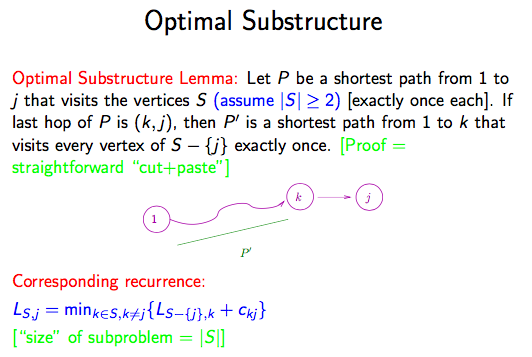
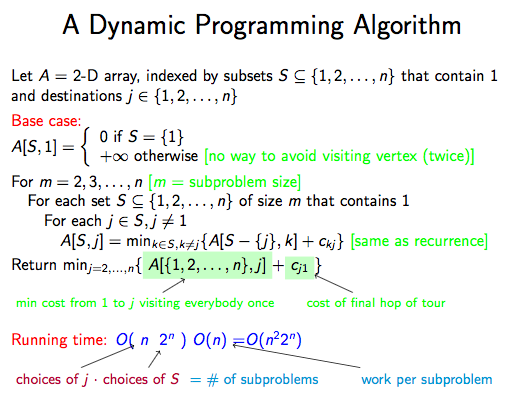
在http://www.geeksforgeeks.org/travelling-salesman-problem-set-1/上也描述了动态规划的解决方案,并给出了其他参考。
任务的问题陈述是:
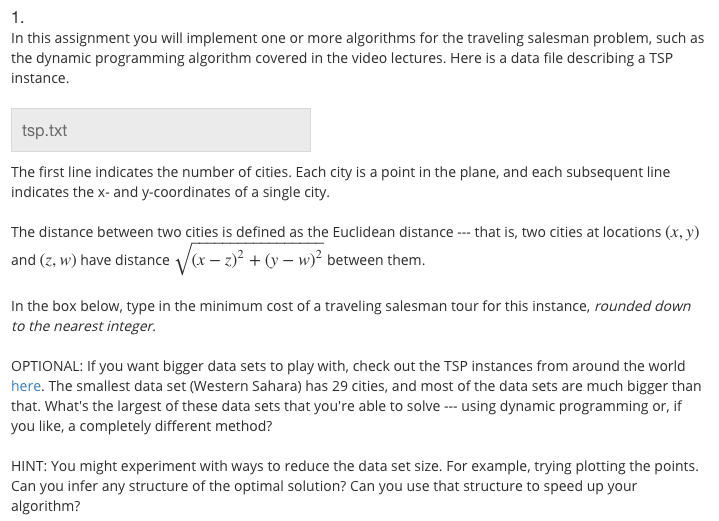
我使用一个用于数组DataFrame的熊猫A对象实现了伪代码。由于集合是不可理解的,不能用作索引,所以我使用元组,注意排序,以便使它们成为集合的唯一表示形式。下面是代码以及几个越来越大的测试用例:
import functools
from itertools import combinations
import numpy as np
import pandas as pd
from cached_property import cached_property
import pytest


def powerset_list(s):
    '''Return a list of tuples representing all subsets of s'''
    return functools.reduce(lambda x, y: x + y, [list(combinations(s, r)) for r in range(len(s)+1)])


class Graph(object):
    def __init__(self, edges):
        self.edges = edges

    @cached_property
    def nodes(self):
        _nodes = set()
        for edge in self.edges:
            u, v, weight = edge
            _nodes.add(u)
            _nodes.add(v)
        return list(_nodes)

    @cached_property
    def W(self):
        '''Matrix of edge weights'''
        n = len(self.nodes)
        w = np.full((n, n), np.inf)
        np.fill_diagonal(w, 0)
        w = pd.DataFrame(w, index=range(1, n+1), columns=range(1, n+1))
        for edge in self.edges:
            u, v, weight = edge
            w.set_value(u, v, weight)
            w.set_value(v, u, weight)
        return w

    def tsp(self):
        '''Solve the traveling salesman problem using a dynamic programming method'''
        n = len(self.nodes)
        sets = [(1,) + x for x in powerset_list(range(2, n+1))]
        A = pd.DataFrame(np.full((len(sets), n), np.inf), index=sets, columns=range(1, n+1))
        A.set_value((1,), 1, 0)
        for m in range(2, n+1):
            for S in [(1,) + perm for perm in combinations(range(2, n+1), m-1)]:
                for j in set(S) - set([1]):
                    S_min_j = tuple(sorted(set(S) - set([j])))
                    A.set_value(S, j, min(A.get_value(S_min_j, k) + self.W.get_value(k, j) for k in S_min_j))
        return min(A.get_value(tuple(range(1, n+1)), j) + self.W.get_value(j, 1) for j in range(2, n+1))


@pytest.fixture
def edges_geeksforgeeks():
    '''Edges from the example graph on http://www.geeksforgeeks.org/travelling-salesman-problem-set-1/'''
    return [(1, 2, 10), (1, 3, 15), (1, 4, 20), (2, 3, 35), (2, 4, 25), (3, 4, 30)]

def test_tsp(edges_geeksforgeeks):
    graph = Graph(edges_geeksforgeeks)
    min_cost = graph.tsp()
    assert min_cost == 80


def dist(coord1, coord2):
    return np.linalg.norm(np.array(coord1) - np.array(coord2))

def edges_from_coords(filename):
    with open(filename) as f:
        coords = [tuple(map(float, line.split())) for line in f.read().splitlines()[1:]]
    nodes = list(range(1, len(coords) + 1))
    coords = dict(zip(nodes, coords))
    return [(comb[0], comb[1], dist(coords[comb[0]], coords[comb[1]])) for comb in combinations(nodes, 2)]

@pytest.mark.parametrize("test_input, expected", [("Hulburd_1.txt", 10.24), ("Hulburd_2.txt", 12.36), ("Hulburd_3.txt", 14.00)])
def test_Hulburd(test_input, expected):
    '''Test data supplied by Eric Hulburd on the course forum'''
    edges = edges_from_coords(test_input)
    graph = Graph(edges)
    min_cost = graph.tsp()
    assert np.around(min_cost, decimals=2) == expected

@pytest.fixture
def edges_cities():
    return edges_from_coords('tsp.txt')

@pytest.mark.skip(reason="This takes too long to run")
def test_tsp_cities(edges_cities):
    graph = Graph(edges_cities)
    min_cost = graph.tsp()
    print("The minimum cost rounded down to the nearest integer is {}".format(int(np.floor(min_cost))))


if __name__ == "__main__":
pytest.main([__file__, "-s"])测试中使用的文件是1.txt、2.txt、3.txt和实际赋值的主文件tsp.txt。问题是,涉及tsp.txt的最后一个(跳过的)测试运行时间太长。
我该如何加快算法的速度?在课程论坛上,有人说他们用位掩码和并行化让它在3分钟内运行;另一个建议是简化数组的索引,而不是使用元组。
回答 1
Stack Overflow用户
回答已采纳
发布于 2017-09-20 21:55:36
提高绩效的几点建议:
- 不要使用元组,而是使用32位ints来表示您的子集--如果您的城市不超过32个,这就足够了。
- 在每一步中,您只需要对大小为m-1的子集进行以前的计算值(您不需要存储任何大小为m-2、m-3等的子集的值)--这可能会大大减少您的内存使用量。
页面原文内容由Stack Overflow提供。腾讯云小微IT领域专用引擎提供翻译支持
原文链接:
https://stackoverflow.com/questions/46317631
复制相关文章
相似问题
腾讯云开发者

Copyright © 2013 - 2026 Tencent Cloud. All Rights Reserved. 腾讯云 版权所有
深圳市腾讯计算机系统有限公司 ICP备案/许可证号:粤B2-20090059  粤公网安备44030502008569号
腾讯云计算(北京)有限责任公司 京ICP证150476号 | 京ICP备11018762号