
Haskell中国剩余定理
Haskell中国剩余定理
提问于 2017-09-17 03:01:13
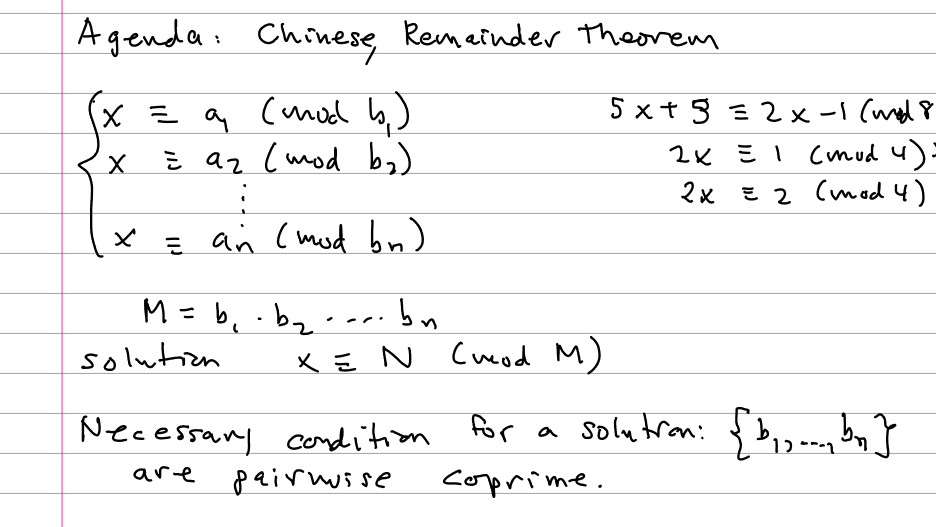
我理解,为了使这个函数工作,crtHasSolution必须是真的,首先,我很难证明n可以是一个解决方案--在haskell中如何编写或检查它的任何想法或技巧?
我知道,N的条件是,它必须大于或等于0,并且小于m,这是所有模基的乘积。
crtHasSolution :: [Integer] -> [Integer] -> Bool
crtHasSolution as ms = length as > 0 &&
                       length ms > 0 &&
                       length as == length ms &&
                       all (>=0) as &&
                       all (>=2) ms &&
                       pairwise_coprime ms

-- Is a given number a solution to a CRT problem?
-- usage: crtIsSolution n as ms = ans
-- assures: ans == True, if crtHasSolution as ms == True and n is a solution
--          ans == False, otherwise

crtIsSolution :: Integer -> [Integer] -> [Integer] -> Bool
crtIsSolution n as ms = crtHasSolution as ms &&
                        n >= 0 &&
                        n < m
                        where m =
回答 1
Stack Overflow用户
发布于 2017-09-17 03:49:45
来自维基百科
很容易检查
x的值是否是一个解决方案:按每个x计算x的欧几里德除法的剩余部分就足够了。
如果x `mod` m_i /= a_i用于任何i,那么x不是解决方案。
这有点家庭作业的味道,所以我将给您一些关于crtIsSolution n as ms实现的主要问题,而不是给您一个计算这个问题的一行。
- 如果
n和as是空的,那么ms是一个解决方案吗? - 如果您可以计算
n `mod` m_0 == a_0和n是否是ms_0和as_0的解决方案,那么n是否是m_0:ms_0和a_0:as_0的解决方案?
页面原文内容由Stack Overflow提供。腾讯云小微IT领域专用引擎提供翻译支持
原文链接:
https://stackoverflow.com/questions/46260241
复制相关文章
相似问题
腾讯云开发者

Copyright © 2013 - 2026 Tencent Cloud. All Rights Reserved. 腾讯云 版权所有
深圳市腾讯计算机系统有限公司 ICP备案/许可证号:粤B2-20090059  粤公网安备44030502008569号
腾讯云计算(北京)有限责任公司 京ICP证150476号 | 京ICP备11018762号