
C:打印数组中点的水平、垂直和斜值。
C:打印数组中点的水平、垂直和斜值。
提问于 2017-09-08 09:13:50
请原谅我的语法错误。
我会尽量解释我的问题是什么。
我正在做一个二维数组,从数组的一个点开始,我应该打印两个水平的,垂直的和斜的附近的单元格。
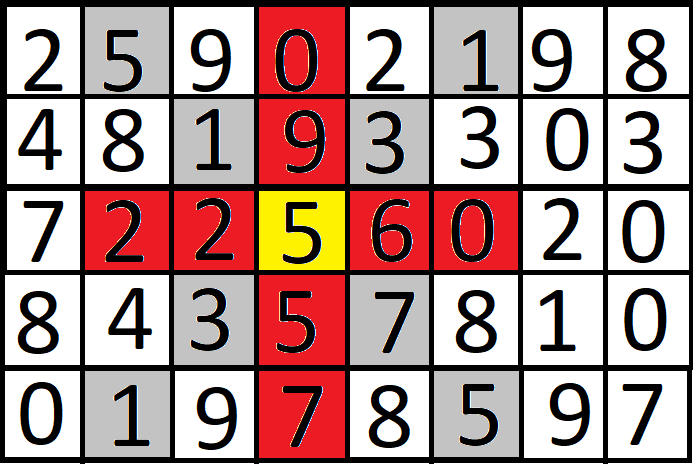
黄色细胞是起点,红色和灰色细胞是我要打印的细胞。
我发现的解决方案是制作4种不同的算法:1种打印水平细胞,另一种打印垂直细胞,另一种打印斜细胞(从右到左),另一种打印斜细胞(从左到右)。
所以我正在解决这个问题,就像我在处理向量一样,我认为这是一个非常糟糕的解决方案。
水平打印的例子:
int startPos=0;
int counter=5; //Five and not four, because it includes the start point that hasn't to be printed

if(column >= 2) startPos = column - 2;
else counter -= (2-column);
for(i=0; i<counter; i++){
    if(startPos + i != column){ //the start point hasn't to be printed
        printf("m-array[%d][%d] ", row, startPos + i);
    }
}
我从起点返回两个,然后打印下四个单元格。
回答 1
Stack Overflow用户
回答已采纳
发布于 2017-09-08 12:15:14
如果您希望4种“不同”算法为1,则只需找到它们之间共享的逻辑,并创建一个实现该逻辑的函数。
共享的部分是他们都打印了一行。每一行从不同的地方开始,以不同的方向打印。我称这个函数为printLine。
注意,我创建的函数可以用于静态和动态分配的数组。
您可以以不同的方式实现它。具体来说,您可以组合这两个for循环并添加一个测试,以防止主单元格被打印出来。
#include <stdio.h>

int isInBounds(int rows, int cols, int y, int x) {
    return (y >= 0) && (y < rows) && (x >= 0) && (x < cols);
}

void printLine(int *array,          // pointer to start of the array
               int rows, int cols,   // amount of rows and columns
               int count,            // how many steps before and after the given cell
               int posY, int posX,   // the position of the cell to print around
               int dirY, int dirX) { // the direction to advance each time
    int y = posY - count * dirY;
    int x = posX - count * dirX;
    int i = 0;

    // loop till we get to the given cell
    // increase y and x according to dirY and dirX
    for(i = 0; i < count; i++, y += dirY, x += dirX) {
        if(isInBounds(rows, cols, y, x)) {
            // don't print if this cell doesn't exist
            printf("Array[%d][%d] = %d\n", y, x, array[y * cols + x]);
        }
    }

    y = posY + dirY;
    x = posX + dirX;
    // loop count times, starting 1 step after the given cell
    for(i = 0; i < count; i++, y += dirY, x += dirX) {
        if(isInBounds(rows, cols, y, x)) {
            // don't print if this cell doesn't exist
            printf("Array[%d][%d] = %d\n", y, x, array[y * cols + x]);
        }
    }
}

void main(void) {
    int rows = 5;
    int cols = 8;
    int array[rows][cols]; // array is uninitialized
    int count = 2; // you wanted to print 5 without middle, which means 2 from each side
    int posY = 2;
    int posX = 3;

    /*************************
    * initialize array here */
    int i = 0;

    for(; i < rows * cols; i++) {
        *(((int *)array) + i) = i;
    }
    /************************/

    printLine((int *)array, rows, cols,
              count,
              posY, posX,
              1, 0); // move 1 row down

    printLine((int *)array, rows, cols,
              count,
              posY, posX,
              0, 1); // move 1 column to the right

    printLine((int *)array, rows, cols,
              count,
              posY, posX,
              1, 1); // move 1 row and column, so down and right

    printLine((int *)array, rows, cols,
              count,
              posY, posX,
              -1, 1); // same as last diagonal but now up and right
}页面原文内容由Stack Overflow提供。腾讯云小微IT领域专用引擎提供翻译支持
原文链接:
https://stackoverflow.com/questions/46112842
复制相关文章
相似问题
腾讯云开发者

Copyright © 2013 - 2026 Tencent Cloud. All Rights Reserved. 腾讯云 版权所有
深圳市腾讯计算机系统有限公司 ICP备案/许可证号:粤B2-20090059  粤公网安备44030502008569号
腾讯云计算(北京)有限责任公司 京ICP证150476号 | 京ICP备11018762号