
R中的下降函数
R中的下降函数
提问于 2017-08-30 03:04:30
我正在研究一个关于年度作物产量与天气参数之间关系的回归模型。从1960年到现在的作物产量数据显示出明显的上升趋势。许多研究表明,这可能是由于技术进步。为了使回归模型更加可靠,可以采用一种去趋势方法。
任何从事同一主题工作的人都知道如何降低作物产量?我尝试过从pracma包中提取下降趋势函数,但它似乎不起作用。
以1960年至1980年两个县的玉米产量数据为例,
>view(corn)
year   county1   county2
1960    50        52
1961    69        79
1962    75        84
1963    77        87
1964    60        81
1965    81        99
1966    67        83
1967    96        103
1968    81        104
1969    81        84
1970    51        82
1971    91        115
1972    100       118
1973    102       106
1974    69        96
1975    96        107
1976    103       95
1977    98        62
1978    106       105
1979    111       136
1980    95        97
有人知道怎么做这种不流行的事吗?非常感谢!
回答 1
Stack Overflow用户
回答已采纳
发布于 2017-08-30 04:02:17
这里有一个解决方案,它使用了实践中的递减函数。它在以特定方式调整数据格式之后工作。
require(pracma)

#Create data frame with country data:
df <- data.frame(
  "country1"=c(50,69,75,77,60,81,67,96,81,81,51,91,100,102,69,96,
               103,98,106,111,95),
  "country2"=c(52,79,84,87,81,99,83,103,104,84,82,115,118,106,96,
               107,95,62,105,136,97))

#Transpose data frame, making a matrix in the process:
df <- t(df)

#Add dates as column names:
colnames(df) <- c(1960,1961,1962,1963,1964,1965,1966,1967,1968,1969,
                  1970,1971,1972,1973,1974,1975,1976,1977,1978,1979,1980)

#Apply detrend:
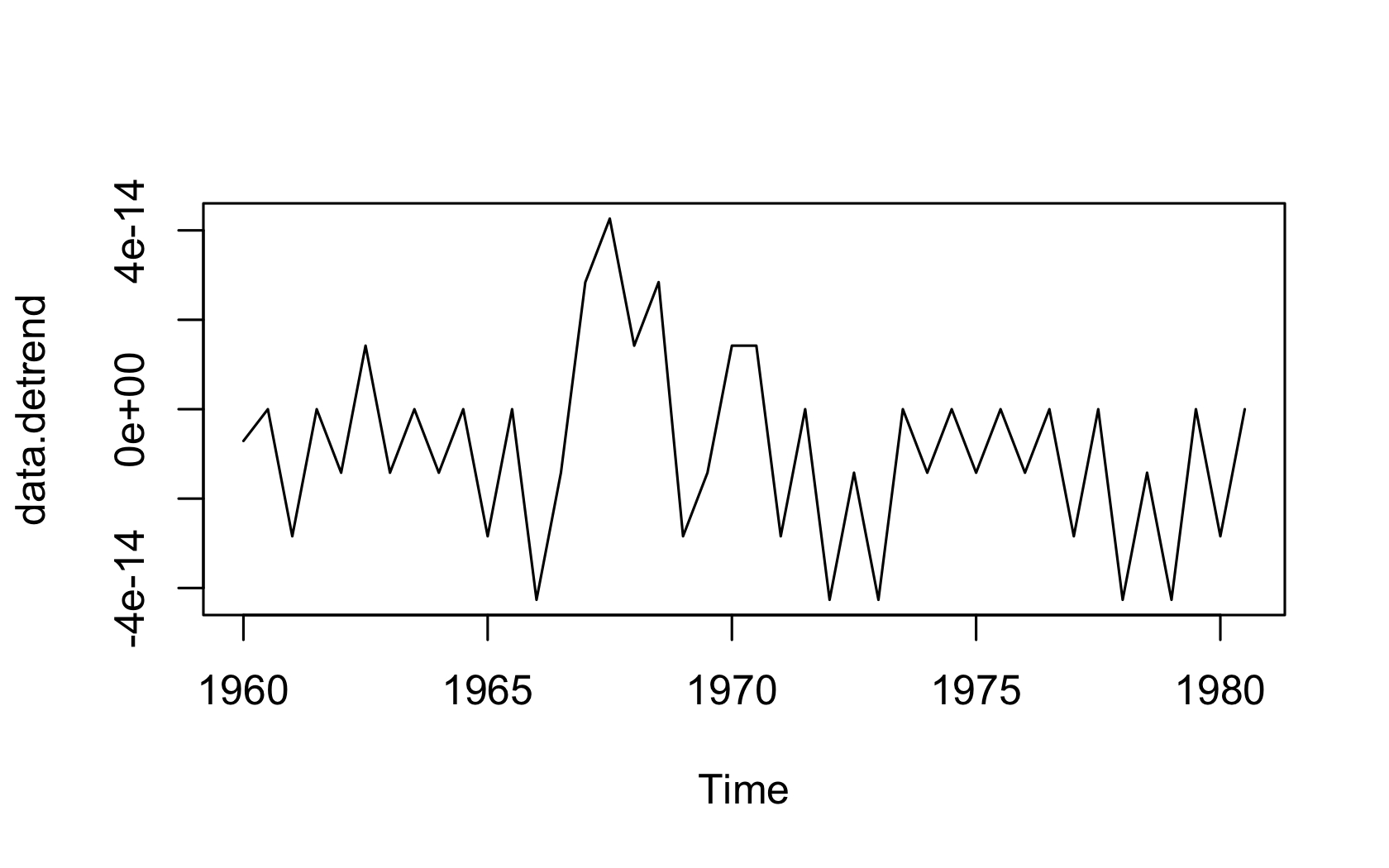
data.detrend <- detrend(df, tt = 'linear')

#Apply time series:
data.detrend <- ts(as.numeric(data.detrend),
                   start=c(1960,1), frequency=2)
str(data.detrend) #check date range

#Plot:
plot.ts(data.detrend)
页面原文内容由Stack Overflow提供。腾讯云小微IT领域专用引擎提供翻译支持
原文链接:
https://stackoverflow.com/questions/45951234
复制相关文章
相似问题
腾讯云开发者

Copyright © 2013 - 2026 Tencent Cloud. All Rights Reserved. 腾讯云 版权所有
深圳市腾讯计算机系统有限公司 ICP备案/许可证号:粤B2-20090059  粤公网安备44030502008569号
腾讯云计算(北京)有限责任公司 京ICP证150476号 | 京ICP备11018762号