
如何在Kotlin中实现Memento模式
我目前正尝试在Kotlin中实现一些设计模式,作为一个练习,我有点被“Memento”模式所困扰。我的参考资源是SourceMaking:纪念品。
我想实施这个结构:
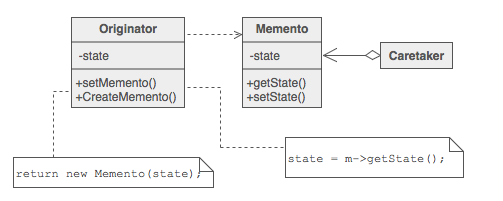
同时遵循他们的“核对表”
- 确定“看管人”和“发起人”的角色。
- 创建一个Memento类,并声明发起人是朋友。
- 管理员知道什么时候应该“检查”发起人。
- 发起人创建一个Memento并将其状态复制到该Memento。
- 看门人抓住了(但不能窥探)的记忆。
- 看门人知道什么时候该“击退”发起人。
- 发起人使用Memento中保存的状态恢复自身。
我不能让第五步开始工作。如何使Memento对象的字段可以从Originator实例内部读取,但对Caretaker完全不透明
我在Java中成功地实现了这一点,如下所示:
public class Originator {

    private final int id;
    private String title;
    private String description;

    public Originator(int id) {
        this.id = id;
    }

    /* skipping title and description getter & setter */

    public Memento saveState() {
        return new Memento(new State(id, title, description));
    }

    public void restore(Memento memento) {
        id = memento.state.id;
        title = memento.state.title;
        description = memento.state.description;
    }

    private class State {

        private final int id;
        private final String title;
        private final String description;

        public State(int id, String title, String description) {
            this.id = id;
            this.title = title;
            this.description = description;
        }
    }

    public class Memento {

        private final State state;

        public Memento(State state) {
            this.state = state;
        }
    }
}
还有一个看门人
public class Caretaker {

    public Originator originator;

    public Caretaker(@NotNull Originator originator) {
        this.originator = originator;
    }

    public Originator.Memento save() {
        return originator.saveState();
    }

    public void restore(@NotNull Originator.Memento memento) {
        originator.restoreFromState(memento);
    }
}因为它们是内部类,所以我可以从我的Memento实例读取State和State的私有字段,但是对于Caretaker,my Memento实例是完全不透明的(只显示Object的成员函数)。
现在,我如何在Kotlin中实现这种精确的行为?基本上,我忽略了读取内部类的私有字段的功能。
我能想到的最贴切的事情是:
class Originator(id: Long) {

    private var id: Long = id
    var description: String = ""
    var title: String = ""

    fun saveState() = Memento(State(id, title, description))

    fun restoreState(memento: Memento) {
        id = memento.state.id // <-- cannot access 'state': it is private in 'Memento'
        title = memento.state.title // <-- cannot access 'state': it is private in 'Memento'
        description = memento.state.description // <-- cannot access 'state': it is private in 'Memento'
    }

    inner class State(private val id: Long,
                  private val title: String,
                  private val description: String)

    inner class Memento(private val state: State)
}这产生了Memento对Caretaker实例完全不透明的预期效果,但我也无法从Originator中读取字段。
顺便说一句,这段代码与IntelliJ的“将Java”特性生成的代码几乎完全相同,该特性应用于我的Java代码(而且显然也不编译)。
那么,有什么明显的(或神奇的)我在这里错过了吗?也许是类图中显示的结构之外的其他东西?或者,这些精确的规范不能在Kotlin中实现吗?
另外一点是:对Memento对象的不透明要求实际上是Memento模式的一个口语化接受的属性,还是SourceMaking提出了这个要求?
回答 2
Stack Overflow用户
发布于 2017-08-24 17:07:23
您可以为Memento定义一个公共父类,并为它定义一个私有继承类:
class Originator {
    /* irrelevant declarations skipped */

    abstract inner class Memento

    private inner class MementoImpl(val state: State) : Memento()

    fun saveState(): Memento {
        return MementoImpl(State(id, title, description))
    }

    fun restore(memento: Memento) {
        memento as MementoImpl
        id = memento.state.id
        title = memento.state.title
        description = memento.state.description
    }
}实现类是private,在Originator之外,实例只能被看作是Memento (请参阅函数签名),这样就无法访问状态。
Stack Overflow用户
发布于 2017-08-24 16:58:28
您应该使用包级访问来定义Memento类属性。
https://stackoverflow.com/questions/45867006
复制相似问题
腾讯云开发者

Copyright © 2013 - 2026 Tencent Cloud. All Rights Reserved. 腾讯云 版权所有
深圳市腾讯计算机系统有限公司 ICP备案/许可证号:粤B2-20090059  粤公网安备44030502008569号
腾讯云计算(北京)有限责任公司 京ICP证150476号 | 京ICP备11018762号