
R-多个数据集作为输入的LPSolve
R-多个数据集作为输入的LPSolve
提问于 2017-07-28 14:29:09
我正在使用R处理LPSolve,我的输入数据以多个CSV文件的形式出现,每个文件都有一个表。其中2份表如下:

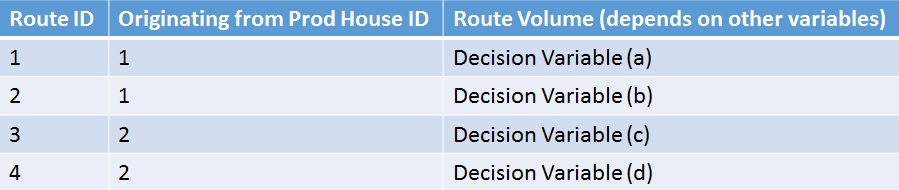
关于约束的描述-
- 每个生产厂都有发运路线。
- 由生产厂流出的总流出量=源自该生产厂的路线总量(路线体积)
- 生产厂总流出<=生产能力
- 路由卷本身就是一个决策变量,它依赖于本文中没有提到的其他变量。
约束的数学表示如下:
`Production Total Outflow = ∑(Route Volume) where (Production House ID from table_1)==(Originating from Prod House ID from table_2)`Production Total Outflow <= Production Capacity
在现实中,我有数千排。我试图为上面的2个约束编写以下代码。将有两个制约因素:
#Reading Data from files
routeData = read.csv("Route.csv", header = TRUE)
ProductionData = read.csv("Production.csv", header = TRUE)

#Fetching variable columns
routeID = routeData$RouteID
productionID = ProductionData$ProductionID
productionCapacity = ProductionData$Supply.Capacity

numberOfColumns = length(routeID) + length(productionID) #4+2 decision variables
model <- make.lp(nrow=0, ncol=numberOfColumns, verbose="important")

for(i in 1:length(productionID)){
  add.constraint(model, 1, "<=", productionCapacity[i]) #Something wrong here
}
#I haven't attempted to write the other constraint
我无法继续写这些限制。请帮帮伙计们。我没有分享这个目标,因为它也有很多其他的限制。
回答 1
Stack Overflow用户
回答已采纳
发布于 2017-08-02 13:35:12
这里有一个例子,它试图将路线量均匀地分配到生产厂。
library(lpSolveAPI)

prodcap <- setNames(c(50,100), c(1,2))
route <- data.frame(rid=1:4, pid_from=rep(1:2, each=2))
route_volume <- 125 # example

nvars <- nrow(route)+1 # example: evenly distribute production house output relative to capacity
lprec <- make.lp(0, nvars)

set.objfn(lprec, obj=1, indices=nvars)

# capacity constraints
for (i in seq(1, length(prodcap))) {
    route_ids <- which(route[,"pid_from"]==i)
    add.constraint(lprec, xt=rep(1, length(route_ids)), type="<=", rhs=prodcap[i], indices=route_ids)
}

# total outflow constraint
add.constraint(lprec, xt=rep(1, nrow(route)), type="=", rhs=route_volume, indices=seq(1, nvars-1))

# example: define the last decision variable as maximum flow over each production house
for (i in seq(1, length(prodcap))) {
    route_ids <- which(route[,"pid_from"]==i)
    add.constraint(lprec, xt=c(rep(1/prodcap[i], length(route_ids)), -1), type="<=", rhs=0, indices=c(route_ids, nvars))
}

# solve
status <- solve(lprec)
if(status!=0) stop("no solution found, error code=", status)
get.variables(lprec)[seq(1, nrow(route))]
#[1] 41.66667 0.00000 83.33333 0.00000请注意,如果您有数千条路线/生产场所,那么在make.lp中预先分配约束并使用set.row而不是add.constraint可能更有效。下面是一个示例,并将route_volume作为附加的决策变量,如注释中所请求的那样:
library(lpSolveAPI)

prodcap <- setNames(c(50,100), c(1,2))
route <- data.frame(rid=1:4, pid_from=rep(1:2, each=2))
route_volume <- 125 # example

# the first nrow(route) vars are the outflows,
# then 1 variable for maximum flow (relative to capacity) over all production house
# then 1 last variable for the route volume
nvars <- nrow(route)+2
ncons <- 2*length(prodcap)+3

# pre-allocate the constraints
lprec <- make.lp(ncons, nvars)

# set objective: minimize maximum flow relative to capacity (example)
set.objfn(lprec, obj=1, indices=nvars-1)

# capacity constraints
rownum <- 1
for (i in seq(1, length(prodcap))) {
    route_ids <- which(route[,"pid_from"]==i)
    set.row(lprec, row=rownum, xt=rep(1, length(route_ids)), indices=route_ids)
    set.rhs(lprec, prodcap[i], constraints=rownum)
    rownum <- rownum + 1
}

# total outflow constraint ("=" resolves to two constraints)
set.row(lprec, row=rownum, xt=c(rep(1, nrow(route)), -1), indices=c(seq(1, nvars-2), nvars))
set.rhs(lprec, 0, constraints=rownum)
rownum <- rownum + 1
set.row(lprec, row=rownum, xt=c(rep(-1, nrow(route)), 1), indices=c(seq(1, nvars-2), nvars))
set.rhs(lprec, 0, constraints=rownum)
rownum <- rownum + 1

# additional constraint for route volume
set.row(lprec, row=rownum, xt=-1, indices=nvars)
set.rhs(lprec, -125, constraints=rownum) #example: route_volume >= 125
rownum <- rownum + 1

# example: define the second last decision variable as maximum flow (relative to capacity) over all production houses
# rhs is 0, which is preset
for (i in seq(1, length(prodcap))) {
    route_ids <- which(route[,"pid_from"]==i)
    set.row(lprec, row=rownum, xt=c(rep(1/prodcap[i], length(route_ids)), -1), indices=c(route_ids, nvars-1))
    set.rhs(lprec, 0, constraints=rownum)
    rownum <- rownum + 1
}

# solve
status <- solve(lprec)
if(status!=0) stop("no solution found, error code=", status)
get.variables(lprec)[seq(1, nrow(route))]页面原文内容由Stack Overflow提供。腾讯云小微IT领域专用引擎提供翻译支持
原文链接:
https://stackoverflow.com/questions/45376030
复制相关文章
相似问题
腾讯云开发者

Copyright © 2013 - 2026 Tencent Cloud. All Rights Reserved. 腾讯云 版权所有
深圳市腾讯计算机系统有限公司 ICP备案/许可证号:粤B2-20090059  粤公网安备44030502008569号
腾讯云计算(北京)有限责任公司 京ICP证150476号 | 京ICP备11018762号