
与Windows 7相比,Windows 10性能较差(页面错误处理是不可扩展的,当没有线程>16时,会出现严重的锁定争用)
我们设置了两个相同的HP Z840工作站,其规格如下
- 2xXeonE5-2690 v4 @ 2.60GHz (涡轮增压,HT关闭,共28个逻辑CPU)
- 32 DDR4 2400内存,四通道
并分别安装了Windows7 SP1 (x64)和Windows 10 Creators (x64)。
然后,我们运行一个小内存基准(下面的代码,由VS2015更新3,64位架构构建),它执行内存分配-填充-同时从多个线程。
#include <Windows.h>
#include <vector>
#include <ppl.h>

unsigned __int64 ZQueryPerformanceCounter()
{
    unsigned __int64 c;
    ::QueryPerformanceCounter((LARGE_INTEGER *)&c);
    return c;
}

unsigned __int64 ZQueryPerformanceFrequency()
{
    unsigned __int64 c;
    ::QueryPerformanceFrequency((LARGE_INTEGER *)&c);
    return c;
}

class CZPerfCounter {
public:
    CZPerfCounter() : m_st(ZQueryPerformanceCounter()) {};
    void reset() { m_st = ZQueryPerformanceCounter(); };
    unsigned __int64 elapsedCount() { return ZQueryPerformanceCounter() - m_st; };
    unsigned long elapsedMS() { return (unsigned long)(elapsedCount() * 1000 / m_freq); };
    unsigned long elapsedMicroSec() { return (unsigned long)(elapsedCount() * 1000 * 1000 / m_freq); };
    static unsigned __int64 frequency() { return m_freq; };
private:
    unsigned __int64 m_st;
    static unsigned __int64 m_freq;
};

unsigned __int64 CZPerfCounter::m_freq = ZQueryPerformanceFrequency();


int main(int argc, char ** argv)
{
    SYSTEM_INFO sysinfo;
    GetSystemInfo(&sysinfo);
    int ncpu = sysinfo.dwNumberOfProcessors;

    if (argc == 2) {
        ncpu = atoi(argv[1]);
    }

    {
        printf("No of threads %d\n", ncpu);

        try {
            concurrency::Scheduler::ResetDefaultSchedulerPolicy();
            int min_threads = 1;
            int max_threads = ncpu;
            concurrency::SchedulerPolicy policy
            (2 // two entries of policy settings
                , concurrency::MinConcurrency, min_threads
                , concurrency::MaxConcurrency, max_threads
            );
            concurrency::Scheduler::SetDefaultSchedulerPolicy(policy);
        }
        catch (concurrency::default_scheduler_exists &) {
            printf("Cannot set concurrency runtime scheduler policy (Default scheduler already exists).\n");
        }

        static int cnt = 100;
        static int num_fills = 1;
        CZPerfCounter pcTotal;

        // malloc/free
        printf("malloc/free\n");
        {
            CZPerfCounter pc;
            for (int i = 1 * 1024 * 1024; i <= 8 * 1024 * 1024; i *= 2) {
                concurrency::parallel_for(0, 50, [i](size_t x) {
                    std::vector<void *> ptrs;
                    ptrs.reserve(cnt);
                    for (int n = 0; n < cnt; n++) {
                        auto p = malloc(i);
                        ptrs.emplace_back(p);
                    }
                    for (int x = 0; x < num_fills; x++) {
                        for (auto p : ptrs) {
                            memset(p, num_fills, i);
                        }
                    }
                    for (auto p : ptrs) {
                        free(p);
                    }
                });
                printf("size %4d MB,  elapsed %8.2f s, \n", i / (1024 * 1024), pc.elapsedMS() / 1000.0);
                pc.reset();
            }
        }
        printf("\n");
        printf("Total %6.2f s\n", pcTotal.elapsedMS() / 1000.0);
    }

    return 0;
}
令人惊讶的是,与Windows 7相比,Windows 10 CU中的结果非常糟糕。我为1MB的块大小和8MB的块大小绘制了下面的结果,将线程数量从2,4,.变化到28。当我们增加线程数时,Windows 7的性能略差一些,而Windows 10的可伸缩性则差得多。
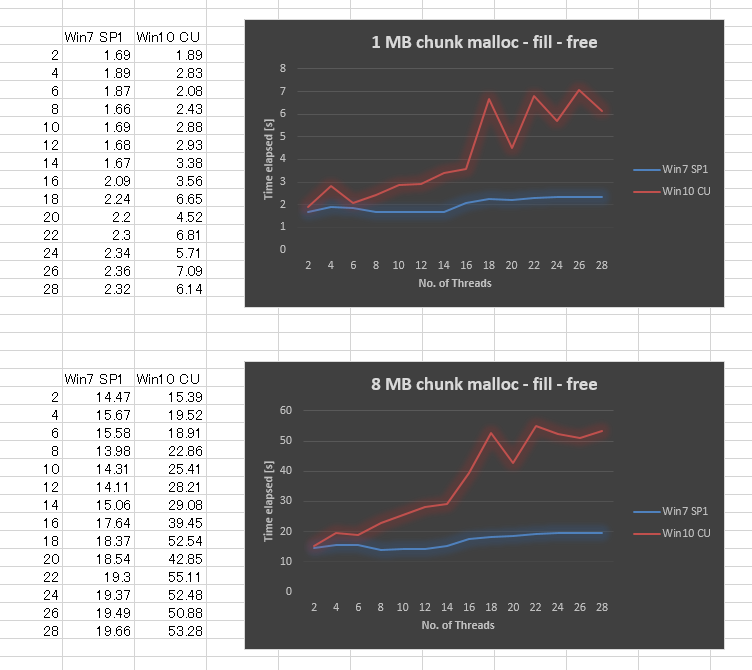
我们试图确保所有的Windows更新都被应用,更新驱动程序,调整BIOS设置,但没有成功。我们还在其他几个硬件平台上运行了相同的基准,并且都给出了类似于Windows 10的曲线,所以这似乎是Windows 10的一个问题。
有没有人有过类似的经历,或者可能知道--这件事怎么样(也许我们错过了什么?)这种行为使我们的多线程应用程序的性能受到了很大的影响。
*编辑
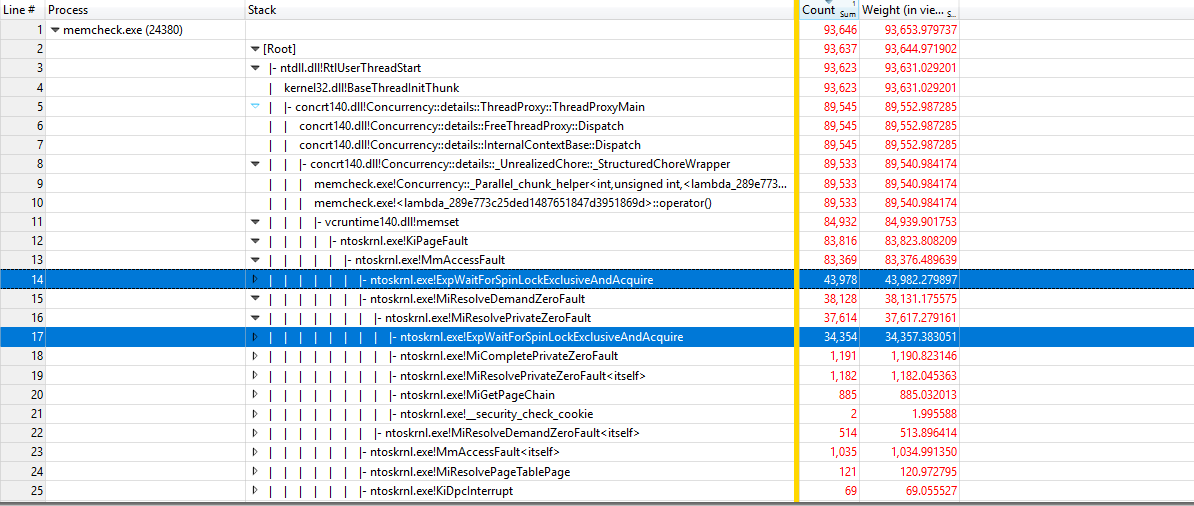
使用https://github.com/google/UIforETW (感谢Bruce )来分析基准测试,我们发现大部分时间都花在内核KiPageFault中。深入挖掘调用树,所有这些都会导致ExpWaitForSpinLockExclusiveAndAcquire。似乎锁争用导致了这个问题。
*编辑
在同一硬件上收集服务器2012 R2数据。2012年服务器R2也比Win7差,但仍然比Win10 CU好得多。

*编辑
这也发生在Server 2016中。我添加了windows-server-2016的标签。
*编辑
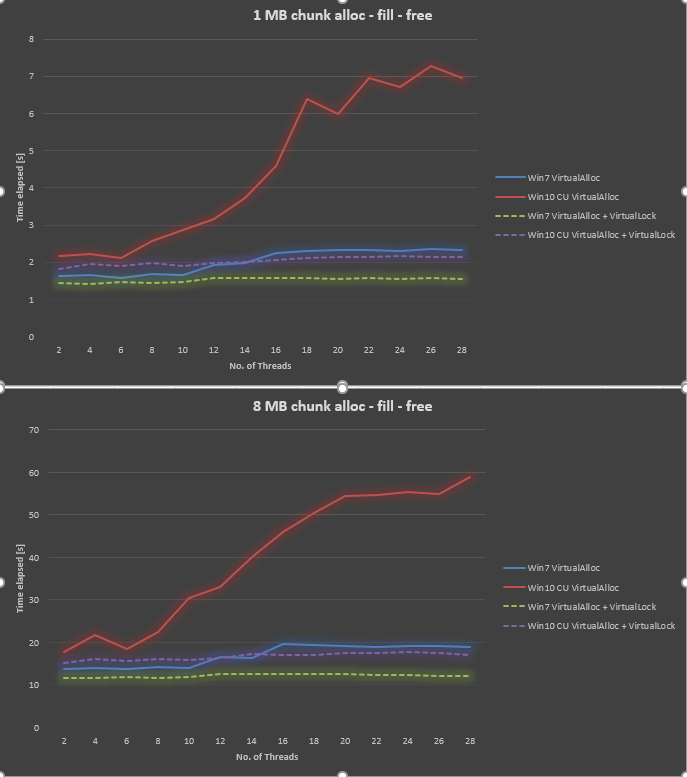
使用@Ext3h中的信息,我修改了基准测试以使用VirtualAlloc和VirtualLock。我可以确认与不使用VirtualLock相比有了很大的改进。总的来说,当使用Win10和VirtualLock时,Win7仍然比Win7慢30%到40%。
回答 2
Stack Overflow用户
发布于 2017-11-14 02:36:43
Microsoft似乎已经解决了Windows 10秋季创建者更新和Windows 10的问题。
这是最新的图表。
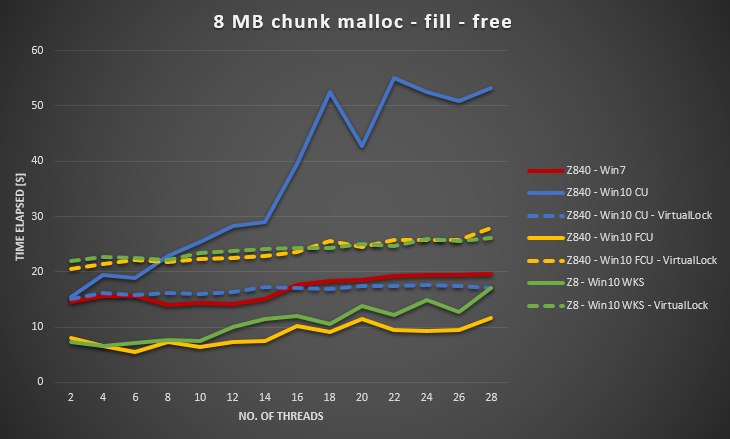
Win 10 FCU和WKS的开销比Win 7低。作为交换,VirtualLock似乎有更高的开销。
Stack Overflow用户
发布于 2017-07-30 20:56:13
不幸的是,没有一个答案,只是一些额外的洞察力。
采用不同的分配策略的小实验:
#include <Windows.h>

#include <thread>
#include <condition_variable>
#include <mutex>
#include <queue>
#include <atomic>
#include <iostream>
#include <chrono>

class AllocTest
{
public:
    virtual void* Alloc(size_t size) = 0;
    virtual void Free(void* allocation) = 0;
};

class BasicAlloc : public AllocTest
{
public:
    void* Alloc(size_t size) override {
        return VirtualAlloc(NULL, size, MEM_RESERVE | MEM_COMMIT, PAGE_READWRITE);
    }
    void Free(void* allocation) override {
        VirtualFree(allocation, NULL, MEM_RELEASE);
    }
};

class ThreadAlloc : public AllocTest
{
public:
    ThreadAlloc() {
        t = std::thread([this]() {
            std::unique_lock<std::mutex> qlock(this->qm);
            do {
                this->qcv.wait(qlock, [this]() {
                    return shutdown || !q.empty();
                });
                {
                    std::unique_lock<std::mutex> rlock(this->rm);
                    while (!q.empty())
                    {
                        q.front()();
                        q.pop();
                    }
                }
                rcv.notify_all();
            } while (!shutdown);
        });
    }
    ~ThreadAlloc() {
        {
            std::unique_lock<std::mutex> lock1(this->rm);
            std::unique_lock<std::mutex> lock2(this->qm);
            shutdown = true;
        }
        qcv.notify_all();
        rcv.notify_all();
        t.join();
    }
    void* Alloc(size_t size) override {
        void* target = nullptr;
        {
            std::unique_lock<std::mutex> lock(this->qm);
            q.emplace([this, &target, size]() {
                target = VirtualAlloc(NULL, size, MEM_RESERVE | MEM_COMMIT, PAGE_READWRITE);
                VirtualLock(target, size);
                VirtualUnlock(target, size);
            });
        }
        qcv.notify_one();
        {
            std::unique_lock<std::mutex> lock(this->rm);
            rcv.wait(lock, [&target]() {
                return target != nullptr;
            });
        }
        return target;
    }
    void Free(void* allocation) override {
        {
            std::unique_lock<std::mutex> lock(this->qm);
            q.emplace([allocation]() {
                VirtualFree(allocation, NULL, MEM_RELEASE);
            });
        }
        qcv.notify_one();
    }
private:
    std::queue<std::function<void()>> q;
    std::condition_variable qcv;
    std::condition_variable rcv;
    std::mutex qm;
    std::mutex rm;
    std::thread t;
    std::atomic_bool shutdown = false;
};

int main()
{
    SetProcessWorkingSetSize(GetCurrentProcess(), size_t(4) * 1024 * 1024 * 1024, size_t(16) * 1024 * 1024 * 1024);

    BasicAlloc alloc1;
    ThreadAlloc alloc2;

    AllocTest *allocator = &alloc2;
    const size_t buffer_size =1*1024*1024;
    const size_t buffer_count = 10*1024;
    const unsigned int thread_count = 32;

    std::vector<void*> buffers;
    buffers.resize(buffer_count);
    std::vector<std::thread> threads;
    threads.resize(thread_count);
    void* reference = allocator->Alloc(buffer_size);

    std::memset(reference, 0xaa, buffer_size);

    auto func = [&buffers, allocator, buffer_size, buffer_count, reference, thread_count](int thread_id) {
        for (int i = thread_id; i < buffer_count; i+= thread_count) {
            buffers[i] = allocator->Alloc(buffer_size);
            std::memcpy(buffers[i], reference, buffer_size);
            allocator->Free(buffers[i]);
        }
    };

    for (int i = 0; i < 10; i++)
    {
        std::chrono::high_resolution_clock::time_point t1 = std::chrono::high_resolution_clock::now();
        for (int t = 0; t < thread_count; t++) {
            threads[t] = std::thread(func, t);
        }
        for (int t = 0; t < thread_count; t++) {
            threads[t].join();
        }
        std::chrono::high_resolution_clock::time_point t2 = std::chrono::high_resolution_clock::now();

        auto duration = std::chrono::duration_cast<std::chrono::microseconds>(t2 - t1).count();
        std::cout << duration << std::endl;
    }


    DebugBreak();
    return 0;
}在所有正常的情况下,BasicAlloc是更快的,就像它应该的那样。事实上,在一个四核CPU (没有HT)上,没有一个星座ThreadAlloc可以超过它。ThreadAlloc总是慢30%左右。(这实际上是令人惊讶的少,而且即使是在1kB的微小分配中也是如此!)
然而,如果CPU有8-12个虚拟核,那么它最终会到达BasicAlloc实际上是负扩展的点,而ThreadAlloc只是“停滞”在软故障的基线上。
如果您分析了这两种不同的分配策略,可以看到对于低线程数,KiPageFault从memcpy on BasicAlloc转移到VirtualLock on ThreadAlloc。
对于更高的线程和内核计数,ExpWaitForSpinLockExclusiveAndAcquire最终开始从几乎为零负载到50%的BasicAlloc开始出现,而ThreadAlloc只维持来自KiPageFault本身的恒定开销。
ThreadAlloc的摊子也很糟糕。无论一个NUMA系统中有多少核心或节点,您目前在新的分配(跨系统中的所有进程中)中硬限制在5-8GB/s之间,这完全受到单线程性能的限制。所有专用内存管理线程都实现了,而不是在竞争的关键部分浪费CPU周期。
你本以为微软会有一个在不同内核上分配页面的无锁策略,但显然根本就不是这样。
自旋锁在Windows7和更早的KiPageFault实现中也已经存在。那么是什么改变了呢?
简单的答案是:KiPageFault本身变得更慢了。不知道到底是什么原因导致它减速,但是自旋锁定从来没有成为一个明显的限制,因为100%的争论以前是不可能的。
如果有人哭哭啼啼地拆开KiPageFault,找出最昂贵的部分--做我的客人。
https://stackoverflow.com/questions/45024029
复制相似问题
腾讯云开发者

Copyright © 2013 - 2026 Tencent Cloud. All Rights Reserved. 腾讯云 版权所有
深圳市腾讯计算机系统有限公司 ICP备案/许可证号:粤B2-20090059  粤公网安备44030502008569号
腾讯云计算(北京)有限责任公司 京ICP证150476号 | 京ICP备11018762号