
单个图像python中的非负矩阵分解
单个图像python中的非负矩阵分解
提问于 2017-07-09 05:34:45
我正在尝试将NMF应用于以灰度模式加载的特定图像。我尝试了几个链接,但我的图像应用后,NMF几乎保持不变,无法区分与灰度图像最初加载。
然而,当我看到关于在dataset上实现分解的scikit的代码时,我看到那里的脸已经被转换成类似幽灵的面孔。以下是链接:
decomposition.html#sphx-glr-auto-examples-decomposition-plot-faces-decomposition-py
下面是我使用的代码:
import cv2
from sklearn import decomposition
import matplotlib.pyplot as plt

img = cv2.imread('test1.jpeg',0)
estimator = decomposition.NMF(n_components = 2, init = 'nndsvda', tol = 5e-3)
estimator.fit(img)
vmax = max(img.max(), -img.min())
plt.imshow(img, cmap=plt.cm.gray, interpolation = 'nearest',vmin=-vmax,vmax=vmax)
plt.show()
我对矩阵上的NMF技术很陌生,尤其是这样一个大的图像数字阵列。
我的图像是test1.jpeg,即225 * 224 .jpeg映像。
有人能帮我实现单个图像的代码吗?提前谢谢。
回答 1
Stack Overflow用户
回答已采纳
发布于 2017-07-09 08:57:54
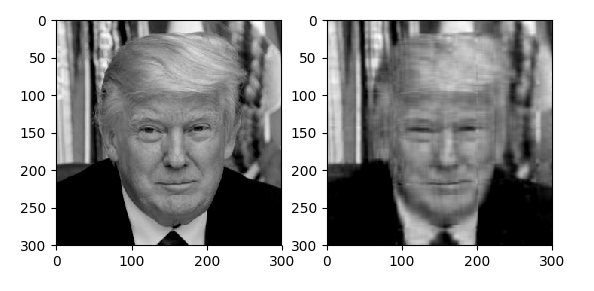
你在图中得到原始图像的原因是你实际上绘制了原始图像。相反,您需要处理estimator的输出。
NMF分解产生两个矩阵W和H,组成原始矩阵。你需要把它们相乘才能得到图像。
import cv2
from sklearn import decomposition
import matplotlib.pyplot as plt
import numpy as np

img = cv2.imread('data/trump2.jpg',0)
vmax = max(img.max(), -img.min())

fig, (ax, ax2)  =plt.subplots(ncols=2)
ax.imshow(img, cmap=plt.cm.gray, interpolation = 'nearest',vmin=-vmax,vmax=vmax)

n_components = 20

estimator = decomposition.NMF(n_components = n_components, init = 'random', tol=5e-3)
W = estimator.fit_transform(img)
H = estimator.components_

new_img = np.dot(W,H)
ax2.imshow(new_img, cmap=plt.cm.gray,
                   interpolation='nearest',
                   vmin=-vmax, vmax=vmax)

plt.show()
页面原文内容由Stack Overflow提供。腾讯云小微IT领域专用引擎提供翻译支持
原文链接:
https://stackoverflow.com/questions/44993322
复制相关文章
相似问题
腾讯云开发者

Copyright © 2013 - 2026 Tencent Cloud. All Rights Reserved. 腾讯云 版权所有
深圳市腾讯计算机系统有限公司 ICP备案/许可证号:粤B2-20090059  粤公网安备44030502008569号
腾讯云计算(北京)有限责任公司 京ICP证150476号 | 京ICP备11018762号