
立即看到System.out.print输出到控制台。所以PrintStream在每次打印后都会刷新,而不仅仅是println?
来自PrintStream 文档
可以选择地创建PrintStream,以便自动刷新;这意味着在写入字节数组()、调用println方法之一()或写入换行符或字节('\n')之后,会自动调用方法。
然后给出代码
System.out.print("hi");   // gives console output: hi
System.out.print(7);      // gives console output: 7

// prevents flushing when stream wiil be closed at app shutdown
for (;;) {
}
,为什么我看到输出到我的控制台?不应该写任何东西来安慰(来自System.out的PrintStream实例),,因为到目前为止什么都不会被刷新!
这没有回答这个问题。
我想答案是在源代码中(私有实用程序方法BufferedWriter.flushBuffer()),但我不理解对代码的注释:“将输出缓冲区刷新到底层字符流,而不刷新流本身”:如果PrintStream (与控制台输出绑定),即“流本身”未刷新,则不应刷新到控制台的输出!
PrintStream.print源(String):
private void write(String s) {
        try {
            synchronized (this) {
                ensureOpen();
                textOut.write(s);
                textOut.flushBuffer();
                charOut.flushBuffer();
                if (autoFlush && (s.indexOf('\n') >= 0))
                    out.flush();
            }
        }
        catch (InterruptedIOException x) {
            Thread.currentThread().interrupt();
        }
        catch (IOException x) {
            trouble = true;
        }
    }
BufferedWriter.flushBuffer()的来源:
/**
     * Flushes the output buffer to the underlying character stream, without
     * flushing the stream itself.  This method is non-private only so that it
     * may be invoked by PrintStream.
     */
    void flushBuffer() throws IOException {
        synchronized (lock) {
            ensureOpen();
            if (nextChar == 0)
                return;
            out.write(cb, 0, nextChar);
            nextChar = 0;
        }
}更多细节也给出了这里。这是非常复杂的,但似乎在某个阶段,BufferedWriter被赋予了PrintStream构造函数。
回答 2
Stack Overflow用户
发布于 2017-06-07 09:06:41
我一步一步地使用调试器,这就是我发现的:
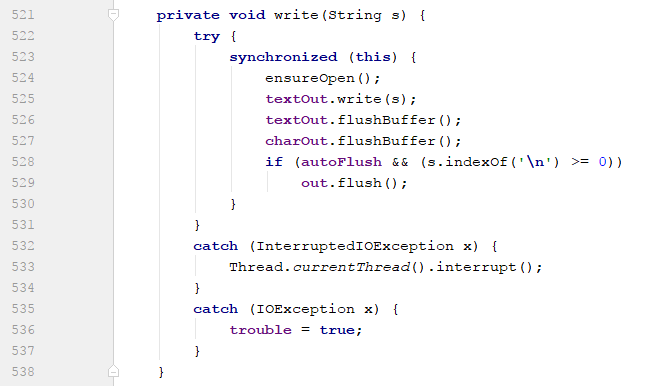
String s在527行后显示在控制台中,因此它在第528行之前,在第528行中完成了\n的检查。
在charOut.flushBuffer()内部深处,有以下方法称为:
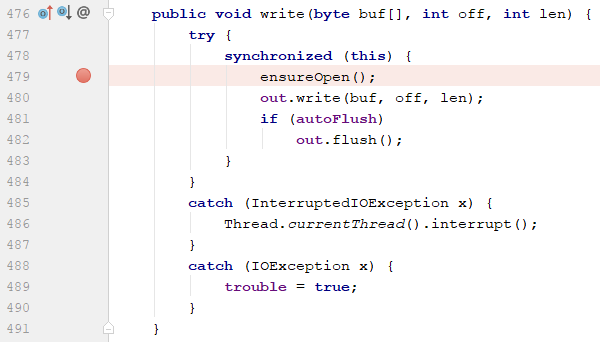
其中,关于\n的检查丢失了。
流动情况如下:
System.out#print(String s)打电话给PrintStream#print(String s)。PrintStream#print(String s)打电话给PrintStream#write(String s)。PrintStream#write(String s)打电话给OutputSteamWriter#flushBuffer()。OutputStreamWriter#flushBuffer()打电话给StreamEncoder#flushBuffer()。StreamEncoder#flushBuffer()打电话给StreamEncoder#implFlushBuffer()。StreamEncoder#implFlushBuffer()打电话给StreamEncoder#writeBytes()。StreamEncoder#writeBytes()调用PrintStream#write(byte buf[], int off, int len)来刷新bufforif(autoFlush)。
最重要的片段在上面。在这个流中,BufferedWriter似乎没有被调用。
Stack Overflow用户
发布于 2018-12-20 18:24:23
https://bugs.openjdk.java.net/browse/JDK-8025883描述了这个错误。
这在一个读取和解析二进制文件的程序中被我咬了一口,它执行了大量的System.out.printf()调用,这花费了更长的时间。
最后,我编写了一个助手类,它违反了流的契约,没有响应每个刷新请求:
class ForceBufferedOutputStream extends OutputStream {

    OutputStream out;
    byte[] buffer;
    int buflen;
    boolean haveNewline;
    private static final int bufsize=16384;

    public ForceBufferedOutputStream(OutputStream out) {
        this.out=out;
        this.buffer=new byte[bufsize];
        this.buflen=0;
        this.haveNewline=false;
    }
    @Override
    public void flush() throws IOException {
        if (this.haveNewline || this.buflen==bufsize) {
            out.write(buffer, 0, buflen);
            out.flush();
            this.buflen=0;
            this.haveNewline=false;
        }
    }
    @Override
    public void close() throws IOException {
        out.close();
    }

    @Override
    public void write(int b) throws IOException {
        buffer[buflen++]=(byte)b;
        if (b=='\n')
            this.haveNewline=true;
        if (buflen==bufsize)
            this.flush();
    }
}然后使用new PrintStream(new ForceBufferedOutputStream(System.out))而不是System.out。
我认为这是一个可怕的软件--正如所说的,它违反了flush()需要确保所有东西都被写入的契约,并且可以优化数组write调用。但是在我的例子中,运行时被从17分钟缩短到3:45,所以如果您需要一个复制/粘贴来加速快速和肮脏类型的程序,我希望它能有所帮助。
https://stackoverflow.com/questions/44408151
复制相似问题
腾讯云开发者

Copyright © 2013 - 2026 Tencent Cloud. All Rights Reserved. 腾讯云 版权所有
深圳市腾讯计算机系统有限公司 ICP备案/许可证号:粤B2-20090059  粤公网安备44030502008569号
腾讯云计算(北京)有限责任公司 京ICP证150476号 | 京ICP备11018762号