
如何以连接的方式穿越连接的节点网络?
如何以连接的方式穿越连接的节点网络?
提问于 2017-05-30 14:40:12
我的数据结构可以可视化为连接的网络,如下所示:
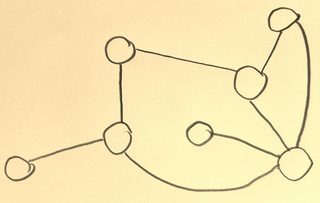
我相信(在没有证据的情况下)应该能够遍历所有节点,总是从一个节点移动到一个连接的节点(当然,回溯是必需的和允许的--就像您对树结构所做的那样)。该怎么做呢?
数据结构可以用伪代码写成如下:
node[N] nodes; // the network as an array of N nodes

class node {
  List<pt_to_node> friend_nodes;  // a list of pointers to connected nodes
}回答 1
Stack Overflow用户
发布于 2017-05-31 18:14:04
您可以简单地使用堆栈实现深度优先搜索,或者使用队列实现广度优先搜索。
例如:
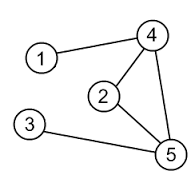
假设我们将从Node 1开始,
#include <vector>
#include <list>
#include <vector>
using namespace std;

class Graph
{
public:
    int vert; //number of vertices
    vector<list<int>> adj;

    Graph(int _v)
    {
        adj.resize(_v);
        vert = _v;
    }

    void addEdge(int v, int key)
    {
        adj[v].push_back(key);
        adj[key].push_back(v); // comment out if undirected
    }

    void bfs(int start);
    void dfs(int start);
};


void Graph::bfs(int start)
{

    vector<bool> visited(vert,false);

    list<int> queue;

    visited[start] = true; // visit the first node
    queue.push_back(start);


    while (!queue.empty())
    {
        start = queue.front();
        cout << start << " ";
        queue.pop_front();

        for (auto i = adj[start].begin(); i != adj[start].end(); ++i)
            if (!visited[*i])
            {
                visited[*i] = true;
                queue.push_back(*i);
            }
    }
    cout << endl;
}

void Graph::dfs(int start)
{
    vector<bool> visited(vert,false);

    vector<int> stack;

    visited[start] = true;
    stack.push_back(start);

    while (!stack.empty())
    {
        start = stack.back();
        cout << start << " ";
        stack.pop_back();

        for (auto i = adj[start].begin(); i != adj[start].end(); ++i)
            if (!visited[*i])
            {
                visited[*i] = true;
                stack.push_back(*i);
            }
    }
    cout << endl;
}

int main()
{

    Graph g(6); // number of vertices we need
    g.addEdge(1, 4);
    g.addEdge(4, 2);
    g.addEdge(4, 5);
    g.addEdge(2, 5);
    g.addEdge(5, 3);

    g.bfs(1); // start with 1
    g.dfs(1);


}
计算结果为DFS :1 4 2 5 3和BFS 1 4 5 3 2,但在实际网络中,每条边缘都有一个权值,表示边缘的距离或速度。
页面原文内容由Stack Overflow提供。腾讯云小微IT领域专用引擎提供翻译支持
原文链接:
https://stackoverflow.com/questions/44265297
复制相关文章
相似问题
腾讯云开发者

Copyright © 2013 - 2026 Tencent Cloud. All Rights Reserved. 腾讯云 版权所有
深圳市腾讯计算机系统有限公司 ICP备案/许可证号:粤B2-20090059  粤公网安备44030502008569号
腾讯云计算(北京)有限责任公司 京ICP证150476号 | 京ICP备11018762号