
对shell中的一些标准输入或heredoc用法感到困惑
对shell中的一些标准输入或heredoc用法感到困惑
提问于 2017-01-14 04:25:59
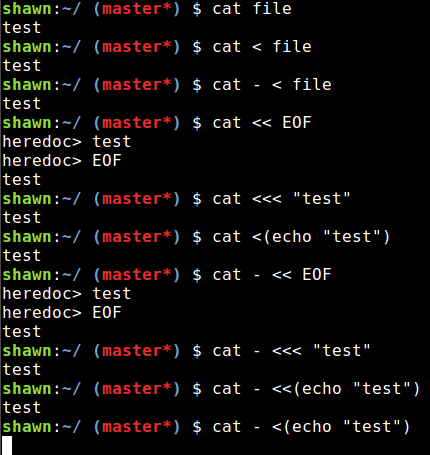
就像图像一样。所有命令都是相似的。我知道怎么用,但我不知道细节。会有人知道吗?非常感谢。
# does `cat` read fd and print?
$ cat file

# does `cat` read from stdin and print?
$ cat < file

$ cat - < file

# with heredoc or herestring, what methods `cat` command use to read from heredoc?stdin?

$ cat << EOF
heredoc> test
heredoc> EOF
test

$ cat <<< "test"

$ cat - << EOF
heredoc> test
heredoc> EOF
test

$ cat - <<< "test"

# and I dont why these commands works?

$ cat <(echo "test")

$ cat - <<(echo "test")

# why this command doesn't work?

$ cat - <(echo "test")回答 1
Stack Overflow用户
回答已采纳
发布于 2017-01-14 04:34:52
一些阅读材料,全部来自非常有用的巴什手册:
- 重定向 (
<filename) --导致标准输入重定向到文件filename - 这里的文件 (
<<WORD) -导致标准输入从下一行重定向到脚本源,直到但不包括行WORD - 在这里字符串 (
<<<"string") --导致标准输入重定向到字符串string(就像字符串被写入临时文件,然后标准输入重定向到该文件一样) - 过程替代 (
<(command)) --启动一个执行command的进程,并将一个名称插入到执行文件名的命令行中,这样从该“文件”中读取就会产生该命令的输出。
使用-表示源文件是标准输入,这在许多命令中是常见的,并且是Posix推荐的。如果没有指定文件,则从标准输入读取许多命令。有些,比如cat,实现了两种方式来表示意图是从标准输入中读取。
注意,-和<(command)都是文件名参数,而<filename、<<WORD和<<<"string"是重定向。因此,虽然它们表面上看起来很相似,但它们在引擎盖下却有很大的不同。它们的共同点是它们与输入有关;其中一些(但不是这里的文档/字符串)与输出有关,使用的是>而不是<。
页面原文内容由Stack Overflow提供。腾讯云小微IT领域专用引擎提供翻译支持
原文链接:
https://stackoverflow.com/questions/41646782
复制相关文章
相似问题
腾讯云开发者

Copyright © 2013 - 2026 Tencent Cloud. All Rights Reserved. 腾讯云 版权所有
深圳市腾讯计算机系统有限公司 ICP备案/许可证号:粤B2-20090059  粤公网安备44030502008569号
腾讯云计算(北京)有限责任公司 京ICP证150476号 | 京ICP备11018762号