
使用bartMachine R软件包预测的概率是失败概率
使用bartMachine R软件包预测的概率是失败概率
提问于 2016-10-26 22:23:28
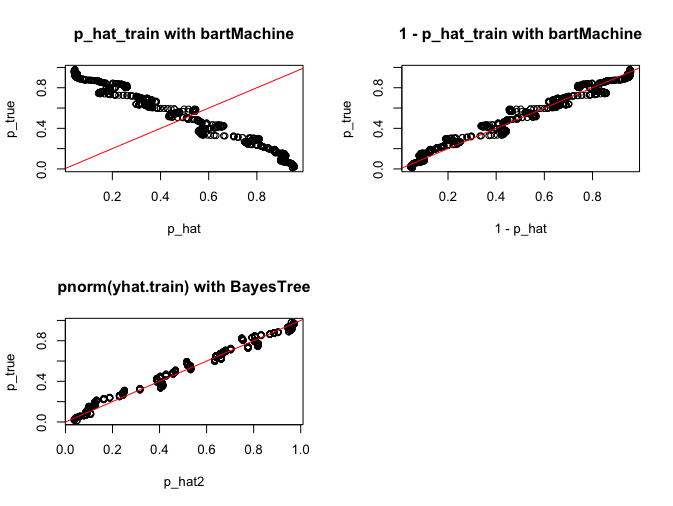
如果我使用bartMachine运行用于分类的BART模型,则返回的p_hat_train值对应的是失败概率,而不是BayesTree R包中BART的初始实现中所做的成功概率。
下面是一个模拟二进制响应的示例:
library(bartMachine)
library(BayesTree)
library(logitnorm)

N = 1000
X <- rnorm(N, 0, 1)
p_true <- invlogit(1.5*X)
y <- rbinom(N, 1, p_true)

## bartMachine
fit <- bartMachine(data.frame(X), as.factor(y), num_burn_in = 200,
                   num_iterations_after_burn_in = 500)
p_hat <- fit$p_hat_train

## BayesTree
fit2 <- bart(X, as.factor(y), ntree = 50, ndpost = 500)
p_hat2 <- apply(pnorm(fit2$yhat.train), 2, mean)

par(mfrow = c(2,2))
plot(p_hat, p_true, main = 'p_hat_train with bartMachine')
abline(0, 1, col = 'red')
plot(1 - p_hat, p_true, main = '1 - p_hat_train with bartMachine')
abline(0, 1, col = 'red')
plot(p_hat2, p_true, main = 'pnorm(yhat.train) with BayesTree')
abline(0, 1, col = 'red')
回答 1
Stack Overflow用户
回答已采纳
发布于 2016-10-26 23:19:42
检查iris示例从?bartMachine中可以看出,bartMachine正在估计一个观察被归类为y变量的第一级的概率,而在您的示例中,这个级别恰好是0。要获得您想要的结果,您需要在将y转换为一个因子时指定级别,即
fit <- bartMachine(data.frame(X), factor(y, levels = c("1", "0")),
  num_burn_in = 200,
num_iterations_after_burn_in = 500)当我们检查build_bart_machine的代码时,我们可以看到发生了什么
if (class(y) == "factor" & length(y_levels) == 2) {
        java_bart_machine = .jnew("bartMachine.bartMachineClassificationMultThread")
        y_remaining = ifelse(y == y_levels[1], 1, 0)
        pred_type = "classification"
}查看来自bartMachine的输出(使用您的原始规范)显示了正在发生的事情:
head(cbind(fit$model_matrix_training_data, y))
#             X y_remaining y
# 1 -0.85093975           0 1
# 2  0.20955263           1 0
# 3  0.66489564           0 1
# 4 -0.09574123           1 0
# 5 -1.22480134           1 0
# 6 -0.36176273 1 0页面原文内容由Stack Overflow提供。腾讯云小微IT领域专用引擎提供翻译支持
原文链接:
https://stackoverflow.com/questions/40273072
复制相关文章
相似问题
腾讯云开发者

Copyright © 2013 - 2026 Tencent Cloud. All Rights Reserved. 腾讯云 版权所有
深圳市腾讯计算机系统有限公司 ICP备案/许可证号:粤B2-20090059  粤公网安备44030502008569号
腾讯云计算(北京)有限责任公司 京ICP证150476号 | 京ICP备11018762号