
故障恢复校验点TensorFlow网
我已经建立了一个自动编码器,以“转换”从VGG19.relu4_1激活为像素。我在tensorflow.contrib.layers中使用了新的方便函数(如TF 0.10rc0)。代码具有与TensorFlow的CIFAR10教程类似的布局,它有一个train.py,用于训练和检查模型到磁盘,还有一个eval.py,用于轮询新的检查点文件并在它们上运行推断。
我的问题是,评估从来没有培训那么好,无论是在损失函数的值方面,还是在我查看输出图像时(即使在与培训相同的图像上运行)。这让我觉得这与恢复过程有关。
当我查看TensorBoard培训的输出时,它看起来很好(最终),所以我不认为我的网络本身有什么问题。
我的网子是这样的:
import tensorflow.contrib.layers as contrib
bn_params = {
    "is_training": is_training,
    "center": True,
    "scale": True
}

tensor = contrib.convolution2d_transpose(vgg_output, 64*4, 4,
    stride=2,
    normalizer_fn=contrib.batch_norm,
    normalizer_params=bn_params,
    scope="deconv1")
tensor = contrib.convolution2d_transpose(tensor, 64*2, 4,
    stride=2,
    normalizer_fn=contrib.batch_norm,
    normalizer_params=bn_params,
    scope="deconv2")
.
.
.在train.py中,我这样做是为了保存检查点:
variable_averages = tf.train.ExponentialMovingAverage(mynet.MOVING_AVERAGE_DECAY)
variables_averages_op = variable_averages.apply(tf.trainable_variables())

with tf.control_dependencies([apply_gradient_op, variables_averages_op]):
    train_op = tf.no_op(name='train')

while training:
    # train (with batch normalization's is_training = True)
    if time_to_checkpoint:
saver.save(sess, checkpoint_path, global_step=step)在eval.py中,我这样做:
# run code that creates the net

variable_averages = tf.train.ExponentialMovingAverage(
                  mynet.MOVING_AVERAGE_DECAY)
saver = tf.train.Saver(variable_averages.variables_to_restore())

while polling:
    # sleep and check for new checkpoint files
    with tf.Session() as sess:
        init = tf.initialize_all_variables()
        init_local = tf.initialize_local_variables()
        sess.run([init, init_local])
        saver.restore(sess, checkpoint_path)

        # run inference (with batch normalization's is_training = False)
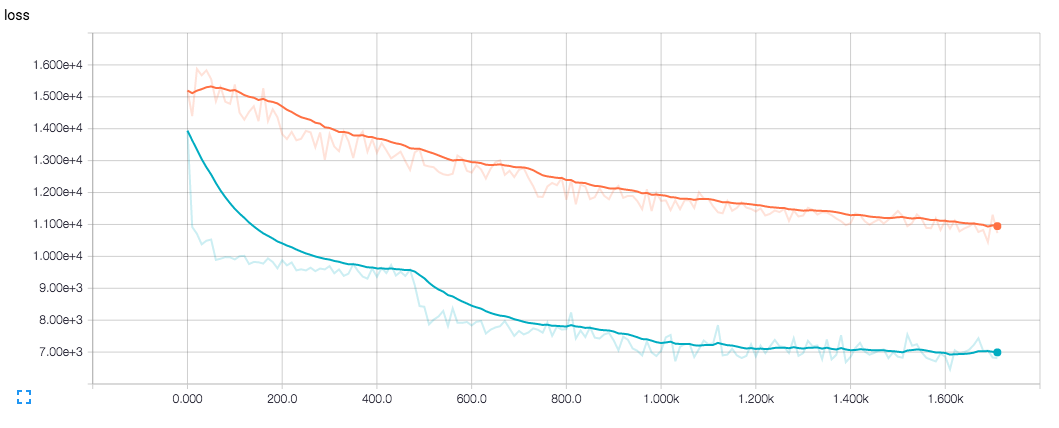
蓝色是训练的损失,橙色是早期的损失。
回答 1
Stack Overflow用户
发布于 2016-08-22 07:29:37
问题是我直接使用了tf.train.AdamOptimizer()。在优化过程中,它没有调用contrib.batch_norm中定义的操作来计算输入的运行均值/方差,所以均值/方差总是0.0/1.0。
解决方案是向GraphKeys.UPDATE_OPS集合添加依赖项。已经在contrib模块中定义了一个函数来执行此操作(optimize_loss())
https://stackoverflow.com/questions/39035041
复制相似问题
腾讯云开发者

Copyright © 2013 - 2026 Tencent Cloud. All Rights Reserved. 腾讯云 版权所有
深圳市腾讯计算机系统有限公司 ICP备案/许可证号:粤B2-20090059  粤公网安备44030502008569号
腾讯云计算(北京)有限责任公司 京ICP证150476号 | 京ICP备11018762号