
我的跳过列表真的是在N中搜索,而不是log(N)吗?
因此,我终于想我完成了创建一个工作跳过列表,并认为我应该检查我的工作,看看时间的搜索功能。我找到了一个关于如何使用clock()的教程,并将其实现如下:
#include <stdio.h>
#include <stdlib.h>
#include <time.h>
#include "skiplist.h"

int main() {
    // initialize
    SkipList *list = initSkipList();
    // numbers to search for, array to store time
    int n[] = {1, 10, 50, 100, 1000, 5000, 10000, 25000, 50000, 100000, 200000};
    double time[11];

    // insert
    for (int i = 1; i <= 200000; i++)
        insertElement(list, i);

    // search, time, print
    for (int i = 0; i < 11; i++) {
        clock_t t;
        t = clock();
        findElement(list, n[i]);
        t = clock() - t;
        double time_taken = ((double)t)/CLOCKS_PER_SEC; // in seconds
        ti[i] = time_taken;
        printf("fun() took %f seconds to execute \n", time_taken);
    }
    return 0;
}
我想,通过这样做并绘制N与时间之间的关系,我会得到一个看起来是对数的图形,但是我的图看起来却是线性的:
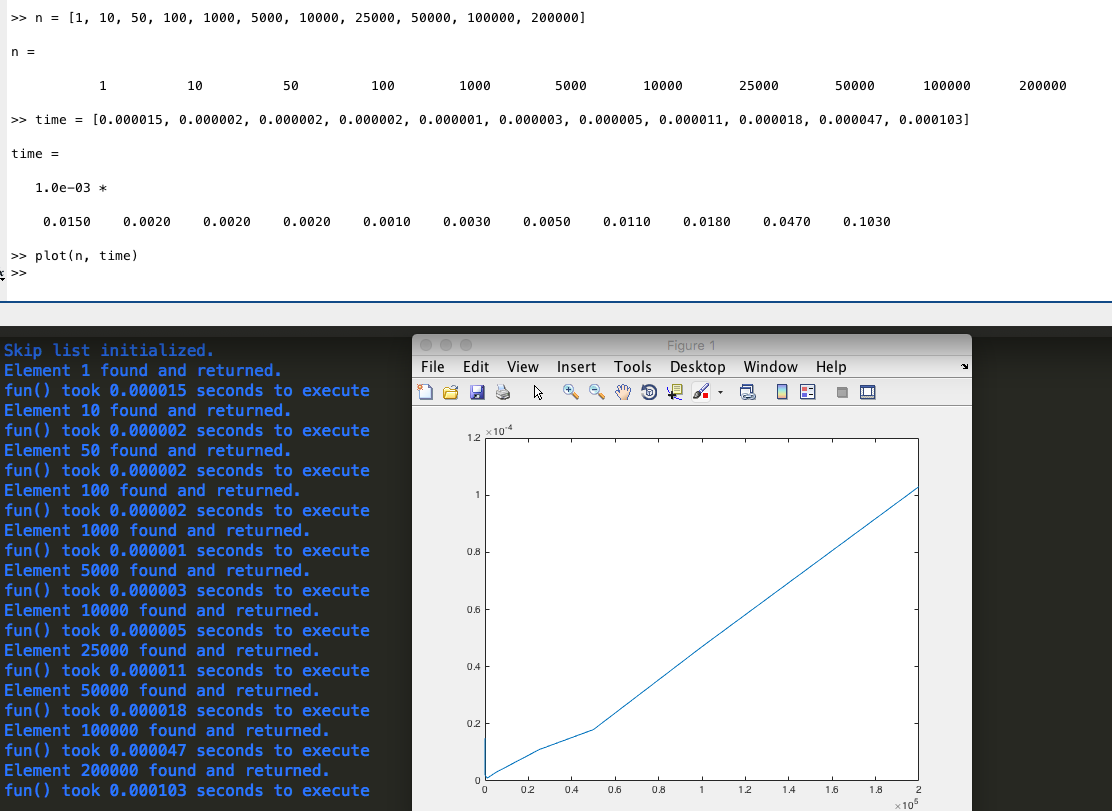
我是否误解了该如何对我的函数进行计时以尝试测试时间复杂性,还是我的跳过列表只是没有按应该的方式进行搜索?以下是我的整个跳过列表实现,以防万一,但搜索函数称为findElement()
#include <stdio.h>
#include <stdlib.h>
#include <time.h>
#include <math.h>

#ifndef SKIPLIST_H_
#define SKIPLIST_H_


// number of lists
#define MAXLEVEL 5

// node with pointers
typedef struct Node {
    int data;
    struct Node *next[1]; // or C99 using flexible array members: *next[]
} Node;


// skiplist
typedef struct SkipList {
    Node *header;
    int level;
    int count;
} SkipList;


// initialize skip list
SkipList* initSkipList() {
    int i;
    SkipList *list = calloc(1, sizeof(SkipList));
    if (!list) {
        printf("Memory Error\n");
        exit(1);
    }
    //list->level = 0;
    if ((list->header = calloc(1, sizeof(Node) + MAXLEVEL*sizeof(Node*))) == 0) {
        printf("Memory Error\n");
        exit(1);
    }
    for (i = 0; i <= MAXLEVEL; i++)
        list->header->next[i] = list->header;   // or = list->header?
    printf("Skip list initialized.\n");
    //srand(time(NULL));
    return list;
}

// insert into skip list, return pointer to node
Node* insertElement(SkipList *list,int data) {
    int i, newLevel;
    Node* temp = list->header;
    Node *update[MAXLEVEL+1];

    // find where data belongs
    for (i = list->level; i >= 0; i--) {
        while(temp->next[i] != list->header && temp->next[i]->data < data)
            temp = temp->next[i];
        update[i] = temp;
    }
    temp = temp->next[0];
    // if element already exists, just return it (no duplicates)
    if (temp != list->header && temp->data == data)
        return temp;

    // determine level (coin flips till failure or max level reached)
    for (newLevel = 0; (rand() < RAND_MAX/2) && (newLevel < MAXLEVEL); newLevel++); // Pr(4) == Pr(5)??
    if (newLevel > list->level) {
        for (i = list->level + 1; i <= newLevel; i++)
            update[i] =  list->header;
        list->level = newLevel;
    }

    // make new  node
    if ((temp = calloc(1, sizeof(Node) + newLevel*sizeof(Node*))) == 0) {
        printf("Memory Error\n");
        exit(1);
    }
    temp->data = data;
    list->count++;
    // update next links
    for (i = 0; i <= newLevel; i++) {
        temp->next[i] = update[i]->next[i];
        update[i]->next[i] = temp;
    }

    //printf("Element %d inserted into list. (level %d)\n", data, newLevel);
    return temp;
}


// delete node containing data
void deleteElement(SkipList *list, int data) {
    int i;
    Node *update[MAXLEVEL+1], *temp;
    temp = list->header;
    for (i = list->level; i >= 0; i--) {
        while (temp->next[i] != list->header && temp->next[i]->data < data)
            temp = temp->next[i];
        update[i] = temp;
    }
    // move to (possible) node to delete
    temp = temp->next[0];
    // if doesn't exist
    if (temp == list->header || temp->data != data) {
        printf("Element %d doesn't exist.\n", data);
        return;
    }
    // adjust next pointers
    for (i = 0; i <= list->level; i++) {
        if (update[i]->next[i] != temp) break;
        update[i]->next[i] = temp->next[i];
    }
    free (temp);
    printf("Element %d deleted from list.\n", data);
    list->count--;
    // adjust header level
    while ((list->level > 0) && (list->header->next[list->level] == list->header)) // double check
        list->level--;
}


// find node containing data
Node* findElement(SkipList *list, int data){
    int i;
    Node *temp = list->header;
    for (i = list->level; i >= 0; i--) {
        while (temp->next[i] != list->header && temp->next[i]->data < data)
            temp = temp->next[i];
    }
    temp = temp->next[0];
    if (temp != list->header && temp->data == data) {
        printf("Element %d found and returned.\n", data);
        return (temp);
    }
    printf("Element %d not found.\n", data);
    return 0;
}


/* Dynamic array for use in printSkipList() function */
typedef struct {
    int *array;
    size_t used;
    size_t size;
} Array;
void initArray(Array *a, size_t initialSize) {
    a->array = malloc(initialSize * sizeof(int));
    a->used = 0;
    a->size = initialSize;
}
void insertArray(Array *a, int element) {
    if (a->used == a->size) {
        a->size *= 2;
        a->array = realloc(a->array, a->size * sizeof(int));
    }
    a->array[a->used++] = element;
}
void freeArray(Array *a) {
    free(a->array);
    a->array = NULL;
    a->used = a->size = 0;
}


// print skip-list info and representational figure
void printSkipList(SkipList *list) {
    int i, j, k, pos = 0, prevPos = 0, diff, numDigits;
    Node* temp = list->header;
    Array a;

    // fill dynamic array with level 0 elements
    initArray(&a, 10);
    while (temp->next[0] != list->header) {
        temp = temp->next[0];
        insertArray(&a, temp->data);
    }
    temp = list->header;
    // print number of levels
    printf("\nNumber of levels in skip-list: %d\n", list->level + 1);
    printf("Number of elements in skip-list: %d\n", list->count);
    printf("Skip-list figure: \n");
    // print data
    for (i = list->level; i >= 0; i--) {
        pos = 0, prevPos = 0;
        while (temp->next[i] != list->header) {
        numDigits = 0;
            temp = temp->next[i];
            while (temp->data != a.array[pos]) {
                numDigits += floor (log10 (abs (a.array[pos]))) + 1;
                pos++;
            }
            pos++;
            diff = (pos - prevPos) - 1;
            if (diff >= 1) {
                for (j = 0; j < (4*diff)+numDigits; j++)
                        printf(" ");
            }
            printf("%d -> ", temp->data);
            prevPos = pos;
        }
        temp = list->header;
        printf("\n");
    }
    printf("\n\n");
}

#endif // SKIPLIST_H_
任何建议都是非常感谢的,谢谢。
回答 2
Stack Overflow用户
发布于 2016-07-22 23:15:38
你的防弹衣太小了。我认为原始文件的水平达到了lg(n),也就是列表大小的日志基2。
从Puch 1990年的原始论文中摘自:
测定MaxLevel 由于我们可以安全地在L(n)处设置上限,所以我们应该选择MaxLevel = L(N) (其中N是跳过列表中元素数的上限)。如果p= l/2,则使用MaxLevel = 16适合于包含最多2^16个元素的数据结构
通常,如果p为1/X,则使用列表大小的日志基X。
MAXLEVEL=5,我得到的结果和你看到的差不多。
evaitl@bb ~/se $ ./foo
Skip list initialized.
Element 1 found and returned.
fun() took 0.000014 seconds to execute
Element 10 found and returned.
fun() took 0.000002 seconds to execute
Element 50 found and returned.
fun() took 0.000002 seconds to execute
Element 100 found and returned.
fun() took 0.000002 seconds to execute
Element 1000 found and returned.
fun() took 0.000003 seconds to execute
Element 5000 found and returned.
fun() took 0.000004 seconds to execute
Element 10000 found and returned.
fun() took 0.000006 seconds to execute
Element 25000 found and returned.
fun() took 0.000011 seconds to execute
Element 50000 found and returned.
fun() took 0.000021 seconds to execute
Element 100000 found and returned.
fun() took 0.000044 seconds to execute
Element 200000 found and returned.
fun() took 0.000087 seconds to execute
将MAXLEVEL提高到20,我得到:
evaitl@bb ~/se $ ./foo
Skip list initialized.
Element 1 found and returned.
fun() took 0.000016 seconds to execute
Element 10 found and returned.
fun() took 0.000003 seconds to execute
Element 50 found and returned.
fun() took 0.000003 seconds to execute
Element 100 found and returned.
fun() took 0.000002 seconds to execute
Element 1000 found and returned.
fun() took 0.000002 seconds to execute
Element 5000 found and returned.
fun() took 0.000003 seconds to execute
Element 10000 found and returned.
fun() took 0.000004 seconds to execute
Element 25000 found and returned.
fun() took 0.000003 seconds to execute
Element 50000 found and returned.
fun() took 0.000004 seconds to execute
Element 100000 found and returned.
fun() took 0.000003 seconds to execute
Element 200000 found and returned.
fun() took 0.000004 seconds to execute
将400000和800000添加到n[]中:
evaitl@bb ~/se $ ./foo
Skip list initialized.
Element 1 found and returned.
fun() took 0.000016 seconds to execute
Element 10 found and returned.
fun() took 0.000001 seconds to execute
Element 50 found and returned.
fun() took 0.000001 seconds to execute
Element 100 found and returned.
fun() took 0.000002 seconds to execute
Element 1000 found and returned.
fun() took 0.000002 seconds to execute
Element 5000 found and returned.
fun() took 0.000002 seconds to execute
Element 10000 found and returned.
fun() took 0.000002 seconds to execute
Element 25000 found and returned.
fun() took 0.000004 seconds to execute
Element 50000 found and returned.
fun() took 0.000003 seconds to execute
Element 100000 found and returned.
fun() took 0.000003 seconds to execute
Element 200000 found and returned.
fun() took 0.000003 seconds to execute
Element 400000 found and returned.
fun() took 0.000004 seconds to execute
Element 800000 found and returned.
fun() took 0.000003 seconds to execute Stack Overflow用户
发布于 2016-07-22 22:47:47
你的计时方法是不传统的。通常,要检查算法性能,请
- 以几次尝试的平均数为例。
- 计时几种不同大小容器的性能。
伪码:
For N in [2..9]:
  Fill container with 10^N items
  lookupTime = 0;
  generate M values in range
  for i in [1..M]:
    lookupTime += duration(lookup(value[i]))
performance[N] = lookupTime/M;https://stackoverflow.com/questions/38535401
复制相似问题
腾讯云开发者

Copyright © 2013 - 2026 Tencent Cloud. All Rights Reserved. 腾讯云 版权所有
深圳市腾讯计算机系统有限公司 ICP备案/许可证号:粤B2-20090059  粤公网安备44030502008569号
腾讯云计算(北京)有限责任公司 京ICP证150476号 | 京ICP备11018762号