
ggpmisc和`dev=“tikz”中回归方程的“圆”或“`sprintf`”函数
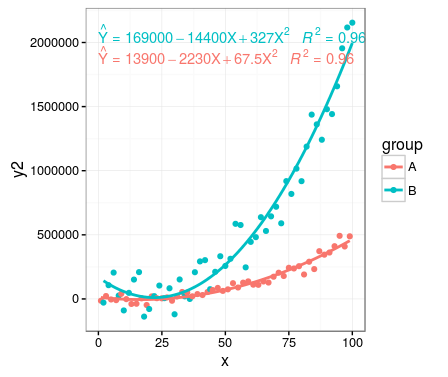
如何使用round或sprintf函数控制回归方程中的数字显示?在使用dev="tikz" =~"时,我也想不出如何使用~"。
library(ggplot2)
library(ggpmisc)

# generate artificial data
set.seed(4321)
x <- 1:100
y <- (x + x^2 + x^3) + rnorm(length(x), mean = 0, sd = mean(x^3) / 4)
my.data <- data.frame(x,
                      y,
                      group = c("A", "B"),
                      y2 = y * c(0.5,2),
                      block = c("a", "a", "b", "b"))

str(my.data)

# plot
ggplot(data = my.data, mapping=aes(x = x, y = y2, colour = group)) +
        geom_point() +
        geom_smooth(method = "lm", se =  FALSE, formula = y ~ poly(x=x, degree = 2, raw = TRUE)) +
        stat_poly_eq(
                       mapping     = aes(label = paste(..eq.label.., ..rr.label.., sep = "~~~"))
                     , data        = NULL
                     , geom        = "text"
                     , formula     = y ~ poly(x, 2, raw = TRUE)
                     , eq.with.lhs = "hat(Y)~`=`~"
                     , eq.x.rhs    = "X"
                     , label.x     = 0
                     , label.y     = 2e6
                     , vjust       = c(1.2, 0)
                     , position    = "identity"
                     , na.rm       = FALSE
                     , show.legend = FALSE
                     , inherit.aes = TRUE
                     , parse       = TRUE
                     ) +
        theme_bw()
回答 2
Stack Overflow用户
发布于 2016-05-22 20:49:46
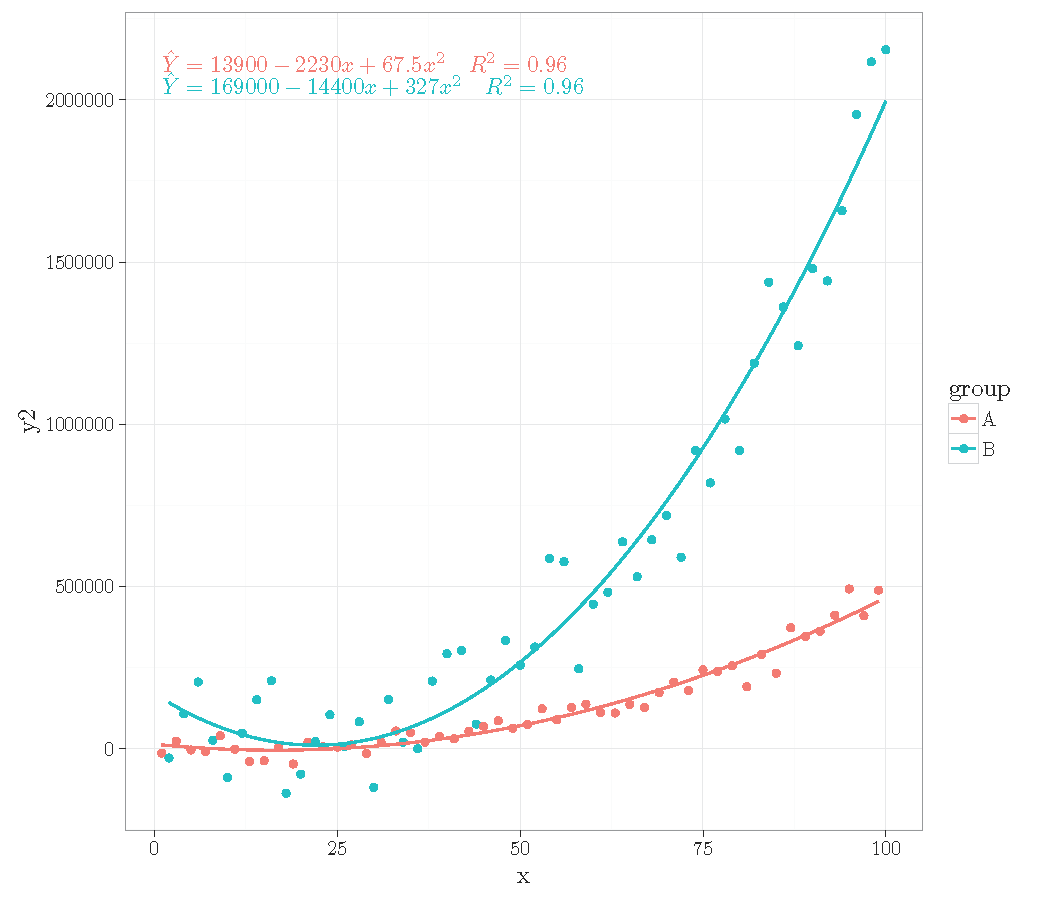
1)如果与'ggpmisc‘一起使用,下面的代码将回答问题的dev="tikz"部分( >= 0.2.9版)
\documentclass{article}

\begin{document}

<<setup, include=FALSE, cache=FALSE>>=
library(knitr)
opts_chunk$set(fig.path = 'figure/pos-', fig.align = 'center', fig.show = 'hold',
               fig.width = 7, fig.height = 6, size = "footnotesize", dev="tikz")
@


<<>>=
library(ggplot2)
library(ggpmisc)
@

<<>>=
# generate artificial data
set.seed(4321)
x <- 1:100
y <- (x + x^2 + x^3) + rnorm(length(x), mean = 0, sd = mean(x^3) / 4)
my.data <- data.frame(x,
                      y,
                      group = c("A", "B"),
                      y2 = y * c(0.5,2),
                      block = c("a", "a", "b", "b"))

str(my.data)
@

<<>>=
# plot
ggplot(data = my.data, mapping=aes(x = x, y = y2, colour = group)) +
  geom_point() +
  geom_smooth(method = "lm", se =  FALSE,
              formula = y ~ poly(x=x, degree = 2, raw = TRUE)) +
  stat_poly_eq(
    mapping     = aes(label = paste("$", ..eq.label.., "$\\ \\ \\ $",
                       ..rr.label.., "$", sep = ""))
    , geom        = "text"
    , formula     = y ~ poly(x, 2, raw = TRUE)
    , eq.with.lhs = "\\hat{Y} = "
    , output.type = "LaTeX"
   ) +
  theme_bw()
@

\end{document}
谢谢你的建议,我也一定会为它自己找到一个用途!
2)回答问题的round和sprintf部分。不能使用round或sprintf来更改数字数,stat_poly_eq当前使用具有三个有效数字的signif作为参数应用于整个系数向量。如果您想要完全控制,那么您可以使用另一个统计信息,stat_fit_glance,也就是ggpmisc (>= 0.2.8),它在内部使用broom:glance。它要灵活得多,但是您必须在对aes的调用中自己处理所有的形成过程。目前有一个问题,broom::glance似乎不能正确地使用poly,您需要显式地编写多项式方程作为参数传递给formula。
Stack Overflow用户
发布于 2016-05-22 18:27:00
Myaseen208,
下面是用.tex创建ggpmisc::stat_poly_eq()输出的问题的解决方法。我能够确认,您目前无法将stat_poly_eq()和"hat(Y)~=~"与library(tikzDevice)组合起来,以创建latex .tex输出。不过,我提供了一个解决方案,以便在过渡期间创建正确的.tex输出。
ggpmisc包的创建者佩德罗·阿法罗非常友好地接受了对ggpmisc::stat_poly_eq()的增强请求。根据所要求的错误报告归档并引用如下。
代码示例:
以下代码将生成没有帽子符号的图形:
# Load required packages
requiredPackages <- requiredPackages <- c("ggplot2", "ggpmisc", "tikzDevice", "latex2exp")

# ipak - Check to see if the package is installed, if not install and then load...
ipak <- function(pkg)
{
  new.pkg <- pkg[!(pkg %in% installed.packages()[, "Package"])]
  if (length(new.pkg))
    install.packages(new.pkg, dependencies = TRUE)
  sapply(pkg, require, character.only = TRUE)
}

ipak(requiredPackages)

# generate artificial data
set.seed(4321)
x <- 1:100
y <- (x + x ^ 2 + x ^ 3) + rnorm(length(x), mean = 0, sd = mean(x ^ 3) / 4)
my.data <- data.frame(
  x, y,
  group = c("A", "B"),
  y2 = y * c(0.5, 2),
  block = c("a", "a", "b", "b")
)

# Define Formaula..
formulaDefined <- (y ~ (poly(x = x, degree = 2, raw = TRUE)))

gp <- ggplot(data = my.data, mapping = aes(x = x, y = y2, colour = group))
gp <- gp + geom_point()
gp <- gp + geom_smooth(method = "lm", se =  FALSE, formula = formulaDefined )
gp <- gp + stat_poly_eq(
  aes(label = paste(..eq.label.., "~~~", ..rr.label.., sep = "")),
#  eq.with.lhs = "italic(hat(y))~`=`~",
  formula     = formulaDefined,
  geom        = "text",
  label.x     = 0,
  label.y     = 2e6,
  vjust       = c(1.2, 0),
  position    = "identity",
  na.rm       = FALSE,
  show.legend = FALSE,
  inherit.aes = TRUE,
  parse       = TRUE)
gp <- gp + theme_bw()
gp
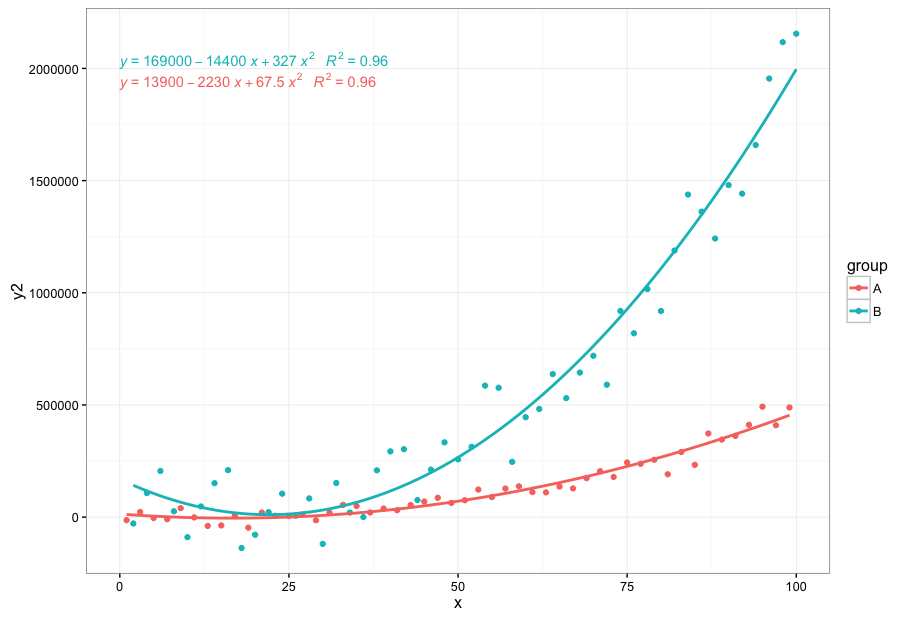
现在,我们可以修改此代码及其tikz output,以创建所需的结果:
Tikz码解
第一步是修改代码以输出所需的.tex文件。这样,我们就可以利用gsub()在.tex文件中找到所需的行,并将{\itshape y};替换为{\^{y}}; Line、646和693。
# Load required packages
requiredPackages <- requiredPackages <- c("ggplot2", "ggpmisc", "tikzDevice", "latex2exp")

# ipak - Check to see if the package is installed, if not install and then load...
ipak <- function(pkg)
{
  new.pkg <- pkg[!(pkg %in% installed.packages()[, "Package"])]
  if (length(new.pkg))
    install.packages(new.pkg, dependencies = TRUE)
  sapply(pkg, require, character.only = TRUE)
}

ipak(requiredPackages)

# generate artificial data
set.seed(4321)
x <- 1:100
y <- (x + x ^ 2 + x ^ 3) + rnorm(length(x), mean = 0, sd = mean(x ^ 3) / 4)
my.data <- data.frame(
  x, y,
  group = c("A", "B"),
  y2 = y * c(0.5, 2),
  block = c("a", "a", "b", "b")
)

setwd("~/dev/stackoverflow/37242863")

texFile <- "./test2.tex"
# setup tex output file
tikz(file = texFile, width = 5.5, height = 5.5)

#Define Formaula..
formulaDefined <- (y ~ (poly(x = x, degree = 2, raw = TRUE)))

gp <- ggplot(data = my.data, mapping = aes(x = x, y = y2, colour = group))
gp <- gp + geom_point()
gp <- gp + geom_smooth(method = "lm", se =  FALSE, formula = formulaDefined )
gp <- gp + stat_poly_eq(
  aes(label = paste(..eq.label.., "~~~", ..rr.label.., sep = "")),
#  eq.with.lhs = "italic(hat(y))~`=`~",
  formula     = formulaDefined,
  geom        = "text",
  label.x     = 0,
  label.y     = 2e6,
  vjust       = c(1.2, 0),
  position    = "identity",
  na.rm       = FALSE,
  show.legend = FALSE,
  inherit.aes = TRUE,
  parse       = TRUE)
gp <- gp + theme_bw()
gp
dev.off()

## OK, now we can take the test.txt file and replace the relevant attributes to
## add the hat back to the y in the .tex output file...

texOutputFile <- readLines(texFile)
y <- gsub('itshape y', '^{y}', texOutputFile )
cat(y, file=texFile, sep="\n")
Tex测试框架:
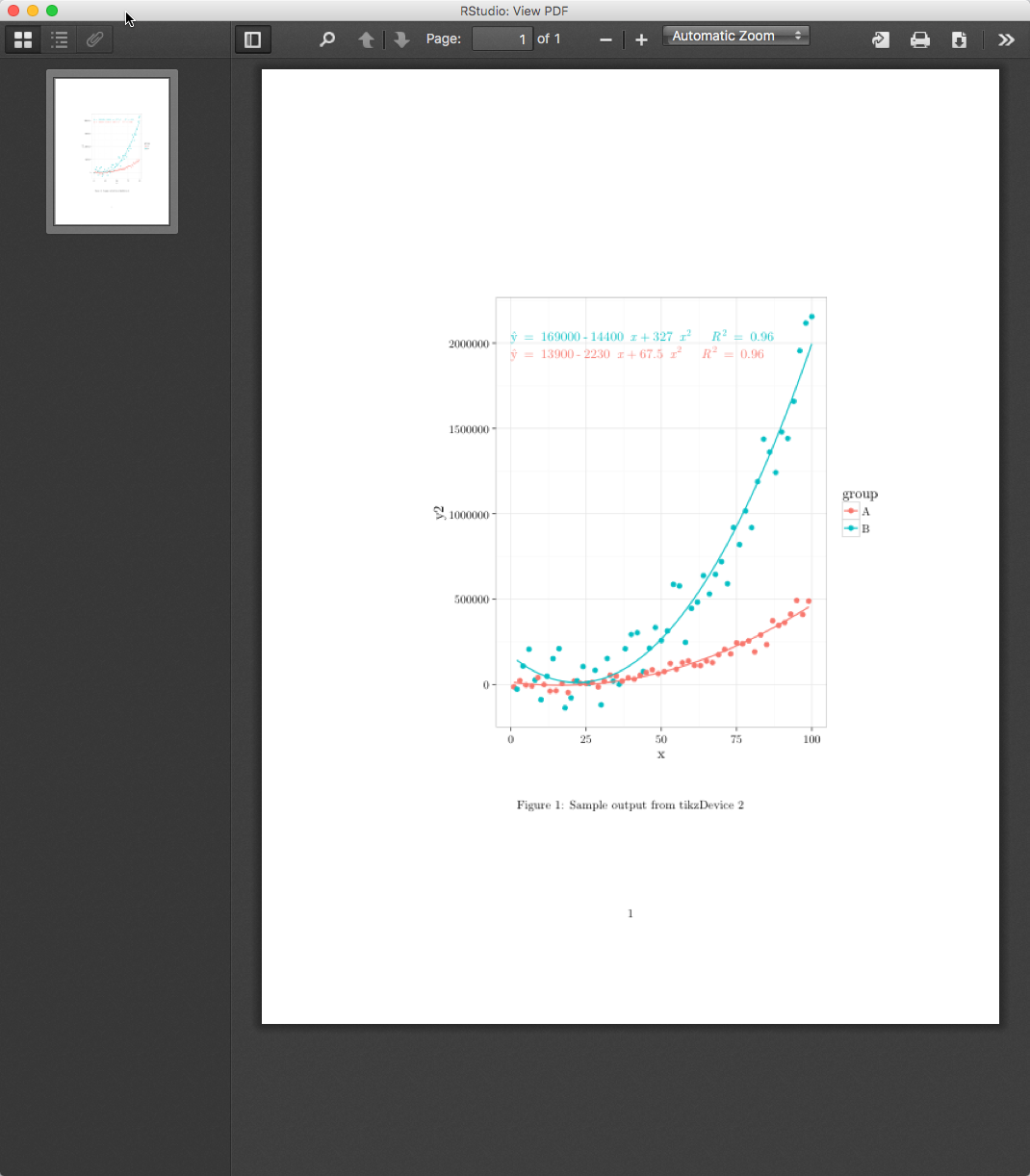
为了测试解决方案,我们可以创建一个小型的乳胶测试工具。您可以在RStudio t1.tex中加载该文件,然后编译它;它将引入通过前面提供的代码生成的test2.text。
注:RStudio是一个用于编译R.
\documentclass{article}

\usepackage{tikz}

\begin{document}

\begin{figure}[ht]
\input{test2.tex}
\caption{Sample output from tikzDevice 2}
\end{figure}

\end{document}
结果:
交替解
另一种选择可能是使用geom_text(),这种方法的缺点是您必须自己编写一个回归线方程函数。这一点在您上一篇文章中讨论过:Adding Regression Line Equation and R2 on graph
如果你需要一个详细的解决方案与geom_text,然后平我。另一种选择是用我所做的ggpmisc提交一个bug报告,看看作者是否已经或能够解决。
Bug报告:eq-fails-when-used-with
我希望上面的内容能有所帮助。
https://stackoverflow.com/questions/37242863
复制相似问题
腾讯云开发者

Copyright © 2013 - 2026 Tencent Cloud. All Rights Reserved. 腾讯云 版权所有
深圳市腾讯计算机系统有限公司 ICP备案/许可证号:粤B2-20090059  粤公网安备44030502008569号
腾讯云计算(北京)有限责任公司 京ICP证150476号 | 京ICP备11018762号