
Spring在JUNIT中创建了额外的线程
Spring在JUNIT中创建了额外的线程
提问于 2016-02-18 11:48:38
我的Springconfig.xml中有简单的任务执行器,并附加了几条链。
      <channel id="inputChannel" />
    <task:executor id="threadPoolExecutor" pool-size="2" />
    <publish-subscribe-channel id="multiCastChannel"
        task-executor="threadPoolExecutor" />

    <chain input-channel="inputChannel"
        output-channel="multiCastChannel">
        <json-to-object-transformer
            type="com.company.integration.domain.DomainObject" />
        <service-activator ref="validator"
            method="validate" />
</chain>

<chain input-channel="multiCastChannel"
        output-channel="inventoryAdjustmentOutputChannelOne">
        <service-activator ref="adapterOne"
            method="buildOutputMessageOne" />
</chain>
<chain input-channel="multiCastChannel"
        output-channel="inventoryAdjustmentOutputChannelTwo">
        <service-activator ref="adapterTwo"
            method="buildOutputMessageTwo" />
</chain>
当消息发布到"inputChannel“并在处理后发送到"multuCastChannel”时,就会创建两个线程,而不会出现以下问题
threadPoolExecutor-1 threadPoolExecutor-2
每输入一条消息,这两条信息只创建一次,这很好。但当我试着用JUnit做同样的测试时.每个"multiCastChannel“链执行两次.意味着链中的服务激活器(adapterOne,adapterTwo)正在调用两次,每个链...which都是有线的。
知道为什么JUnit会有这种行为吗?
下面是Junit代码段
@RunWith(SpringJUnit4ClassRunner.class)
@ContextConfiguration(locations = { "classpath:configuration/spring-config.xml"})
@FixMethodOrder(MethodSorters.NAME_ASCENDING)
@PropertySource("classpath:application.properties")
@SuppressWarnings("unchecked")
@WebAppConfiguration
@DirtiesContext(classMode = DirtiesContext.ClassMode.AFTER_EACH_TEST_METHOD)
public class InventoryAdjustmentMessageTest {


    @Autowired
    private DirectChannel inputChannel;


    @Test
    public void testTaskShed()
            throws IOException, InterruptedException, JMSException {
        String validInput = setup("valid-message.txt");
        Message<String> inputMessage = TextMessageUtil.createNewGenericMessage(validInput);
        inputChannel.send(inputMessage);
        Thread.sleep(5000);
}
Spring集成版本: 4.1.6
添加应用程序配置信息:
@Import({ HarnessConfiguration.class, LocalConfiguration.class, MongoDbConfiguration.class, WebConfiguration.class,
        WebsphereMQJMSConfiguration.class })
@Configuration
@EnableWebMvc
@ComponentScan(basePackages = { "com.abc.inventory.adjustment.integration.service",
        "com.abc.inventory.adjustment.integration.domain" }, useDefaultFilters = false, excludeFilters = {
                @ComponentScan.Filter(type = FilterType.ASSIGNABLE_TYPE, value = ApplicationConfiguration.class) }, includeFilters = {
                        @ComponentScan.Filter(type = FilterType.ANNOTATION, value = { Controller.class,
                                Component.class }) })
@ImportResource({ "classpath:configuration/spring-config.xml", "classpath:configuration/spring-adapters.xml" })
@EnableMongoRepositories("com.abc.inventory.adjustment.integration.service.audit.repository")
@EnableAutoConfiguration
@EnableMongoAuditing
public class ApplicationConfiguration extends WebMvcConfigurerAdapter {
//
}
添加调试快照
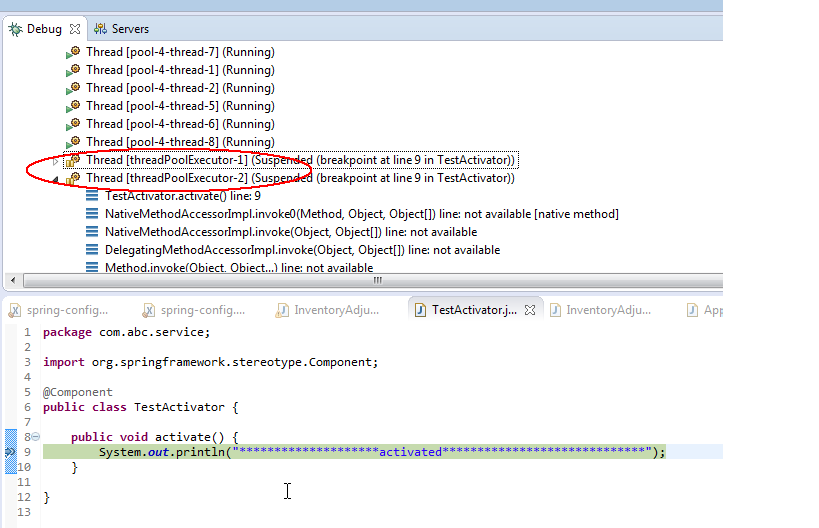
-Tej
回答 1
Stack Overflow用户
回答已采纳
发布于 2016-02-18 22:05:13
在这里,您可以找到简单的测试用例来演示正确的行为:
<task:executor id="executor" pool-size="2"/>

<publish-subscribe-channel id="pubSubChannel" task-executor="executor" />

<service-activator input-channel="pubSubChannel" expression="T(System).out.println(payload)"/>

<service-activator input-channel="pubSubChannel" expression="T(System).out.println('foo: ' + payload)"/>@Test
public void testPubSubChannel() throws InterruptedException {
ConfigurableApplicationContext context = new ClassPathXmlApplicationContext("pubSubChannelConfig.xml", getClass());
MessageChannel channel = (MessageChannel) context.getBean("pubSubChannel");
for (int i = 0; i < 10; i++) {
channel.send(new GenericMessage<Integer>(i));
}
Thread.sleep(10000);
context.close();
}结果如下:
foo: 0
0
foo: 1
1
2
foo: 2
3
foo: 3
4
foo: 4
5
foo: 5
6
foo: 6
7
foo: 7
8
foo: 8
9
foo: 9页面原文内容由Stack Overflow提供。腾讯云小微IT领域专用引擎提供翻译支持
原文链接:
https://stackoverflow.com/questions/35480640
复制相关文章
相似问题
腾讯云开发者

Copyright © 2013 - 2026 Tencent Cloud. All Rights Reserved. 腾讯云 版权所有
深圳市腾讯计算机系统有限公司 ICP备案/许可证号:粤B2-20090059  粤公网安备44030502008569号
腾讯云计算(北京)有限责任公司 京ICP证150476号 | 京ICP备11018762号