
分段封装中的等斜率和相对斜率
分段封装中的等斜率和相对斜率
提问于 2016-02-13 18:16:11
嗨,我试着使用R中的分段包来拟合分段线性回归模型来估计我的数据中的断点。我使用了下面的代码来获得这个图形。
library(segmented)
set.seed(5)
x <- c(1:10, 13:22)
y <- numeric(20)
## Create first segment
y[1:10] <- 20:11 + rnorm(10, 0, 1.5)
## Create second segment
y[11:20] <- seq(11, 15, len=10) + rnorm(10, 0, 1.5)

## fitting a linear model
lin.mod <- lm(y~x)
segmented.mod <- segmented(lin.mod, seg.Z = ~x, psi=15)
summary(segmented.mod)
plot(x,y, pch=".",cex=4,xlab="x",ylab="y")
plot(segmented.mod, add=T, lwd = 3,col = "red")
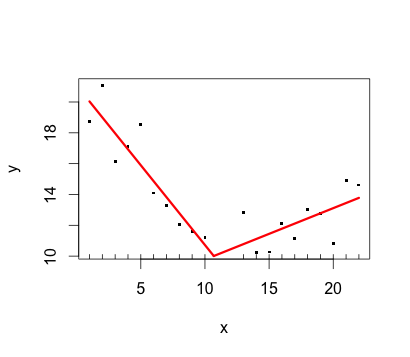
理论计算表明,断点附近两条线的斜率应该相等,但在符号上相反。我刚开始学习lm和glms。我希望能有一种方法来估计受此关系约束的斜坡的断点,slope2 1=-slope2 2。
回答 1
Stack Overflow用户
回答已采纳
发布于 2016-02-13 20:21:25
分段包中不支持这一点。
nls2与"plinear-brute"算法可结合使用。在输出中,.lin1和.lin2分别是常数项和斜率。这将尝试x范围内的每个值,作为一个可能的bp来拟合每个值的线性回归。
library(nls2)

st <- data.frame(bp = seq(min(x), max(x)))
nls2(y ~ cbind(1, abs(x - bp)), start = st, alg = "plinear-brute")
给予:
Nonlinear regression model
  model: y ~ cbind(1, abs(x - bp))
   data: parent.frame()
       bp     .lin1     .lin2
14.000000  9.500457  0.709624
 residual sum-of-squares: 45.84213

Number of iterations to convergence: 22
Achieved convergence tolerance: NA
下面是另一个例子,它可以澄清这一点,因为它是从相同的模型中生成数据的:
library(nls2)

set.seed(123)
n <- 100
bp <- 25
x <- 1:n
y <- rnorm(n, 10 + 2 * abs(x - bp))

st <- data.frame(bp = seq(min(x), max(x)))
fm <- nls2(y ~ cbind(1, abs(x - bp)), start = st, alg = "plinear-brute")
给予:
> fm
Nonlinear regression model
  model: y ~ cbind(1, abs(x - bp))
   data: parent.frame()
    bp  .lin1  .lin2
25.000  9.935  2.005
 residual sum-of-squares: 81.29

Number of iterations to convergence: 100
Achieved convergence tolerance: NA注:在上面的中,我们假设bp是x范围内的一个整数,但是如果不需要这样的条件,我们可以通过使用nls2的结果作为nls优化的起始值,即nls(y ~ cbind(1, abs(x - bp)), start = coef(fm)[1], alg = "plinear")来放松。
页面原文内容由Stack Overflow提供。腾讯云小微IT领域专用引擎提供翻译支持
原文链接:
https://stackoverflow.com/questions/35383554
复制相关文章
相似问题
腾讯云开发者

Copyright © 2013 - 2026 Tencent Cloud. All Rights Reserved. 腾讯云 版权所有
深圳市腾讯计算机系统有限公司 ICP备案/许可证号:粤B2-20090059  粤公网安备44030502008569号
腾讯云计算(北京)有限责任公司 京ICP证150476号 | 京ICP备11018762号