
使用多列时无法使用带计数(*)的分区
假设我有一个具有下列列的表:
- 类型
- 部门
- 供货商
- 订单
- 合计
我想查询这些数据,以便得到有序的结果,首先按类型分组。命令是订单的数量。然后,以下查询 for me (http://sqlfiddle.com/#!15/78cc1/1)运行良好:
WITH company_sales(type, department, supplier, order_number, total) AS (
   VALUES
     ('Edibles'    , 'Department-1', 'Supplier-1' , 'ORDER-1' ,   10)
   , ('Edibles'    , 'Department-1', 'Supplier-2' , 'ORDER-2' ,   20)
   , ('Edibles'    , 'Department-1', 'Supplier-3' , 'ORDER-3' ,   30)
   , ('Edibles'    , 'Department-1', 'Supplier-4' , 'ORDER-4' ,   40)
   , ('Edibles'    , 'Department-2', 'Supplier-5' , 'ORDER-5' ,   50)
   , ('Edibles'    , 'Department-2', 'Supplier-6' , 'ORDER-6' ,   60)
   , ('Edibles'    , 'Department-3', 'Supplier-7' , 'ORDER-7' ,   70)
   , ('Edibles'    , 'Department-3', 'Supplier-8' , 'ORDER-8' ,   80)
   , ('Edibles'    , 'Department-3', 'Supplier-9' , 'ORDER-9' ,   90)
   , ('Edibles'    , 'Department-3', 'Supplier-9' , 'ORDER-10',  100)
   , ('Edibles'    , 'Department-4', 'Supplier-10', 'ORDER-11',  110)
   , ('Non-Edibles', 'Department-2', 'Supplier-11', 'ORDER-12', 1000)
   , ('Non-Edibles', 'Department-3', 'Supplier-12', 'ORDER-13', 1010)
   , ('Non-Edibles', 'Department-3', 'Supplier-13', 'ORDER-14', 1020)
   , ('Non-Edibles', 'Department-3', 'Supplier-14', 'ORDER-15', 1030)
   , ('Non-Edibles', 'Department-3', 'Supplier-14', 'ORDER-16', 1040)
   , ('Non-Edibles', 'Department-4', 'Supplier-15', 'ORDER-17', 1050)
)
SELECT cs.type,
       count(*)   sum_total_count,
       sum(total) sum_grand_total
FROM   company_sales cs
GROUP  BY cs.type
ORDER  BY Sum(Count(*)) OVER (partition BY cs.type) DESC,
cs.type ASC;如果我想查询这些数据,以便得到有序的结果,首先按类型分组,然后按部门分组。命令是订单的数量。然后,以下查询 for me (http://sqlfiddle.com/#!15/78cc1/2)运行良好:
WITH company_sales(type, department, supplier, order_number, total) AS ( ...)
SELECT cs.type,
       cs.department,
       count(*)   sum_total_count,
       sum(total) sum_grand_total
FROM   company_sales cs
GROUP  BY cs.type,
          cs.department
ORDER  BY Sum(Count(*)) OVER (partition BY cs.type) DESC,
          Sum(Count(*)) OVER (partition BY cs.type, cs.department) DESC,
          cs.type ASC,
cs.department ASC;但是,当我想要订购结果时,遵循相同的模式,首先按类型分组,然后按部门分组,然后按供应商分组,订单是订单的数量。然后,下面的查询对我来说不工作(http://sqlfiddle.com/#!15/78cc1/3):
WITH company_sales(type, department, supplier, order_number, total) AS (...)
SELECT cs.type,
       cs.department,
       cs.supplier,
       count(*)   sum_total_count,
       sum(total) sum_grand_total
FROM   company_sales cs
GROUP  BY cs.type,
          cs.department,
          cs.supplier
ORDER  BY Sum(Count(*)) OVER (partition BY cs.type) DESC,
          Sum(Count(*)) OVER (partition BY cs.type, cs.department) DESC,
          Sum(Count(*)) OVER (partition BY cs.type, cs.department, cs.supplier) DESC,
          cs.type ASC,
          cs.department ASC,
          cs.supplier ASC;
以上查询的结果如下:
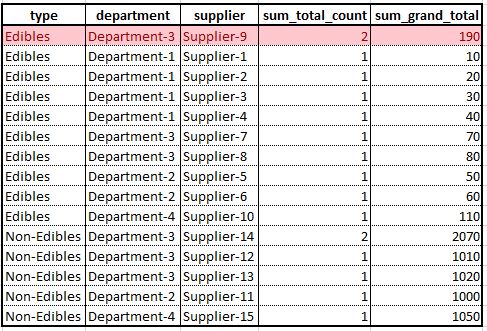
鉴于此,我希望以下几点:
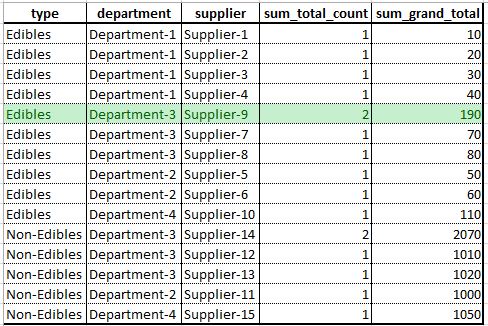
我哪里出问题了?
回答 1
Stack Overflow用户
发布于 2016-01-27 04:27:33
两项初步工作:
- 从不使用为列名保留关键字。在
type -> typ和order -> ordnum之后。 - 学习使用
VALUES子句。我建议您按照下面的示例编辑您的问题,不需要重复3次(只需使用类似于WITH company_sales (...) AS (...) SELECT ...的内容,例如,PG手册就是这样做的)。事实上,你的问题过于冗长,人们不会仔细阅读。(好的- Erwin Brandstetter从OP中编辑了这篇文章)
First
查询根据所需的顺序返回结果,因为您指定的ORDER BY子句顺序错误。在typ = 'Edibles'下,1部门和3部门都有4个订单。通过分析您的ORDER BY子句,我们可以看到以下内容:
      -- 1. This orders by the type with the most orders - OK
ORDER BY Sum(Count(*)) OVER (PARTITION BY cs.type) DESC,
      -- 2. Number of orders by department within each type - OK but tie #1 and #3
         Sum(Count(*)) OVER (PARTITION BY cs.type, cs.department) DESC,
      -- 3. Number of orders by supplier with each type, department - NOT OK
         Sum(Count(*)) OVER (PARTITION BY cs.type, cs.department, cs.supplier) DESC,
      -- 4. In case of ties, order by type name - OK
         cs.type ASC,
      -- 5. In case of ties, order by department name - OK
         cs.department ASC,
      -- 6. In case of ties, order by supplier name - OK
cs.supplier ASC;那为什么3号不行呢?实际上,#3很好,但是#4、#5和#6的位置不对。您希望按类型的数量,然后是部门,然后是供应商,并按字母顺序解决关系。在每次对行数进行排序后(删除过时的表别名和ASC子句),您应该立即解决这些联系:
ORDER BY
  Sum(Count(*)) OVER (PARTITION BY typ) DESC, typ,
  Sum(Count(*)) OVER (PARTITION BY typ, department) DESC, department,
  Sum(Count(*)) OVER (PARTITION BY typ, department, supplier) DESC, supplier;
那你为什么点错了?那么,“可供食用”中的第一和第三部门各有四行,因此它们被绑在一起。以下条款订购供应商9,比其他供应商高出2份,各订购1份。按部门名称订购之前,供应商订单打破部门之间的联系,您的所有行订单都很好。
然后
Sum(Count(*)) OVER (PARTITION BY ...)条款是无稽之谈。count(*)为分区中的每一行分配一个新列,其中包含该分区中的行数。再加一次,就会得到与基本行数完全相同的排序属性的正方形。
此外,Sum(Count(*)) OVER (PARTITION BY typ, department, supplier)是无用的,因为您已经在选择列表中GROUP BY这些列以生成count(*)。
给出
将所有这些组合在一起,并使用位置参数来简化,然后我们得到:
WITH company_sales(typ, department, supplier, ordnum, total) AS (...)
SELECT typ,
       department,
       supplier,
       count(*) sum_total_count,
       sum(total) sum_grand_total
FROM   company_sales
GROUP  BY 1, 2, 3
ORDER BY
      count(*) OVER (PARTITION BY typ) DESC, 1,
      count(*) OVER (PARTITION BY typ, department) DESC, 2,
      4 DESC, 3;
其结果是:
     typ     |  department  |  supplier   | sum_total_count | sum_grand_total
-------------+--------------+-------------+-----------------+-----------------
 Edibles     | Department-1 | Supplier-1  |               1 |              10
 Edibles     | Department-1 | Supplier-2  |               1 |              20
 Edibles     | Department-1 | Supplier-3  |               1 |              30
 Edibles     | Department-1 | Supplier-4  |               1 |              40
 Edibles     | Department-3 | Supplier-9  |               2 |             190
 Edibles     | Department-3 | Supplier-7  |               1 |              70
 Edibles     | Department-3 | Supplier-8  |               1 |              80
 Edibles     | Department-2 | Supplier-5  |               1 |              50
 Edibles     | Department-2 | Supplier-6  |               1 |              60
 Edibles     | Department-4 | Supplier-10 |               1 |             110
 Non-Edibles | Department-3 | Supplier-12 |               1 |            1010
 Non-Edibles | Department-3 | Supplier-13 |               1 |            1020
 Non-Edibles | Department-3 | Supplier-14 |               2 |            2070
 Non-Edibles | Department-2 | Supplier-11 |               1 |            1000
 Non-Edibles | Department-4 | Supplier-15 |               1 |            1050
(15 rows)https://stackoverflow.com/questions/35026644
复制相似问题
腾讯云开发者

Copyright © 2013 - 2026 Tencent Cloud. All Rights Reserved. 腾讯云 版权所有
深圳市腾讯计算机系统有限公司 ICP备案/许可证号:粤B2-20090059  粤公网安备44030502008569号
腾讯云计算(北京)有限责任公司 京ICP证150476号 | 京ICP备11018762号