
选择光栅数据有效范围的最快方法
使用R,我需要选择一个给定光栅的有效范围(从包raster)以最快的方式。我试过这个:
library(raster)
library(microbenchmark)
library(ggplot2)
library(compiler)

r <- raster(ncol=100, nrow=100)
r[] <- runif(ncell(r))

#Let's see if precompiling helps speed...
f <- function(x, min, max) reclassify(x, c(-Inf, min, NA, max, Inf, NA))
g <- cmpfun(f)

#Benchmark!
compare <- microbenchmark(
    calc(r, fun=function(x){ x[x < 0.2] <- NA; x[x > 0.8] <- NA; return(x)}),
    reclassify(r, c(-Inf, 0.2, NA, 0.8, Inf, NA)),
    g(r, 0.2, 0.8),
    times=100)
autoplot(compare) #Reclassify is much faster, precompiling doesn't help much.

#Check they are the same...
identical(
          calc(r, fun=function(x){ x[x < 0.2] <- NA; x[x > 0.8] <- NA; return(x)}),
          reclassify(r, c(-Inf, 0.2, NA, 0.8, Inf, NA))
) #TRUE
identical(
          reclassify(r, c(-Inf, 0.2, NA, 0.8, Inf, NA)),
          g(r, 0.2, 0.8),
) #TRUE
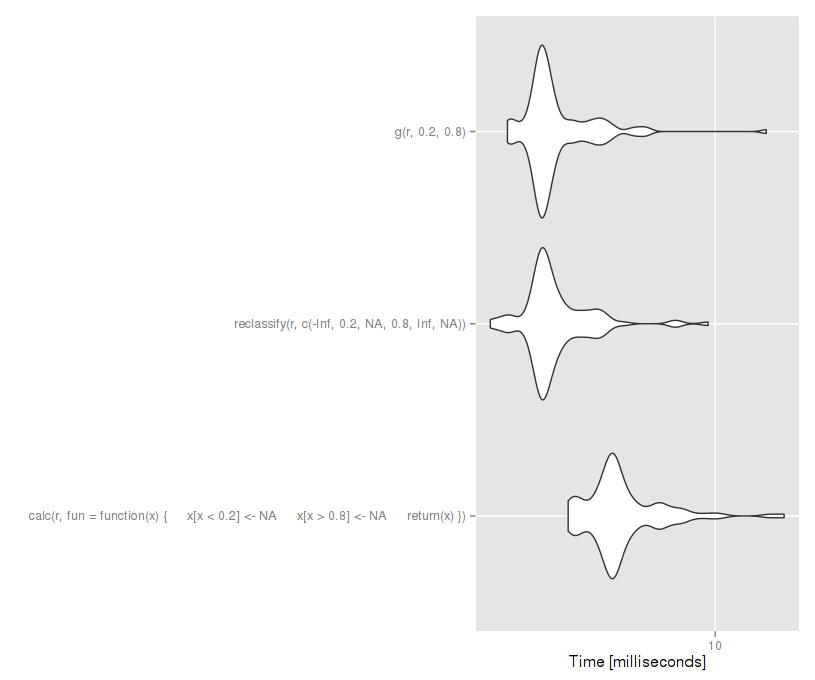
重分类方法要快得多,但我相信它可以加快速度。我怎样才能做到呢?
回答 3
Stack Overflow用户
发布于 2015-12-03 12:52:01
还有一种方法:
h <- function(r, min, max) {
  rr <- r[]
  rr[rr < min | rr > max] <- NA
  r[] <- rr
  r
}

i <- cmpfun(h)

identical(
  i(r, 0.2, 0.8),
  g(r, 0.2, 0.8)
)


#Benchmark!
compare <- microbenchmark(
  calc(r, fun=function(x){ x[x < 0.2] <- NA; x[x > 0.8] <- NA; return(x)}),
  reclassify(r, c(-Inf, 0.2, NA, 0.8, Inf, NA)),
  g(r, 0.2, 0.8),
  h(r, 0.2, 0.8),
  i(r, 0.2, 0.8),
  times=100)
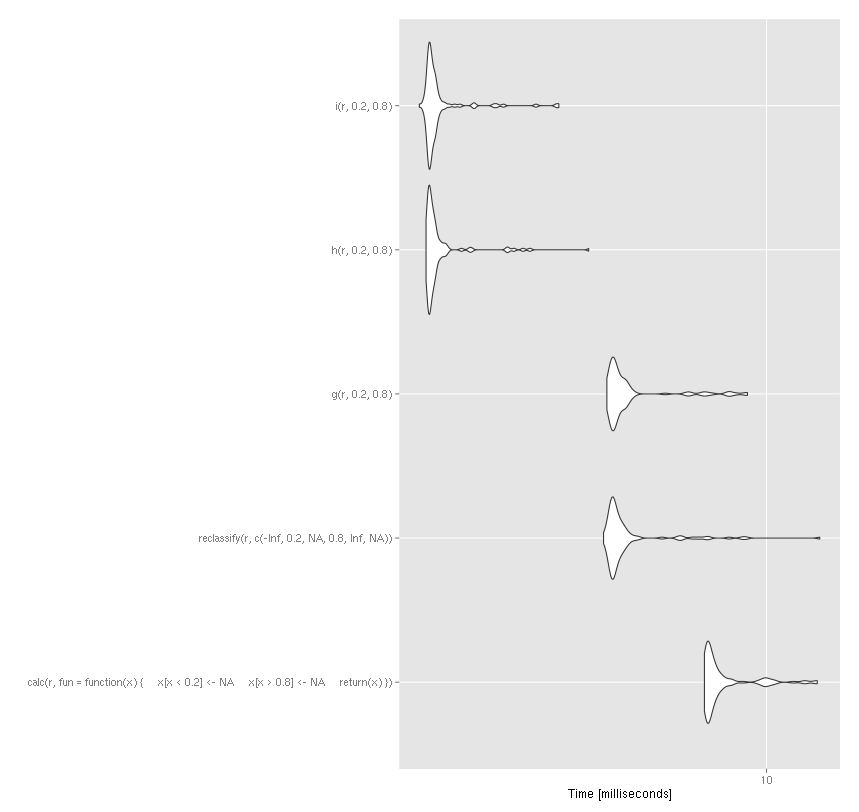
autoplot(compare)
编译在这种情况下没有多大帮助。
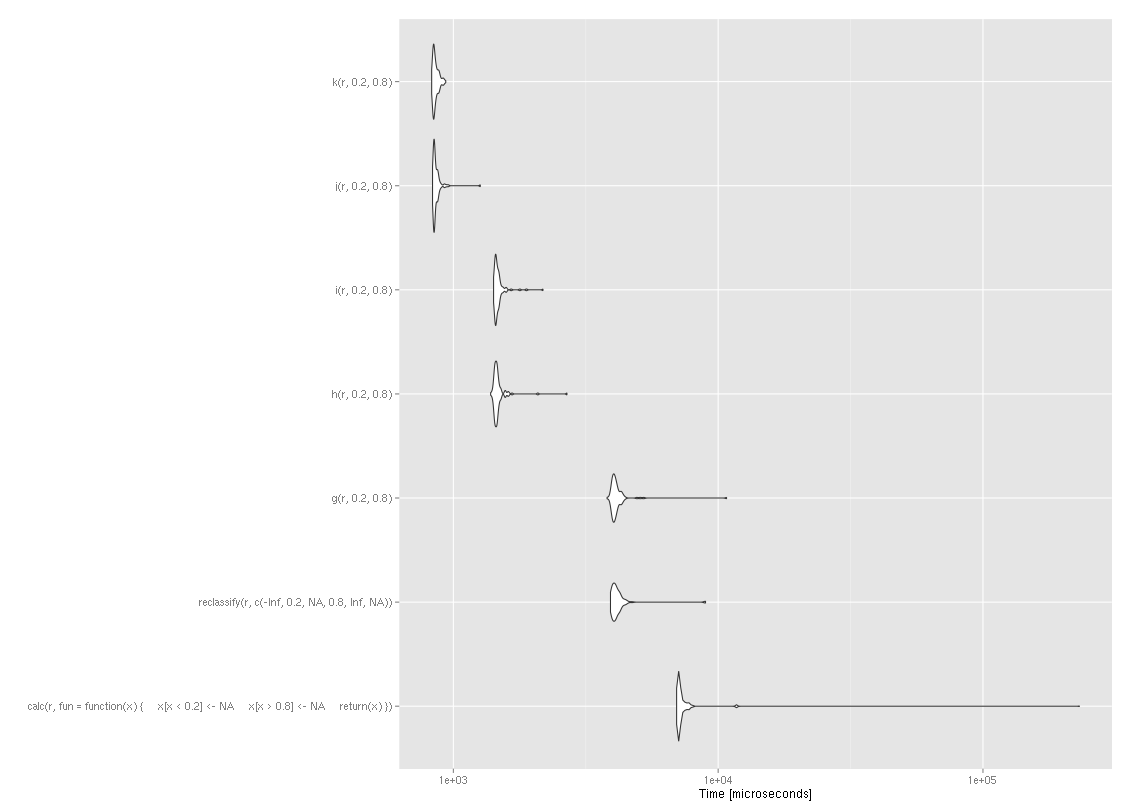
您甚至可以通过直接使用@访问光栅对象的插槽来进一步提高速度(尽管通常不鼓励这样做)。
j <- function(r, min, max) {
  v <- r@data@values
  v[v < min | v > max] <- NA
  r@data@values <- v
  r
}

k <- cmpfun(j)

identical(
  j(r, 0.2, 0.8)[],
  g(r, 0.2, 0.8)[]
)
Stack Overflow用户
发布于 2016-03-28 20:27:08
虽然对这个问题的公认答案对于光栅来说是正确的,但重要的是要注意,最快的安全函数高度依赖光栅大小:@rengis提供的函数h和i只有相对较小的栅格(和相对简单的重分类)才更快。在OP的示例中,只需将光栅r的大小增加10级,就可以使reclassify更快:
# Code from OP @AF7
library(raster)
library(microbenchmark)
library(ggplot2)
library(compiler)

#Let's see if precompiling helps speed...
f <- function(x, min, max) reclassify(x, c(-Inf, min, NA, max, Inf, NA))
g <- cmpfun(f)

# Funcions from @rengis
h <- function(r, min, max) {
  rr <- r[]
  rr[rr < min | rr > max] <- NA
  r[] <- rr
  r
}

i <- cmpfun(h)

# Benchmark with larger raster (100k cells, vs 10k originally)
r <- raster(ncol = 1000, nrow = 100)
r[] <- runif(ncell(r))

compare <- microbenchmark(
  calc(r, fun=function(x){ x[x < 0.2] <- NA; x[x > 0.8] <- NA; return(x)}),
  reclassify(r, c(-Inf, 0.2, NA, 0.8, Inf, NA)),
  g(r, 0.2, 0.8),
  h(r, 0.2, 0.8),
  i(r, 0.2, 0.8),
  times=100)
autoplot(compare)
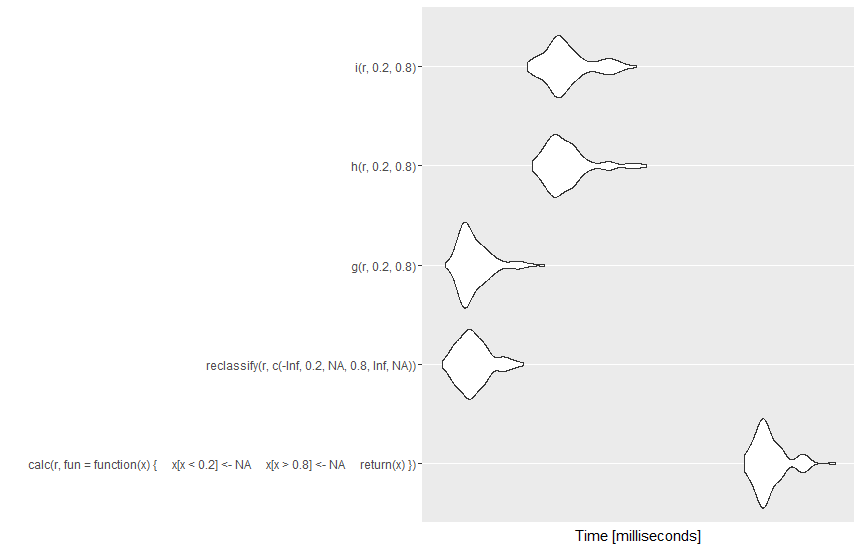
reclassify变得更快的确切点既取决于栅格中细胞的数量,也取决于重新分类的复杂性,但在这种情况下,交叉点大约在50,000个单元格(见下文)。
随着光栅变得更大(或者计算更复杂),另一种加快重新分类的方法是使用多线程,例如使用snow包:
# Reclassify, using clusterR to split into two threads
library(snow)
tryCatch({
      beginCluster(n = 2)
      clusterR(r, reclassify, args = list(rcl = c(-Inf, 0.2, NA, 0.8, Inf, NA)))
    }, finally = endCluster())
多线程涉及到更多的设置开销,因此只有在非常大的栅格和/或更复杂的计算中才有意义(事实上,我惊讶地注意到,在我下面测试过的任何条件下,它都不是最好的选择--也许是进行更复杂的重新分类?)
为了举例说明,我用OP的设置间隔了1,000万个单元(每个单元运行10次),绘制了微基准测试的结果如下:
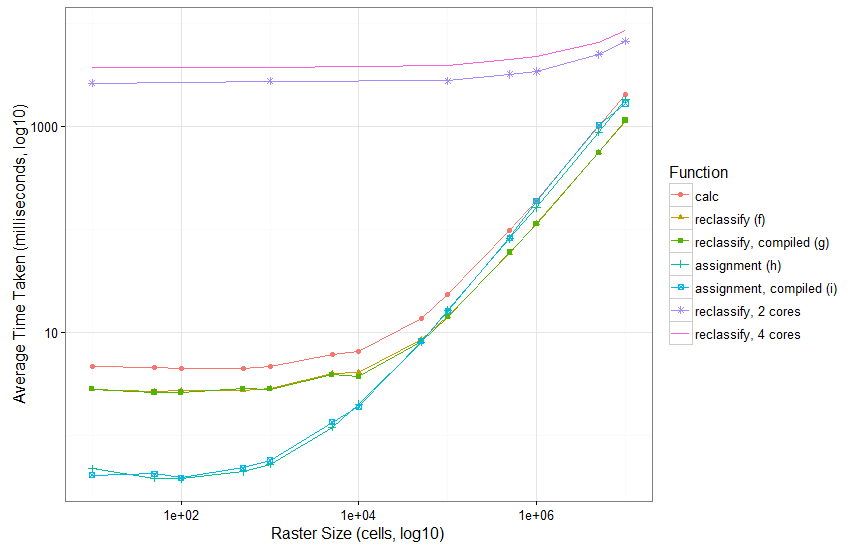
作为最后的说明,编译在任何测试大小上都没有区别。
Stack Overflow用户
发布于 2015-12-07 18:00:11
光栅包具有这样的功能:clamp。它比g快,但比h和i慢,因为它内置了一些开销(安全性)。
compare <- microbenchmark(
  h(r, 0.2, 0.8),
  i(r, 0.2, 0.8),
  clamp(r, 0.2, 0.8),
  g(r, 0.2, 0.8),
  times=100)
autoplot(compare) https://stackoverflow.com/questions/34064738
复制相似问题
腾讯云开发者

Copyright © 2013 - 2026 Tencent Cloud. All Rights Reserved. 腾讯云 版权所有
深圳市腾讯计算机系统有限公司 ICP备案/许可证号:粤B2-20090059  粤公网安备44030502008569号
腾讯云计算(北京)有限责任公司 京ICP证150476号 | 京ICP备11018762号